Executive Summary
Introduction
A political realignment, in its most basic sense, is a prominent change in a political party—what it stands for, the wedge issues that distinguish it from the other parties, and who is included in the coalition of the political party. This change can happen suddenly with a major conflict or issue that disrupts the existing social order—like the Great Depression—or more gradually as the emergence of new issues and significant social, economic, and cultural changes force voters to reconsider existing political affiliations—like the rise of the technocratic voting demographic.
Throughout US history, our political parties have reconfigured time and time again: the emergence of the New Deal Coalition in the 1930s, the racial realignment from Republicans to Democrats during the Civil Rights Movement in the 1960s, the embrace of Reagan economic policies drawing in typically Democrat-leaning working-class white voters in the 1980s.
Walter Burnham's theory on political realignments posits that these transformative shifts occur every 30–40 years, meaning we have either recently completed a political realignment or are currently experiencing one. The 2024 election results demonstrated ideological changes within both major parties. The Democratic coalition now spans from democratic socialists to former Republicans, while traditional voting patterns have shifted—for example, non-college voters across racial lines increasingly support Republicans. While pundits and politicians attempt to make sense of this realignment, democracy experts have identified a troubling concern: support for democratic institutions and the rule of law is unevenly distributed across our political coalitions. Democracy 2076 recognizes this challenge and is committed to preparing for the next political realignment. By investing resources now to shape that future transformation, we can work to ensure that all major political parties emerge as genuinely pro-democracy.


Political Realignments for 2076
Democracy 2076 is founded on the belief that the US democracy field needs to engage in long-term strategic thinking in addition to short-term defensive work. We believe that it is not enough to protect democracy in a time when so many are dissatisfied with its outcomes. Rather, we need to reimagine democracy for the next generation, embracing all of the complexities and challenges we are likely to face over the next 50 years. A core piece of that mission is understanding how US political alignments may be shaped over the long term.
The Spectra
Through a comprehensive synthesis of over 100 research pieces, expert interviews, and surveys across the political spectrum, we identified 17 new axes of political polarization that transcend the traditional left-right divide. Our qualitative methodology prioritized diverse knowledge sources—from grassroots perspectives to academic analysis. By drawing on the expertise of our participants, we were able to capture insights from within a variety of communities before those insights could be gleaned in polling or election returns. As a result, we were able to define and refine the spectra based on a range of types of evidence. These newly identified spectra represent fundamental changes in how political coalitions and divisions are forming, providing a framework for designing interventions that help us move towards a pro-democracy future. These axes include:

left-right divide




Demographics & Generations
Political Structures & International Dynamics

The Scenarios
Bringing together a cross-ideological, cross-experiential cohort of community leaders, we engaged in a collaborative process to develop evidence-based scenarios about the future of US political parties. Utilizing a horizon scanning methodology—where participants identified relevant insights from a variety of inputs, including conversations with their communities, social media posts they saw, and articles they read—we identified emerging themes that would impact future political parties. We ultimately created five scenarios of the future, each with different outcomes for the political coalitions’ beliefs in democracy and how these new spectra divisions could reshape American politics. In our workshops with participants and briefings with external stakeholders, we iterated the scenarios based on feedback, improving their plausibility based on how key social, economic, and institutional dynamics may unfold and defining the wedge issues, key political ideologies, and seismic shifts that mark each scenario. Our final scenarios for US democracy in 2054 include:
Scenario 1: Climate Adaptation vs. Transformation
Both major parties are pro-democracy, split by divergent strategies for resilience.

Scenario 2: Cultural Revivalism and Strategic Exclusion
Both major parties drift toward authoritarian-adjacent governance under the banner of revival and order.

Scenario 3: Democracy Under Siege
The right-leaning party is marked by its authoritarian populism and is challenged by a pro-democracy coalition active at the local and regional levels.
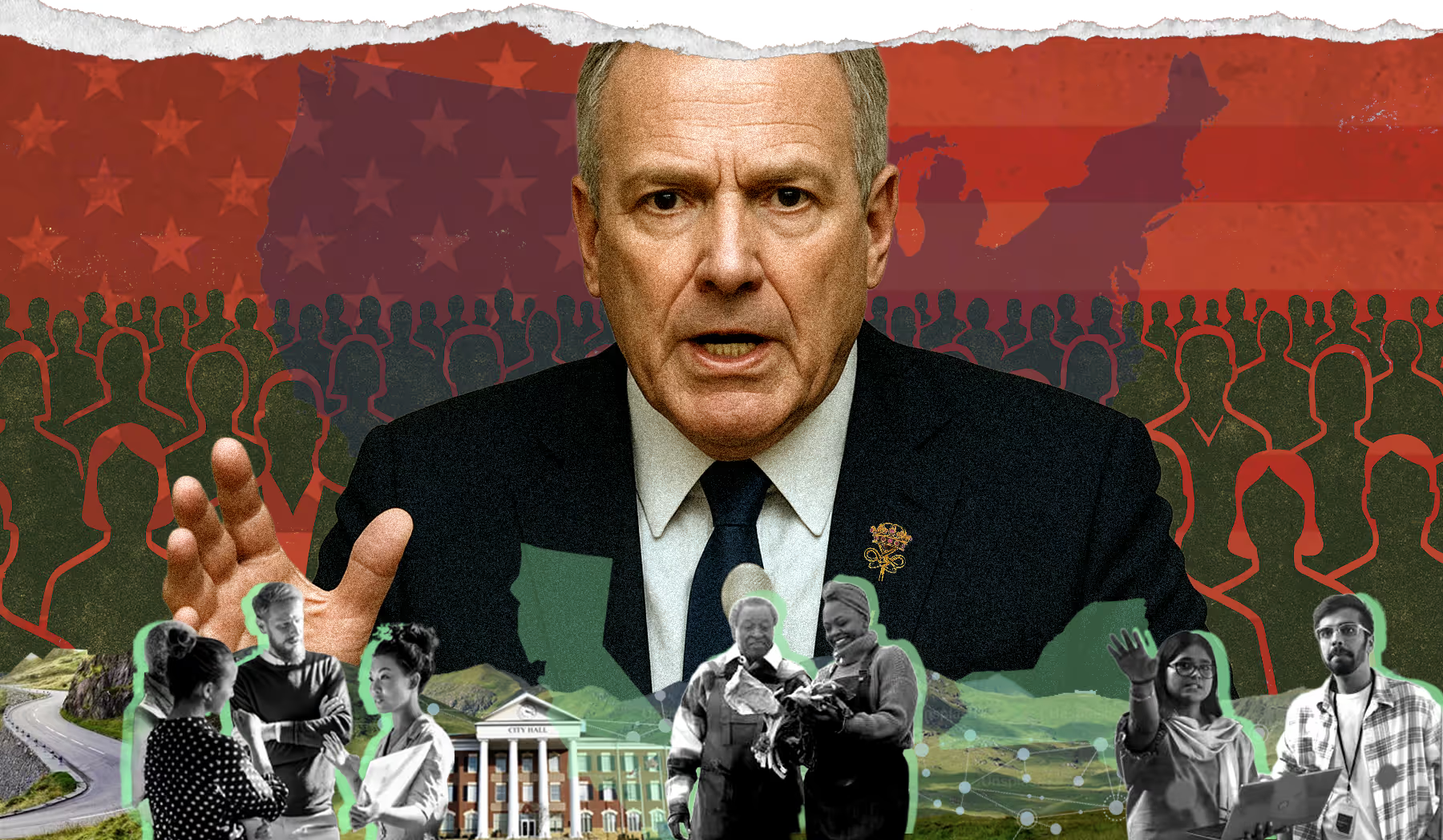
Scenario 4: Left Behind
The Democratic Party is marked by authoritarian populism and is challenged by liberal-proceduralist conservatism from the Republican Party.
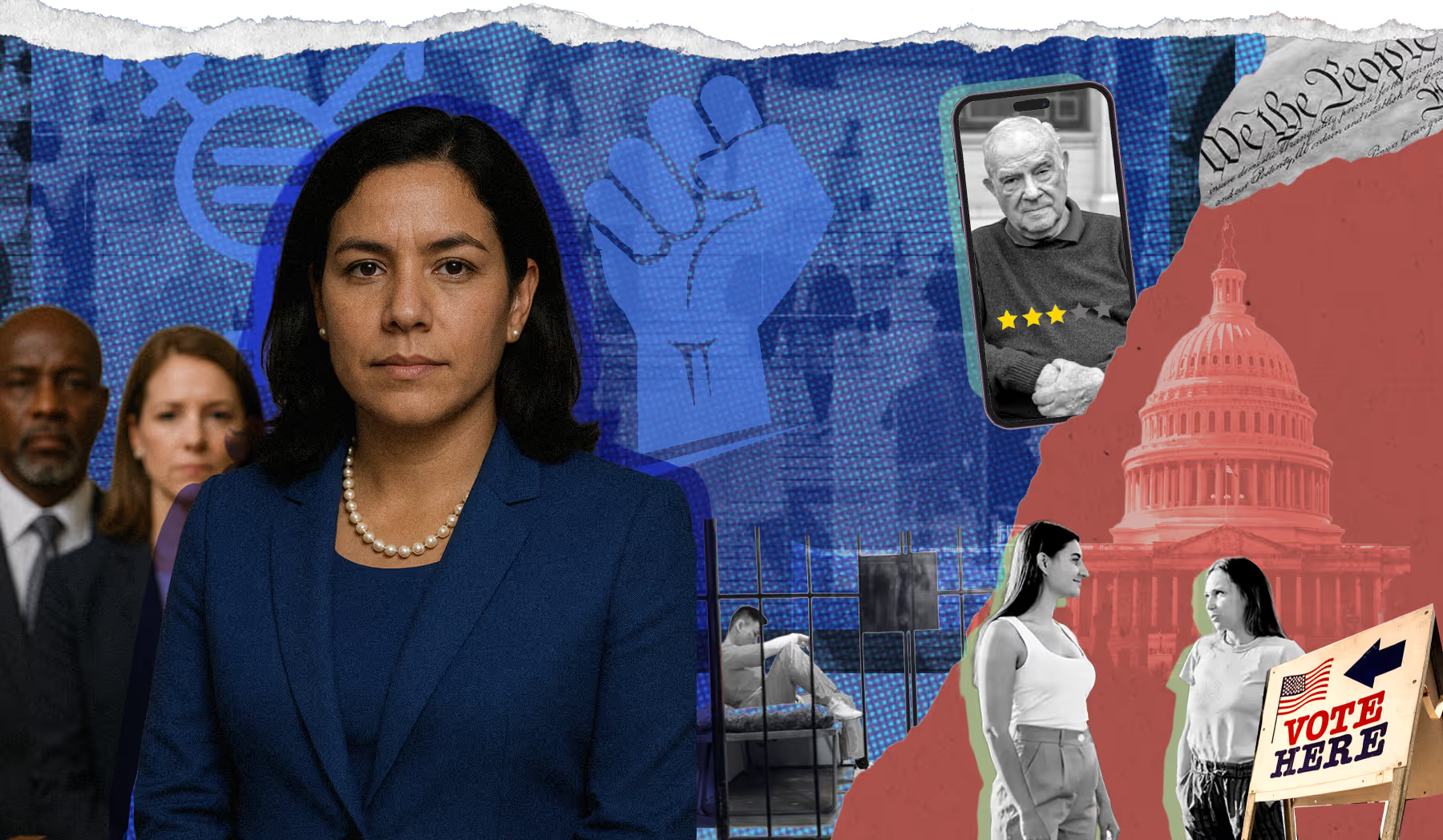
Scenario 5: Fractured Democracy—A Three-Bloc Patchwork
Rather than a clean red–blue divide, the US resembles a mosaic of clashing jurisdictions, a “fractured democracy” shaped by regional power, ideological silos, and contested truths.
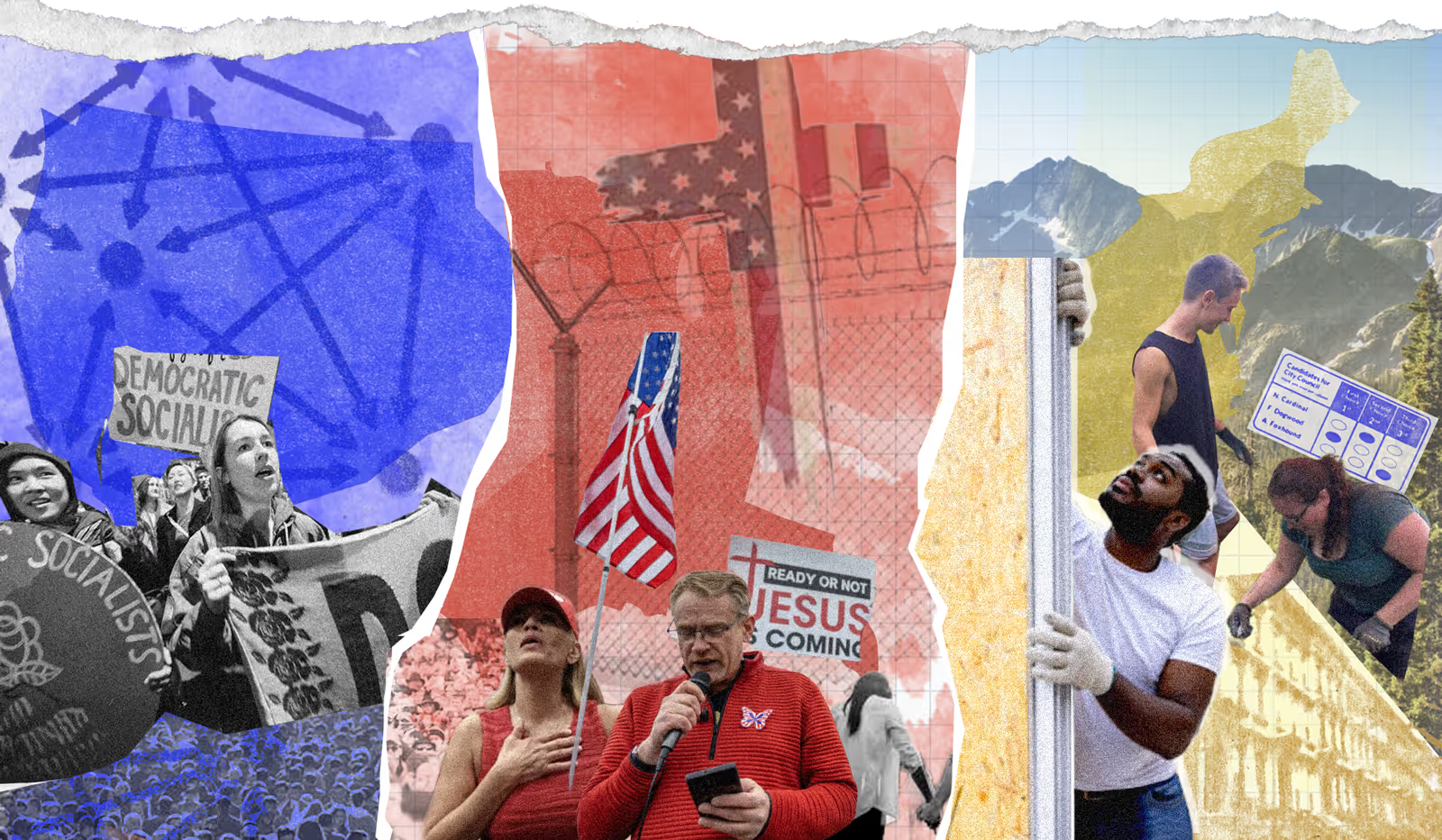
The Signposts
Ultimately, we used the scenarios to produce signposts that will help us determine if we are on the likely path for each scenario, and, therefore, moving towards or away from pro-democracy political coalitions. If the scenarios are the “what,” then signposts are the “how.” We identified potential early indicators that can help us assess whether a scenario is beginning to take shape. This included pulling out one or two themes that may currently feel implausible and asking: What would have to change to make this possible? What should we be watching for? For example, in Scenario 4, which includes an authoritarian Democratic Party, the signposts we identified include favourable referencing of authoritarian regimes and figures in mainstream Leftist discourse and the surging of anti-elite rhetoric and negative sentiment towards traditional party leadership (some of which is already observable today). These signposts and others must be—and will be—revisited and updated with time, new insights, and feedback. They can serve as a roadmap to understand what we are heading towards and how to shift focus and resources as needed.
We approach this effort as an initial assessment of patterns and scenarios beginning to emerge. Our process is intentionally iterative and will be continuously updated as conditions shift. As such, the frameworks laid out in this report are only as strong as our willingness to continually test, challenge, and adapt them. This report serves not as a fixed forecast, but as an invitation to be agents of our next political realignment to ensure a more democratic future.


What's Next
We believe that the true value of this research will be in its long-term use and iteration. To ensure that we maximize that value, Democracy 2076 will advance this work through the following initiatives:

1. Map networks and ecosystems
to identify the networks, influencers, and online platforms shaping discourse along each spectrum to enable sophisticated signpost tracking and targeted interventions at key intersections.

2. Catalyze interventions
by building a collaborative community of practice across issues and geographies that will allow us to deploy resources towards identified gaps across the field.

3. Track shifts in the signposts and update scenarios
regularly to ensure timely responses to emerging risks and opportunities in a rapidly evolving political environment.

4. Validate the 17 spectra
through quantitative research and surveys to strengthen the framework and equip stakeholders with sharper tools to understand and shape realignments.

5. Create preferred future scenarios
in collaboration with a cohort of participants, anchoring long-term strategic planning and coalition building in aspirational, actionable pathways rather than defensive postures.

Learnings and Recommendations
The Implications of Issue Prominence
Our research reveals how issues become polarized once they gain political prominence. Democracy itself—formerly nonpartisan—has become increasingly divisive over the past decade, partly due to heightened attention from movements and organizing efforts. In scenarios where both parties support democracy or embrace multi-racial identities, these issues cease to be politically divisive. This creates a paradox: effective organizing requires raising awareness, which inevitably activates both allies and opponents. This is not a call to avoid discussing important issues, but rather an observation that an issue becoming more “mainstream” tends to generate polarization.
Importance of Emphasizing Protopian Stories
At the conclusion of the process, participants asked for more scenarios where both parties are pro-democracy, revealing a hunger for pathways to positive futures. They recognized that their own negativity bias constrained the scenario-building process—even with neutral prompting, they struggled to surface positive signals without active guidance. This reflects broader cultural challenges: only 8% of democracy stories in film and TV depict the future, and only half show healthy democracies. We want to encourage storytellers to imagine diverse political futures and will deliberately cultivate preferred pro-democracy scenarios in future iterations.
Developing Clarity on Left-Wing Authoritarianism
Historic trends show that authoritarianism is not confined to one side of the political spectrum. Long-term mitigation requires understanding how democratic institutions can be undermined from multiple political directions. The political Left must develop clear frameworks for distinguishing between policy preference disagreements and fundamental disagreements about democratic governance itself, including internal mechanisms to evaluate whether tactics advance or undermine democratic values. The goal is principled and consistent defense of democracy regardless of from which political direction authoritarian threats emerge.
Understanding Emerging Axes of Political Division and Alignment
Current political alignments and divisions are insufficient for understanding those we are seeing today and predicting the ones to come. Attitudes on one issue no longer clearly predict positions on another. This presents stakeholders with a variety of challenges and opportunities: researchers can incorporate the 17 emerging axes into polling methodologies; issue-based advocates can engage in nuanced coalition-building by recognizing potential allies who agree on core issues but diverge elsewhere; and bridge-building efforts can focus on emerging wedge issues with less entrenched identity attachments as new spaces for productive conversation.
Impact on Participants
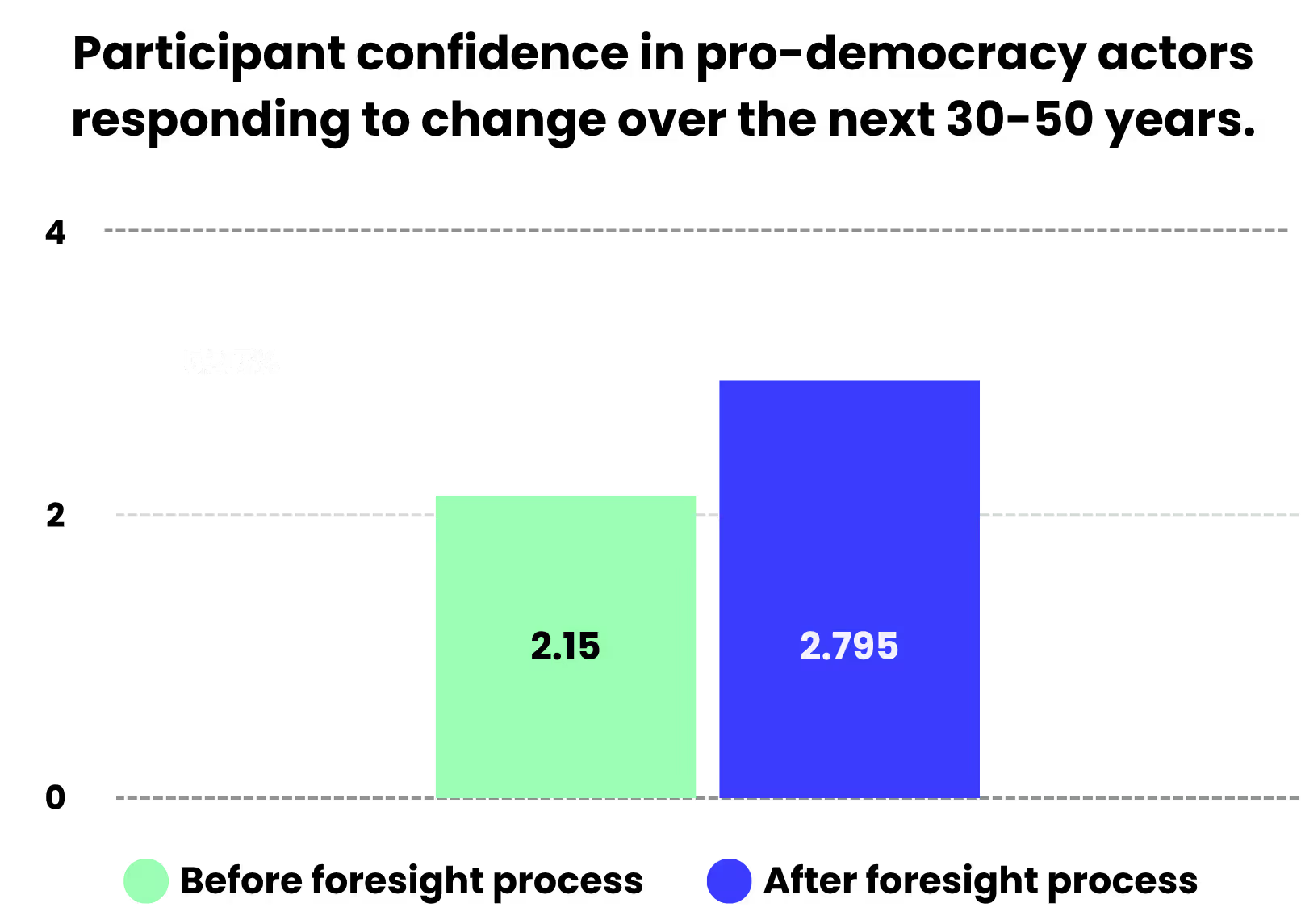
The strategic foresight process catalyzed a significant shift in how participants approached long-term pro-democracy work. While most aspired to think in generational terms, they acknowledged struggling to practice this amidst election cycle pressures and the sector's reactive mode. This was reflected in participants’ scoring an average of 2.15 out of 4 in response to the question, “What is your confidence in pro-democracy actors to respond to economic, political, environmental, cultural, and technological change over the next 30–50 years?” By the process's conclusion, these figures reversed dramatically: participants reported a 30% increase in their confidence that pro-democracy actors will respond to economic, political, environmental, cultural, and technological change over the next 30–50 years while demonstrating expanded capacity for scenario thinking, gaining practical tools for navigating uncertainty and planning iteratively rather than reactively. Beyond individual mindset shifts, participants reframed coalition work itself: moving from crisis-driven responses to proactive, visionary strategies that bridge ideological divides, center intergenerational responsibilities, and intentionally incorporate diverse perspectives to surface opportunities and identify blind spots earlier. As one participant reflected, "Democracy is a human enterprise. I am more interested in working with individuals who value human beings and will seek ways for them to flourish—regardless of ideology and identity politics." These outcomes suggest that the strategic foresight process itself—not merely the scenarios it produced—served as a powerful catalyst for building the adaptive capacity essential to imagine, test, and co-create more democratic futures.
—Participant Quote



How you can use this report
This report is both a synthesis and a strategic tool. It is designed to inform strategy, identify opportunities for new coalitional alignment, and spark new investment in pro-democracy futures. You might find it useful in the following ways:
Broad taxonomy and analysis of possible political divides
This report offers a comprehensive view of future axes of political realignment based on research of existing articles and scholarship, original interviews, and surveys that created 17 emerging spectra of political ideology.
Identification of possible future challenges
This report intends to help practitioners locate their blind spots, assess what may become challenges for their communities, and identify opportunities for intervention. It supports actors in recognizing where to build knowledge, where to partner, and new ways to consider existing issues—such as public health or climate work—as political realignment work.
Scenarios as Strategic Tools
The co-created scenarios offered in this report can be utilized as both warning signs and inspiration. They can catalyze new questions, highlight neglected futures (including underexplored scenarios like Left-wing authoritarianism), build empathy, and prompt proactive strategic planning.
Developing Communities of Practice
This report helps establish parameters for a broader, interdisciplinary community of practice around future pro-democracy political coalitions. It points toward key actors to engage, new groups to bring in, and zones of total inattention where urgent work is needed—whether to catalyze potential leaders or intervene in emerging ideological vacuums.
Ongoing Signposting & Monitoring
The signposts outlined in this report can serve as early indicators for which realignment scenarios may be materializing. This opens the door to annual or real-time tracking efforts that help funders, organizers, and policymakers respond to developments as they unfold.
Participants
Our Project Survey Participants
- Adam Taylor — Sojourners
- Bri Xandrick — United Vision for Idaho
- Gideon Lichfield — Futurepolis
- Jennifer Thomas — Mormon Women for Ethical Government
- Jon Soske — RISD Center for Complexity
- Kana Hammon — Asian American Futures
- Kate Barranco — Conscious Futures
- Kate Bitz — Western States Center
- Partha Chakrabartty — Independent Researcher
- Rich Logis — Leaving MAGA
- Sofi Hersher Andorsky — formerly with A More Perfect Union: The Jewish Partnership for Democracy
- Anonymous Participant working in tracking and monitoring extremism
- Anonymous Participant working in rural communities
- Anonymous Participant working in violence prevention
Our Project Interviewees
- Dan Cantor
- Eli Lehrer
- Jesica Wagstaff
- Matthew Grossmann
- Sabeel Rahman
Our Workshop Participants
- Adam Taylor — Sojourners
- Bri Xandrick — United Vision for Idaho
- Gideon Lichfield — Futurepolis
- Jennifer Thomas — Mormon Women for Ethical Government
- Jon Soske — RISD Center for Complexity
- Kana Hammon — Asian American Futures
- Kate Barranco — Conscious Futures
- Kate Bitz — Western States Center
- Partha Chakrabartty — Independent Researcher
- Rich Logis — Leaving MAGA
- Sofi Hersher Andorsky — formerly with A More Perfect Union: The Jewish Partnership for Democracy
- Anonymous Participant working in violence prevention
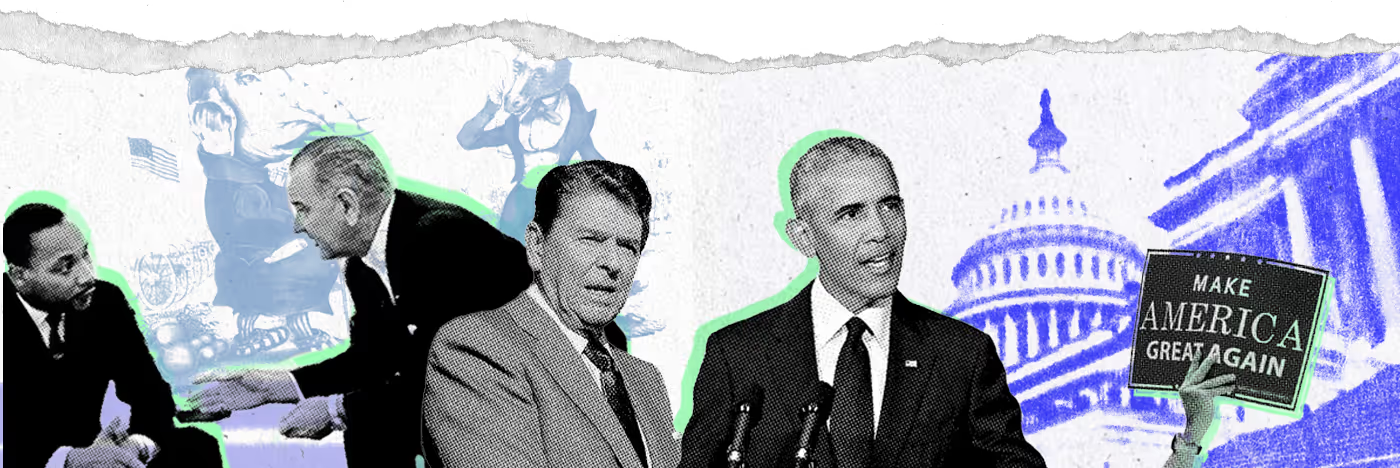
Background
Note: a full list of articles and reports used for background research on the history of US political realignments can be found in the appendix.
Historical Realignments
Political scientists generally agree that a major realignment happened in 1932 in the lead-up to the New Deal. In that national election, combined support from working-class voters, recent immigrant groups, and low-income voters drawn to the economic liberalism of the Democratic Party amidst the Great Depression led to Franklin Roosevelt becoming the first Democrat to win the presidency by a majority vote in 80 years, alongside record margins for Congressional Democrats.
Realignment theory, as first defined by V.O. Key, describes political realignments as critical elections that cause durable shifts in the partisan coalitions and the issues that define party competition. More recent opinions—specifically from Harold Meyerson—have critiqued this model for being too episodic, arguing that partisan change often occurs gradually rather than in single-election earthquakes. Nonetheless, the pattern of 30–40 year realignments remains a useful framework for understanding how and on what timeline parties typically reorganize.
Subsequent moments of realignment, while debated among experts, are commonly cited as shaping today’s political landscape:
1964: Civil Rights & the Southern Strategy
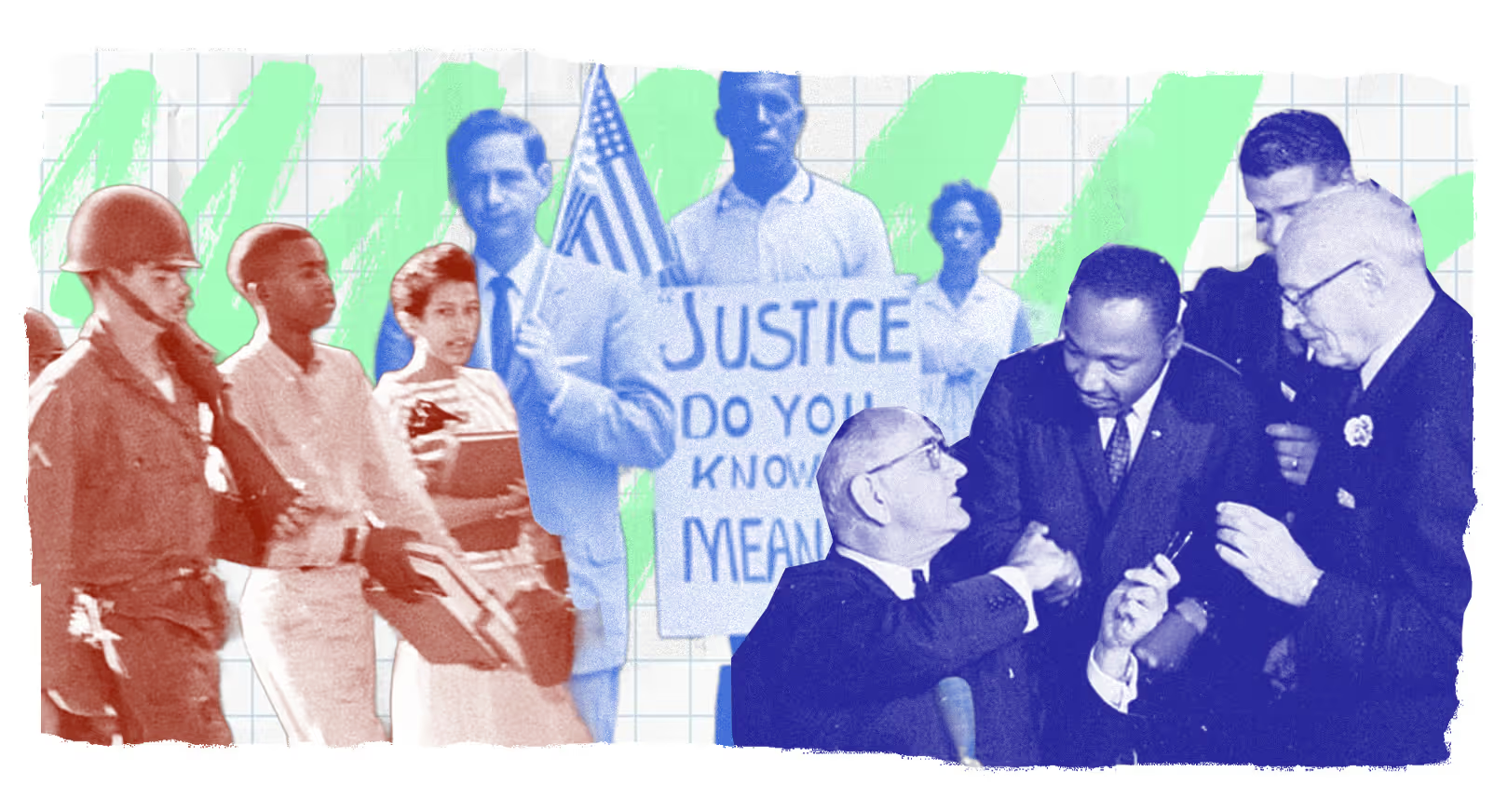
This was an issue-based realignment over Civil Rights. The Democratic Party’s embrace of civil rights legislation triggered a racial and geographic realignment.
Party Shifts: Conservative white Southerners migrated to the Republican Party; Black voters consolidated as a core Democratic bloc.
Ideological Changes: Democrats fully embraced civil rights, while Republicans emphasized “states’ rights” and “law and order.”
Key Wedge Issues: Civil Rights Act of 1964, school integration, busing.
Impact: Laid the foundation for today’s cultural polarization, aligning race and party identity.
1980: The Reagan Coalition

This was an ideological realignment in the Republican Party. The conservative coalition consolidated around Ronald Reagan, uniting economic libertarians, cultural conservatives, and “Reagan Democrats.”
Party Shifts: Working-class whites realigned Republican; Evangelicals became a core GOP constituency; Southern congressional seats flipped Republican.
Ideological Changes: Republicans embraced free-market economics, anti-government sentiment, and religious conservatism.
Key Wedge Issues: Abortion, school prayer, family values, tax policy.
Impact: “Culture war” issues became central to partisan identity; labor unions’ political power declined significantly.
1994 Midterms: The Republican Revolution
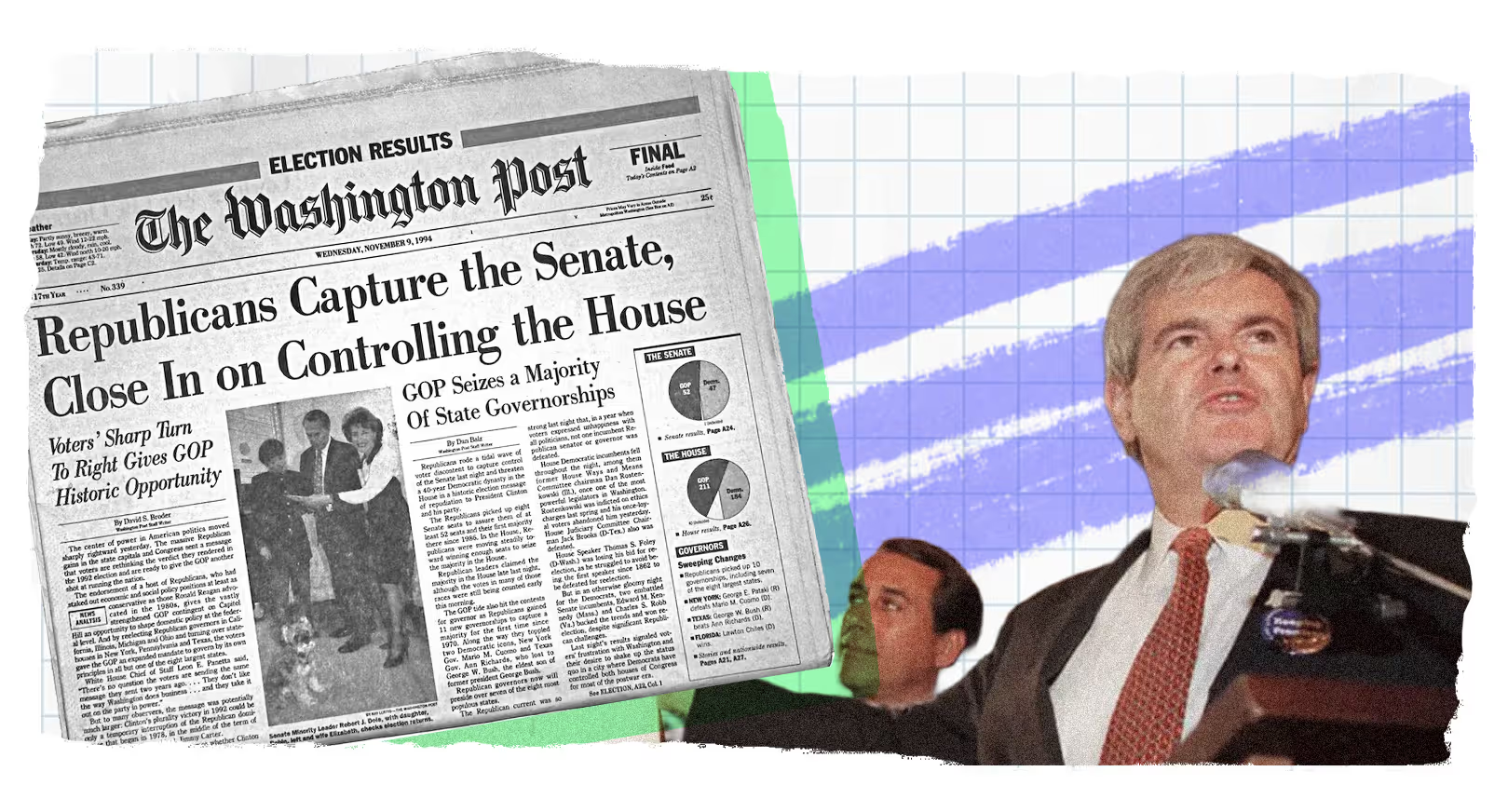
This realignment was brought about when Republicans won control of Congress for the first time in 40 years. Republicans won on a wave of cultural backlash, solidifying the South as Republican and elevating religious issues as a central partisan cleavage.
Party Shifts: Ticket-splitting declined; partisan sorting intensified.
Ideological Changes: Republicans became more unified on cultural conservatism and anti-government positions; Democrats moved toward centrist economic policies under Clinton.
Key Wedge Issues: Gun rights, welfare reform, size of government, crime policy.
Impact: Deepened ideological sorting and made partisan identity a stronger predictor of issue positions.
2010s: The Obama Coalition

A new Democratic coalition emerged, centered on urban areas, college-educated voters, young people, and growing minority populations— trends accelerated by the 2008 financial crisis.
Party Shifts: College-educated voters moved toward Democrats; non-college voters, particularly whites, consolidated under Republicans. Suburban women began trending Democratic.
Ideological Changes: Cultural liberalism rose in salience, with Democratic platforms emphasizing identity politics, climate action, and social justice.
Key Wedge Issues: Immigration, climate change, healthcare reform, racial justice, trade policy, and economic inequality.
Impact: Class-based voting patterns reversed from the New Deal era, with education level replacing income as the key predictor of partisan alignment. Patrick Ruffini and Matthew Grossmann note that this “diploma divide” is now the defining cleavage in American politics, with graduate-educated voters especially concentrated in the Democratic coalition. Early signals of the MAGA movement—such as Tea Party backlash and questioning of Obama’s legitimacy—foreshadowed a more populist right.
While there is some scholarly debate regarding the extent to which each of these shifts qualifies as an official political realignment, in each instance, the US political landscape is marked by seismic shifts in party composition, changing ideologies, and the key wedge issues driving respective parties’ platforms. Together, they reveal a recurring pattern: major social, economic, and cultural shocks disrupting party coalitions on a regular cycle, reconfiguring the political map, and creating new governing majorities.

Evidence of a Current Realignment
This brings us to our current moment. Review of scholarship and analysis from the last 20 years suggests the US is experiencing multiple simultaneous forces that historically precede major political realignments: economic trends reconfiguring class and education, the rise of new generations to political power, party identification trends, geographical sorting leading to more politically homogenous environments, increased levels of social disconnection, and rapidly changing gender roles and identities.
Most prevalently, these powerful shifts reflect deeper realignments tied to class, education, and identity. In a country that is rapidly moving towards an electorate in which no one racial group has a clear population majority, class has become a stronger predictor of voting behavior than race. For example, working-class voters—especially those without college degrees—are moving steadily toward the Republican Party. At the same time, education has emerged as a dominant dividing line: college graduates (particularly white and Left-leaning) are increasingly Democratic. These dynamics are global, but have distinct implications in the US, where non-college-educated voters still make up the majority.
Gen Z, the most diverse and LGBTQ-inclusive generation to date, is also showing signs of disaffection from prior generational patterns: while still largely Democratic, their support has softened, with 42% voting for Trump in 2024 and declining faith in democracy overall. Additionally, 28% of Gen Z now identify as LGBTQ, making them the most openly queer generation in US history, and indicating that their skepticism of institutions may represent a generational value shift. The LGBTQ vote, however, remains overwhelmingly Democratic and politically engaged.
This is all happening amidst traditional party structures that appear increasingly misaligned with voter concerns. Record high independent identification (43%) and Democratic Party identification at historic lows (27%) indicate party vulnerability. Traditional Democratic voters are less and less likely to identify with the official party, while Republican identification has held steady. This is potential evidence of an “asymmetric dealignment” as opposed to a symmetric realignment. Dealignment occurs when voters leave their party without joining another, resulting in increased numbers of independent voters and support for third-party candidates.
Moreover, geography, gender, and cultural identity continue to sort the electorate. Geographic polarization—reflected in the increasing number of “super landslide” counties (where the winning candidate receives 80% or more of the two-party vote) and SuperZips (zipcodes with the top 5% per capita income and college graduation rates)—mirrors the growing ideological consolidation of high-income, highly educated voters into urban enclaves. Latino voters are also shifting, with rising support for Republicans—especially among men—as they “find it increasingly difficult to relate to…a white, educated, progressive Democratic Party.”
Our social-relational infrastructure is also rapidly changing. Research highlights declining “middle-ring” relationships (workplace, religious congregations, civic associations), leading to self-imposed solitude and making ideological sorting more durable. Polarization is increasingly baked into where people live, worship, and socialize, making depolarization more difficult.
Finally, the gender gap remains pronounced, but with some exceptions. While women generally and consistently support Democrats, Trump has made gains among white, non-college-educated women and evangelical women. All of these evolving patterns highlight the extent to which traditional partisan assumptions are breaking down—and how new coalitions are reshaping the future of American politics.
Together, these converging forces—class realignment, generational shifts, party dealignment, geographic sorting, social disconnection, and evolving gender dynamics—signal that the US may be entering a period of profound political realignment rather than simply experiencing typical electoral volatility. The simultaneity and depth of these changes suggest that traditional coalitional assumptions are no longer sufficient guides for understanding or shaping American democracy's trajectory. This context makes strategic foresight essential: rather than projecting past patterns forward, pro-democracy actors must anticipate how these intersecting forces could combine to produce fundamentally different political futures.
Emerging Wedge Issues
While some ideological wedge issues are consistently divisive across political realignments—big vs. small federal government, for example, has been a divider in American political identity since the Founding Fathers—new valences have emerged in this particular political moment:
Institutional trust
Growing divides on whether institutions are legitimate, functional, or corrupt. Declining trust is not evenly distributed: Republican voters increasingly view federal institutions as weaponized, while Democrats express skepticism toward local policing and courts. This distrust fuels calls to either reform or dismantle institutions entirely, raising the stakes for legitimacy crises.
Technology
Rapidly developing technology drives polarizing conversation around expectations of privacy and technological governance, with a noticeable shift on the Left from viewing tech as empowering to seeing it as an instrument of surveillance and disinformation. Simultaneously, parts of the right are embracing decentralized digital communities as a bulwark against government overreach.
Science and Public Health
The aftermath of the COVID pandemic has accelerated both firm support for science and medicine as well as an equally fervent anti-science movement. Cross-partisan movements like the “Make America Healthy Again” (MAHA) coalition illustrate how health politics are increasingly unpredictable across traditional partisan lines.
Gender and Identity
Trans rights and reproductive justice movements have propelled new ideological debates around gender expression and identity. As illustrated above, these issues cut across existing party affiliations. Growing comfort with authoritarian behavior in increasingly religious conservative communities, for example, impacts emerging ideas around gender roles and reproductive justice.
DEI and Free Speech
Rapidly changing technology and right-wing backlash have stoked divides on the role of DEI programming in government entities, schools, and workplaces, elevating polarizing conversations around free speech—who has the right to say what and where—that defy previous partisan lines.
Climate Crisis
The increase in natural disasters due to climate change heightens the urgency and stakes of questions around communal vs. individual responsibility as well as the role of governments and industries in environmental regulation and response.
These emerging wedge issues signal that the United States is in the midst of a profound ideological flux. Having reviewed the historical patterns of realignment and the current shifts reshaping our political coalitions, we now turn to the central question of this report: how can we influence what might happen next?


Scenarios with Implications
In strategic foresight methodology, scenarios are structured stories about how the future might unfold. They support strategic thinking, decision-making, and help foster agency despite uncertainties. They explore different pathways the future might take, based on varying assumptions about key driving forces and uncertainties. Scenarios are always about future change in the external environment, and meaningful, high-quality scenarios form a systematic set: future-oriented, credible, coherent, and clearly distinct from one another.
As illustrated in the Methodology section, determining our final scenarios was a multi-stage process that included outside research, interviews, strategic foresight workshops, and multiple rounds of participant feedback. Below, we outline the final draft of each scenario and its corresponding systemic shifts and possible wedge issues, some brief notes about how those scenarios evolved throughout the process, as well as some questions, risks, and opportunities that each scenario brings.
In addition, each scenario is followed by correlating signposts. Signposts are early indicators that a given scenario—or some aspects of that scenario—might be unfolding. By identifying important shifts and issues that could enable each scenario, we are able to specify the variables that we need to monitor over time to gauge directions of political realignment.
With our participants, we collaborated to determine what would serve as these early indicators; Democracy 2076 then worked to operationalize those indicators to determine what likely outputs or quantifiable metrics would be. Most signposts exist somewhere if we look deep and wide enough; our challenge and opportunity in using these signposts as tools for future work is to assess the volume of their appearance and how much things are shifting in one direction or another.
As you review the scenarios and signposts below, we encourage you to engage with the following questions:
- What are the shifts that need to occur for this scenario to come to pass?
- How might this scenario happen, and what should I look out for?
- How might I (or my organization) respond? What can I be doing now to prevent the aspects of the scenario that I don’t want and encourage those I do?
Our collective endeavor at answering the first two questions can be found in the signposts. We have also provided our take on how different sectors might respond should these signposts emerge in the future, and what they can be doing now in the implications section for each scenario.

Scenarios are structured stories about how the future might unfold. They are future-oriented, credible and coherent.
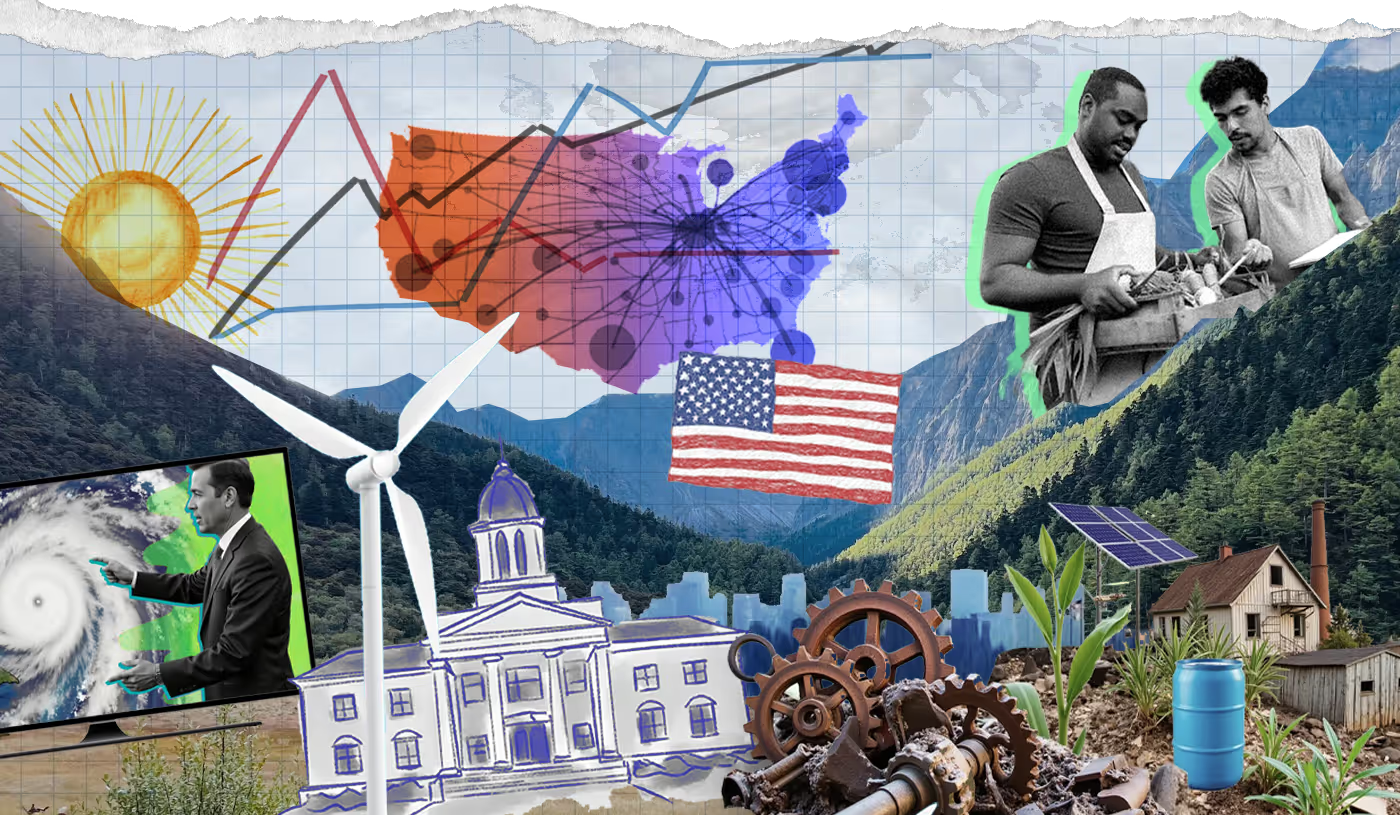
Scenario 1: Realism 2054 — Climate Adaptation vs. Transformation
Both major parties are pro-democracy, split by divergent strategies for resilience.
Scenario Description
By 2054, the United States had weathered thirty years of cascading crises: climate displacement, institutional decay, AI disruption, and a widening economic divide between enclaves that prospered and innovated and those left behind, often working in struggling or obsolete sectors. The "crisis century"—a term popularized in the 2030s—reshaped American life around survival, adaptation, and pragmatic governance.
The great displacement of the 2030s, driven by AI and pervasive automation, reshaped science and industry, governance, and daily life. Not only did it eliminate routine jobs, but it also transformed professional work, creating a period of profound economic dislocation marked by widespread upheaval across industries, livelihoods, and the structure of labor.
This coincided with increasingly devastating climate impacts: a megadrought in the Southwest, Gulf Coast abandonment after back-to-back hurricanes, and the Pacific Northwest firestorms of 2037. These compounding crises fundamentally reorganized economic life and shifted attention from the global to the regional, prioritizing resilience over efficiency.
The social isolation epidemic that began in the 2020s reached its peak in the mid-2030s, when nearly 40% of Americans reported having no close confidants outside of digital spaces. This breakdown in community ties initially accelerated polarization but ultimately led to a profound cultural shift. Americans began to build new forms of connection organized around pragmatic and inherently geographic survival-based needs rather than emphasizing ideological alignment. Younger generations were drawn to these emerging spaces that offered safe, accessible ways to reconnect through participation in their local communities. As a result, the trend toward social isolation began to reverse. Local gatherings emerged across the country where people engaged with governance at multiple scales, harnessing technology to fuse virtual and physical participation with in-person deliberation.
Amid exhaustion with polarization, voters began rewarding competence, transparency, and community resilience rather than ideological purity. American democracy, once teetering, survived not through dramatic reforms but through cultural fatigue with chaos and the practical necessity of cooperation for survival. Democracy today is different. The realignment is less defined by ideological division and more grounded and adaptive—shaped by intergenerational mentoring and practical, local efforts to sustain democracy.
Both major parties have renewed their democratic commitments but are split sharply on how to endure our volatile future. One party, dominated by highly educated urban and suburban voters, is embracing Transformational Realism: the belief that systemic overhauls—in climate, economics, governance, and technology—are the only path to collective survival. The other, rebuilt around rural, exurban, and working-class coalitions, leans into Adaptive Realism, mobilizing around the conviction that survival depends on local autonomy, market adaptation, and scepticism of centralized elites.
The repeated failure of federal responses to climate disasters sparked the formation of regional governance coalitions—initially as emergency response networks but evolving into Congressionally-approved interstate compacts with significant policy authority. These regional structures became laboratories for both adaptation and transformation approaches.
The traditional left–right culture wars faded not because identity ceased to matter, but because existential concerns overshadowed them. Identity politics evolved toward functional coalitions based on lived experience with climate impacts, technological displacement, and resource constraints. Unexpected issue-based coalitions now regularly form across party lines on issues like water rights, AI governance, and disaster preparation. The dividing lines have shifted from ideology to strategy: reengineer the system—or make it survivable.
Seismic shifts
Education is now the dominant political divider
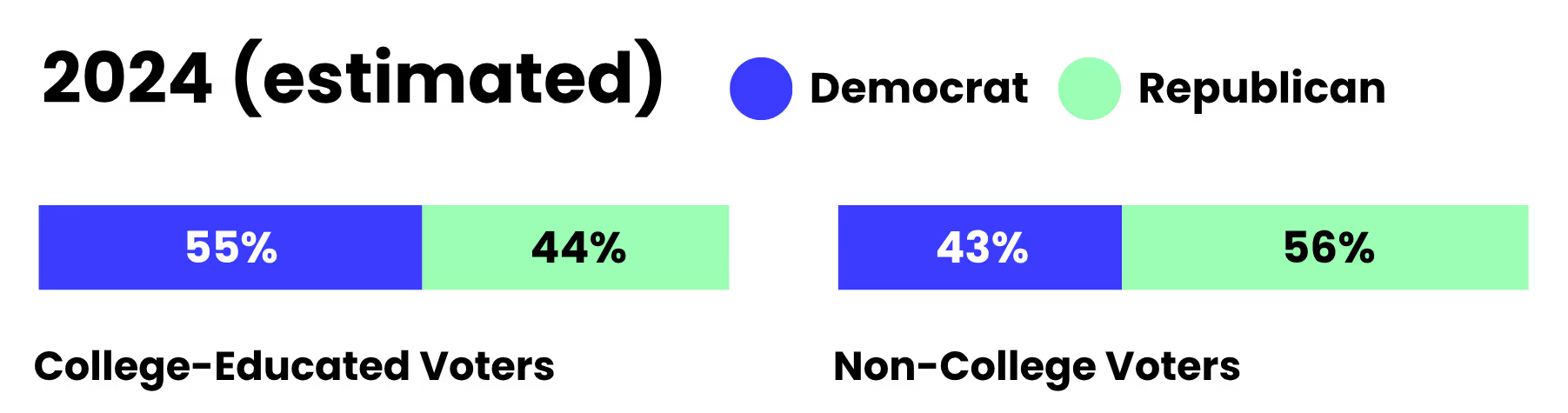
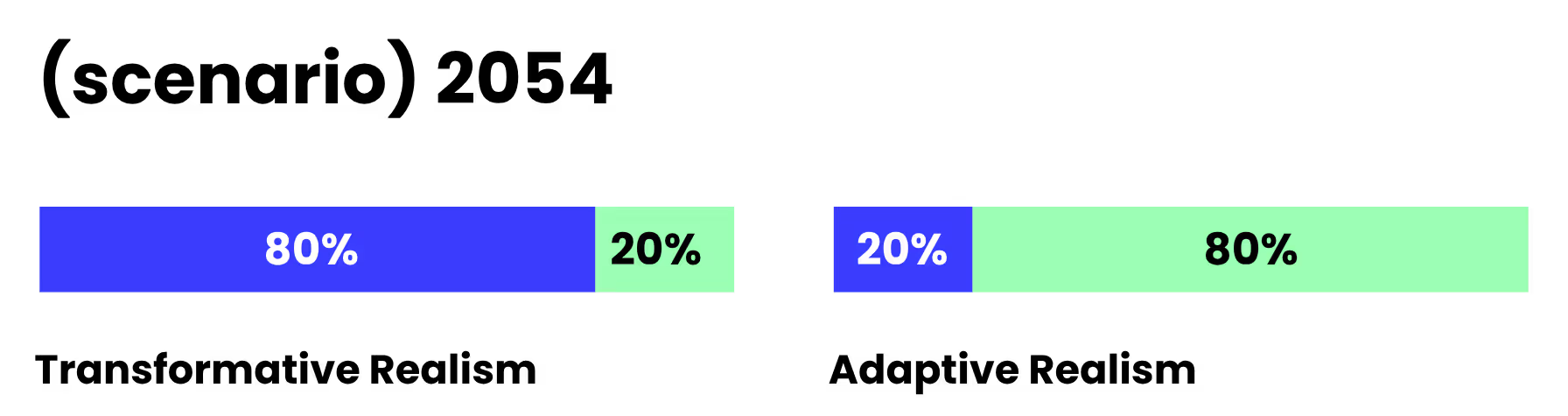
In 2024, 55% of college graduates voted for Democrats and 44% for Republicans, while non-college voters split at 56% Republican and 43% Democrat. Breaking away from this mixed alignment, by 2054, college graduates are over 80% aligned with the Transformation Realism party, while non-college voters are over 80% aligned with the Adaptive Realism party. Survival strategies have hardened along educational lines, erasing much of today’s demographic overlap.
Education as the Dominant Political Divider: 2024 vs 2054
(2024 data sourced from CNN polling. Unless otherwise indicated, the 2024 data for all shifts in this document are referenced from the CNN Exit Poll Results 2024 and depict the National, US House General Results. 2054 data is a projected hypothetical extrapolating on existing data patterns within this predicted scenario.)
Other notable demographic shifts
From moderate to explicit geographic polarization
In 2024, Democrats won 59% of urban and 47% of suburban voters, while Republicans dominated rural areas with 65% support and held 52% of the suburban vote with significant overlap in mixed regions. By 2054, the majority of urban/suburban voters (around 90%) align with Transformation Realism, while the majority of rural/exurban voters (around 90%) align with Adaptive Realism. Geography now almost perfectly mirrors political affiliation, driven by climate resilience strategies rather than culture wars. Urban/suburban areas serve as transformation hubs, while exurban/rural areas function as adaptive autonomy zones.
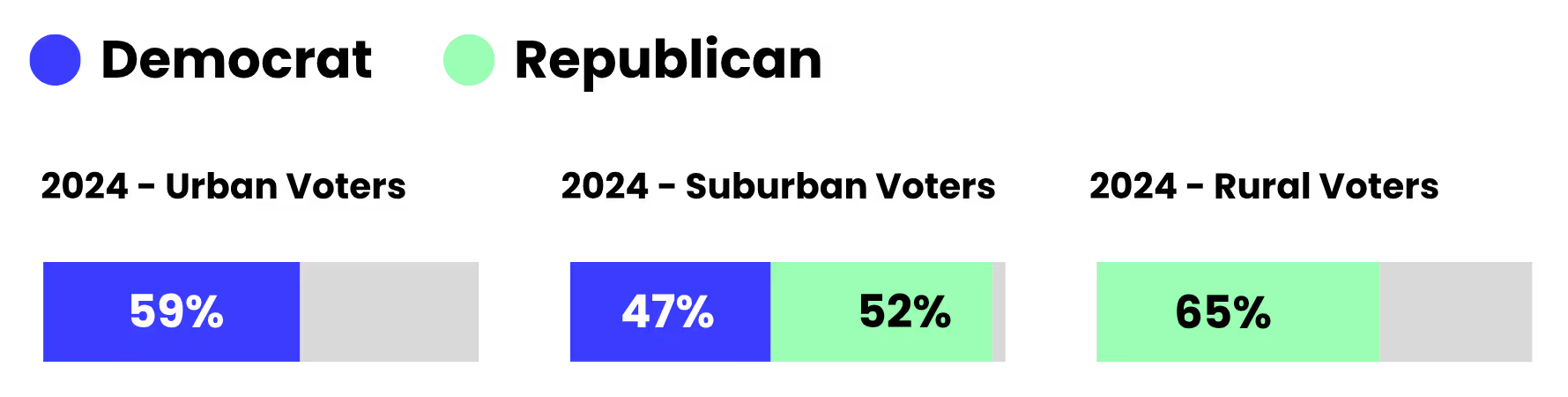
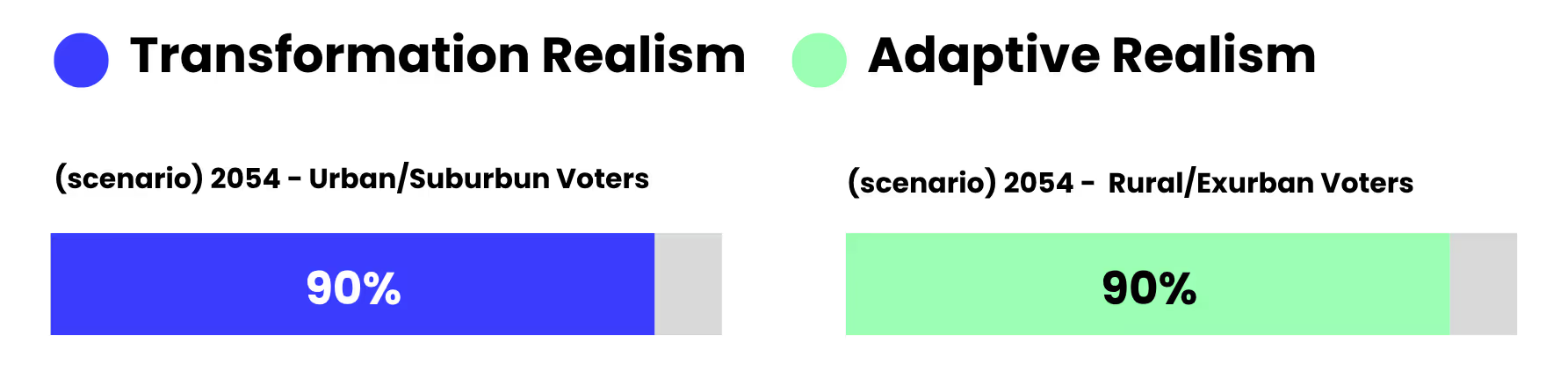
(2024 data sourced from CNN polling. Unless otherwise indicated, the 2024 data for all shifts in this document are referenced from the CNN Exit Poll Results 2024 and depict the National, US House General Results. 2054 data is a projected hypothetical extrapolating on existing data patterns within this predicted scenario.)
From identity politics to climate survival coalitions
In 2024, party coalitions were strongly race-based, with Democrats winning 54% of Latino voters, 84% of Black voters, and 60% of Asian voters, while Republicans secured 58% of White voters. By 2054, race is less predictive, as each major party draws at least 40–45% support from every racial group, with alignment shaped by shared survival priorities such as water and resource management.
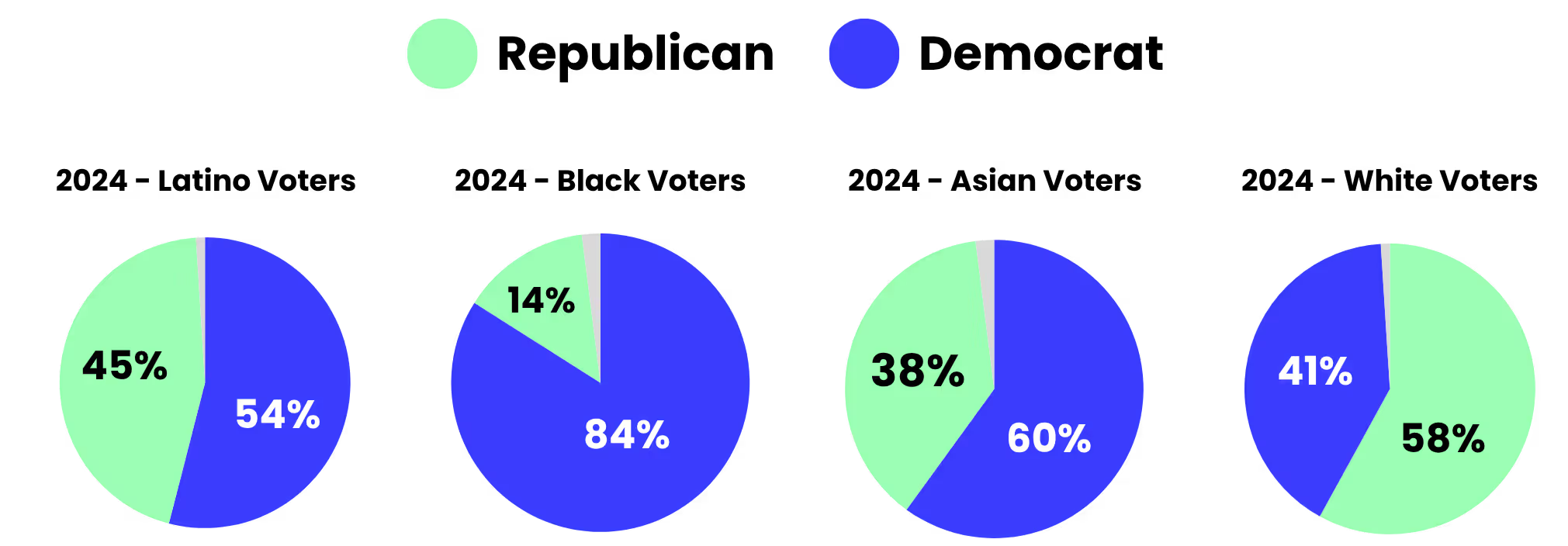
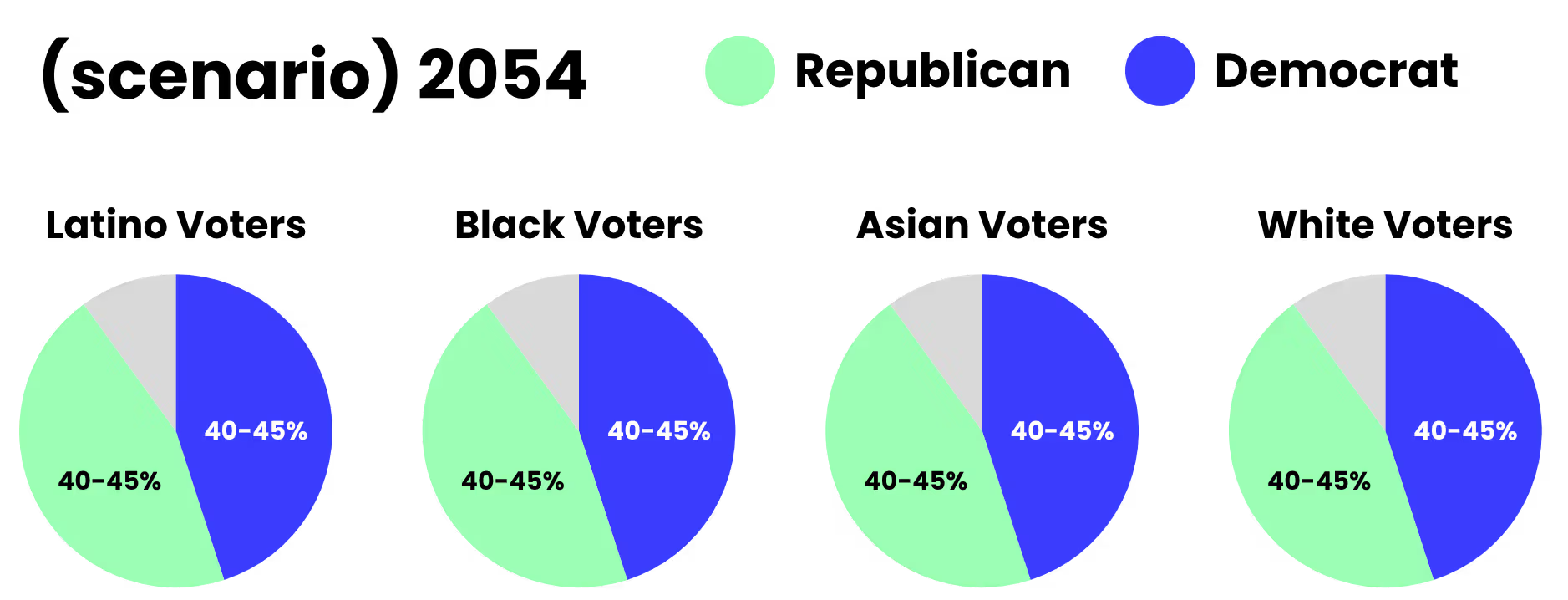
(2024 data sourced from CNN polling. Unless otherwise indicated, the 2024 data for all shifts in this document are referenced from the CNN Exit Poll Results 2024 and depict the National, US House General Results. 2054 data is a projected hypothetical extrapolating on existing data patterns within this predicted scenario.)
Possible wedge issues
- Climate adaptation and survival strategies
- Technology access and regional economic divide
- Centralized or regional responses of government in climate adaptation
Implications & Recommendations
This scenario points to a future where democracy endures through pragmatism and resilience rather than ideology. It suggests that actors across sectors will need to adapt to regional governance, shifting demographics, and evolving coalitions. The following implications highlight practical steps organizations and institutions can take now to strengthen democratic capacity in the face of climate, technological, and economic disruptions in order to encourage the aspects of this future we want to see and mitigate those we don’t. To move toward a both-parties-pro-democracy future organized around climate survival, we would recommend the following for various stakeholders:
- Regional actors (governors, compacts, Metropolitan Planning Organizations): Create interstate compacts on climate and workforce with shared rules, ideas, and decision-making instead of waiting for federal fixes.
- Pollsters and researchers: Weight findings by education, geography, and climate exposure as opposed to relying solely on race or partisan identification as dividing lines.
- Coalition leaders: Build single-issue alliances based on lived experiences (climate, tech disruption, scarce resources) and design structures and approaches that make it clear that alignment on a coalition issue is not a guarantee of alignment on other issues.
- Municipal governments: Strengthen parallel civic capacity (mutual aid, local resilience programs) that can withstand the failure of federal infrastructure.
- Food justice organizations: Broaden access to programs that teach food sustainability practices like gardening, food growing, animal raising, and butchery to build food resilience and food self-sufficiency.
- Disaster response agencies: Collaborate with local community development programs or other low-barrier community education programs to teach disaster response skills, like carpentry, building flood barriers, and fireproofing homes.
Both major parties are pro-democracy, split by divergent strategies for resilience.


Scenario 1 Signposts
The signposts presented here reflect our best judgment about observable developments that may indicate movement toward this scenario. In many cases, the line between “observable” and “not yet observable” is fluid, as trends fluctuate or appear unevenly across the country. We offer these signposts not as predictions, but as potential markers to monitor over time.
1. A future shift away from identity-based politics towards strategic approaches to survival
A sustained period of crisis has shifted US societal priorities. The impact of droughts, hurricanes, and fires, and the resulting climate displacement, combined with widespread job loss, has fundamentally reshaped perceptions of risk and what matters most, both in ideological politics and daily life in communities. These shared challenges have led to people cooperating in multiracial communities in order to survive.
Observable
Increase in climate-related relocation in national datasets
Climate-driven natural disasters and extreme weather events are already prompting Americans to relocate. Americans are avoiding low-lying areas, and in some cases, entire states, because of their climate vulnerability. This could escalate if climate-related drivers become the primary reason for internal migration across multiple consecutive years—potentially displacing economic opportunity as the dominant migration motivator.
Sharp decline in prioritization of identity-based issues
Recent Gallup polling shows that issues like race relations and immigration consistently rank lower in public concern compared to economic issues such as inflation, indicating a decline in the prioritization of identity-based politics. This is also observable with the recent defunding or rollback of identity-based protections—such as DEI initiatives, ethnic studies programs, or civil rights enforcement under the justification that they are no longer aligned with public priorities. This could escalate if provisions of the Civil Rights Act are rolled back or eliminated under the guise of neutrality-based governance or implied equality.
Shift in disaster risk insurance and property values
Litigation against insurers or mandated coverage guarantees become part of party platforms as significant changes in insurance policies for disaster risk areas emerge, also driven by declining real estate values for high-risk zones. This could escalate if party platforms begin to incorporate explicit stances on disaster insurance—framing it as either a market failure or a climate equity issue. Further destabilization of insurance markets could lead to federally subsidized coverage guarantees, regional migration spikes, or increased financial burden on local governments left to manage uninsured losses.
Not Yet Observable
Rise in self-identification based on geographic displacement
It becomes increasingly common for people to identify based on their climate migration status rather than traditional demographic categories, for example, saying “I’m a California refugee” instead of citing race or religion.
Greater data collection on climate change and related events
Expanded and more rigorous systematic data gathering aimed at strengthening the evidence base on climate-related variables to improve policymaking and support pragmatic responses.
Shift from climate blame to focus on survival
As climate change returns as a priority on the public agenda, discourse increasingly moves from assigning blame to instead focusing on prioritising strategies for survival in the face of shared risks.
Divergent AI investment strategies emerge
Clear divisions arise over the application of AI and quantum computing, becoming a point of contention in public discourse and reflected in party platforms. One approach is towards large-scale scientific and systemic transformation goals such as climate modelling, geoengineering, or settlement in space; the other focuses on small-scale, locally targeted innovations strengthening resilience within climate constraints.
Policies welcoming and supporting climate refugees
The emergence of official state or city-level policies to actively attract and integrate climate-displaced populations, including relocation programmes, housing initiatives, and employee incentives for climate migrants.
A future shift away from identity-based politics towards strategic approaches to survival

2. The rise of collective responsibility and cooperation
As climate change impacts intensify and become universal, attitudes change from a focus on the individual to a collective ethos of mutual aid. “Bad luck” becomes less moralized, and citizens believe they have a collective responsibility to all in their own communities or to those fleeing danger. People are prepared to sacrifice their material quality of life to protect others, knowing their own survival relies on collective endeavour.
Observable
Growth in citizen-led mutual aid and disaster response networks
Municipalities incorporate official community-led disaster planning as part of local governance (e.g., through city council, mutual aid, or emergency protocols). This could escalate if mutual aid networks begin to replace, rather than supplement public funding, or if cities begin creating official coordination offices, or embedding citizen-led response structures into long-term emergency management plans—potentially reframing the role of civil society in disaster governance and shifting expectations for federal and state accountability.
Not Yet Observable
Shifting values around resource-sharing and migration
Rising support for housing migrants and enabling universal access to space and resources, such as bartering goods and sharing property.
The rise of collective responsibility and cooperation

3. New enablers and challenges drive the regionalization of governance
Federal ineffectiveness and withdrawal create the space and necessity for more organised local and regional governance.
Observable
Sharp decline and eventual suspension of key federal services
Entire federal programs sunsetted or unfunded for multiple years (e.g., FEMA emergency grant programs, HUD housing programs), while some services are revived by individual states at the local level. This could escalate if Congress fails to reauthorize major federal programs during future budget cycles.
Rise of Autonomous State Revenue Systems
Many states supplant federal support through independent revenue mechanisms, initially only related to carbon tax, climate adaptation funds, or regional insurance pools. This could escalate if states begin using independent revenue systems to fund broad public services traditionally supported by federal programs—such as healthcare, education, or infrastructure. This could weaken national economic coordination and expand disparities in access to core services.
Not Yet Observable
Displacement of federal authority and agencies by states
Emergence of state-led regulatory systems in more than 30 states that directly contradict federal frameworks and replace them, without triggering legal reversals (for instance, in education, climate, or public health).
Establishment of regional governance compacts or interstate agreements
Examples: MOUs, regional legislation, or joint institutions such as multi-state water boards that manage critical resources or provide disaster support.
New enablers and challenges drive the regionalization of governance

Scenario 2: Cultural Revivalism & Strategic Exclusion (2054)
Both major parties drift toward authoritarian adjacent governance under the banner of revival and order.
Scenario Description
By 2054, the United States has entered an era of strategic cultural revivalism: a political landscape fueled by exhaustion, fractured social trust, and a longing for moral and institutional clarity after decades of disruption.
The widening economic divide between thriving innovation hubs and other sectors sliding into deep, long-lasting decline began in the 2020s and accelerated through the AI revolution of the 2030s. A wave of automation affecting both physical labour and knowledge-based, white-collar jobs was unleashed that benefited some, creating a society divided not just by wealth but by economic security. Climate disasters, supply chain collapses, and repeated pandemic waves in the 2030s left many Americans yearning for stability at any cost. This economic precarity and social dislocation created fertile ground for authoritarian tendencies across the political spectrum.
Both major parties remain vibrant and competitive—but democracy itself has been hollowed. Popular participation rebounds to historic highs, driven less by hope and more by fear of loss: cultural loss, security loss, identity loss. While elections continue and institutions remain intact, voter choice has narrowed to competing forms of control. The isolation crisis that peaked in the 2030s—marked by epidemic levels of loneliness, social disconnection, and mental health challenges—left millions vulnerable to movements promising belonging through conformity. Technology that once promised connection instead exacerbated echo chambers of varying sophistication on both sides of the political divide, enabled by subtle algorithmic influence that deepened polarization. Over time, emigration rose quietly, especially among younger professionals unwilling to submit to any form of cultural or political coercion.
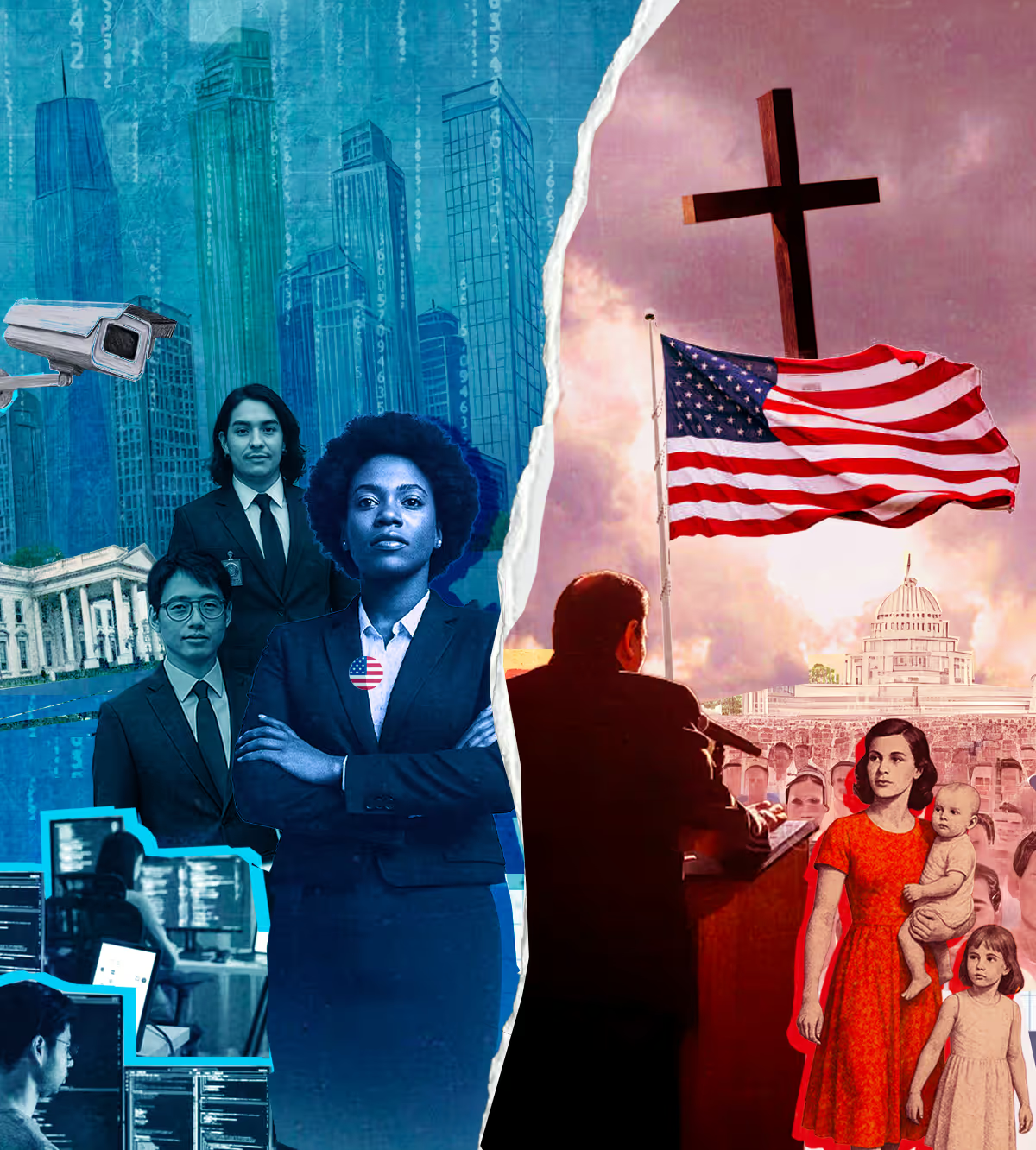
The Republican Party rides a tide of Revivalist Nationalism with strong Christian underpinnings: reasserting traditional values, religious authority, strict immigration limits, and national mythmaking. This isn't the dramatic religious revival some predicted, but a steady growth in religious identification among younger men seeking structure and meaning in a chaotic world. Speech and expression are curtailed in the name of protecting the nation from "degenerative influences," with algorithmic content filters deployed to maintain "cultural hygiene." The party proposes a deeply punitive carceral system that fuses religious doctrine with law enforcement, imposing sentencing norms for “degenerative crimes” that go against religious doctrine.
Facing internal fragmentation, the Democratic Party doubles down on Secular Technocratic Paternalism—where expert elites make decisions on behalf of the public based on science and technical reasoning, even where these decisions are not fully understood or supported. This elite administrative governance is framed as a necessity for preserving a multicultural society. Dissent is managed by manipulating narratives and reframing the truth rather than direct censorship. Cultural expression is carefully taxonomized and regulated through "equity auditing" and "harm reduction frameworks." While these tools originated with progressive intentions, they evolved into systems for managing allowed discourse rather than expanding it.
Alternative information verification systems have emerged on both sides. Republicans establish "Truth Councils" dominated by religious and nationalist validators, while Democrats deploy "Information Integrity Networks" overseen by academic and tech experts. Neither system prioritizes viewpoint diversity nor challenges established narratives.
Each party justifies coercive measures—one in the name of moral defense, the other in the name of social management.
Seismic shifts
Rising religion among youth, especially young men
In 2024, younger voters were the most secular group, with only 28% of adults aged 18–29 saying religion is “very important”, and religion was not a major defining factor in either party. By 2054 in this scenario, almost 70% of young men identify as religiously observant, with over 60% of them supporting the GOP, leading to a religious revival within the party and making faith identity a political litmus test among the younger generation.
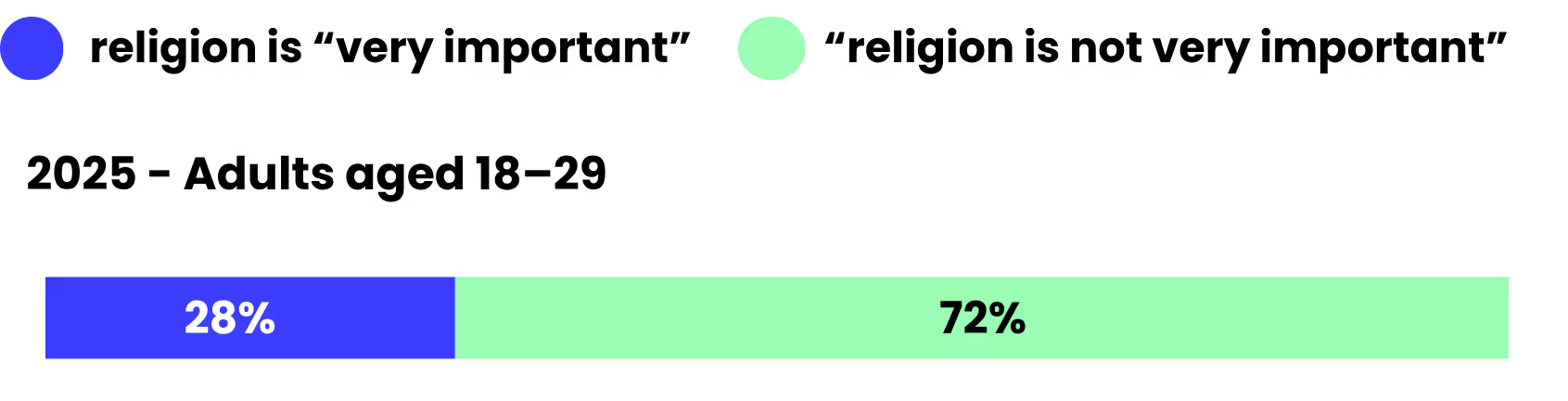
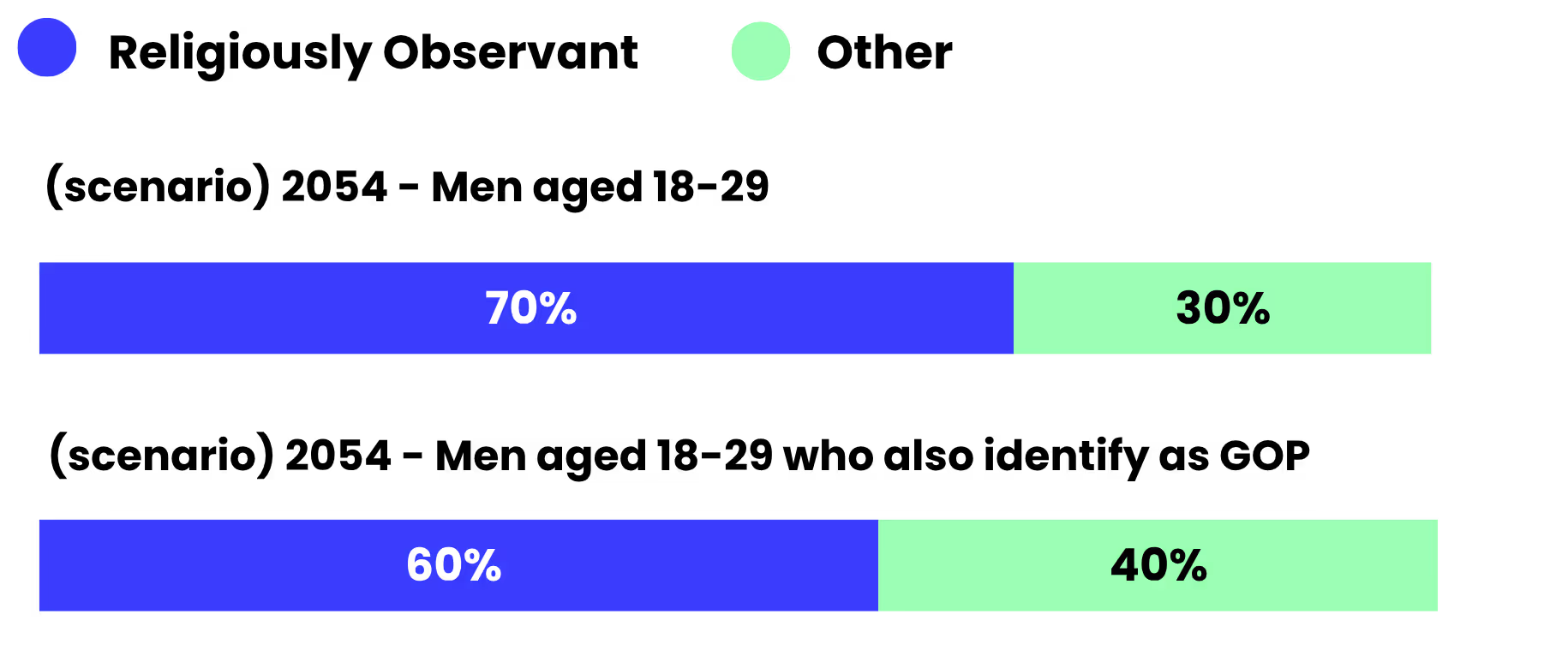
(2025 Data sourced from Pew Research. 2054 data is a projected hypothetical extrapolating on existing data patterns within this predicted scenario.)
Other notable demographic shifts
Gender becomes a defining electoral split
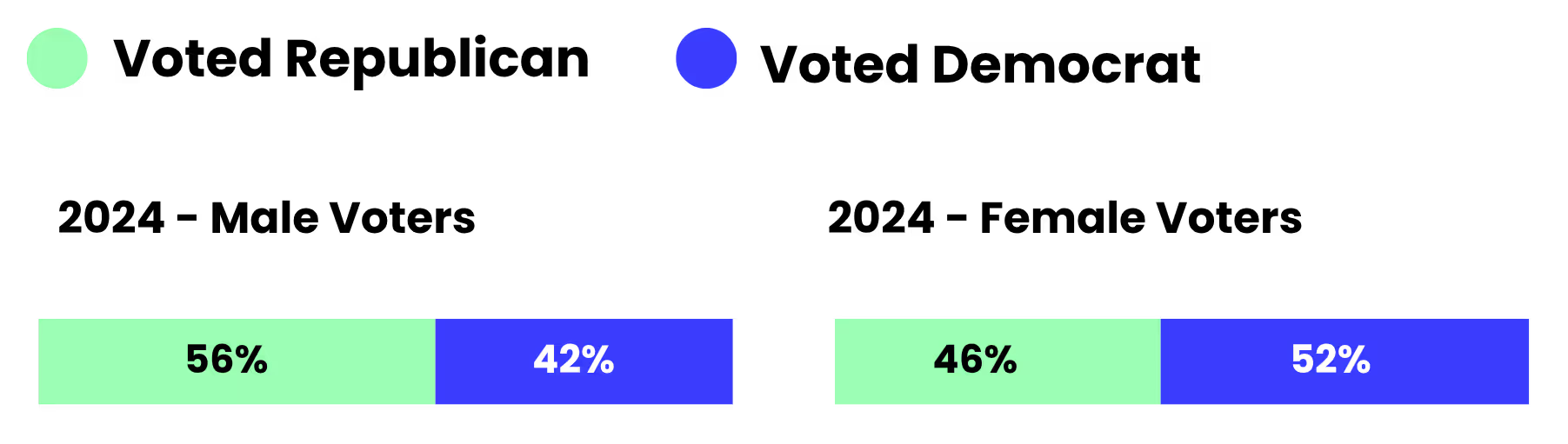
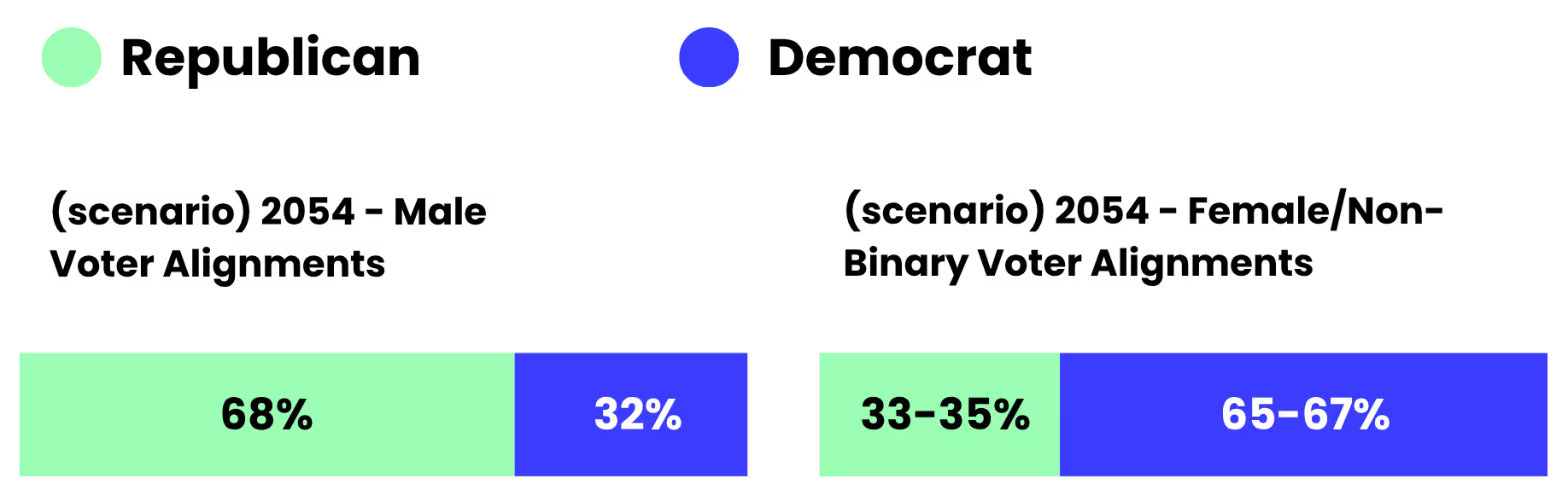
In 2024, gender differences exist between parties but are relatively modest: men voted 56% Republican and 42% Democrat, and women voted 52% Democrat and 46% Republican. By 2054, the Republican Party skews about 68% male, driven by younger men seeking structure, while the Democratic Party skews 65-67% female or non-binary.
Education aligns with party governance styles
In 2024, Democrats already lean more educated and Republicans less so: Democrats won 55% of college graduates and Republicans 44%, while non-college voters were split at 56% Republican and 43% Democrat. By 2054, Democrats are overwhelmingly college-educated, with over 80% holding a college degree and favoring technocratic and expert-driven governance, while the predominantly non-college-educated base of the Republican Party comprises 80% of its members, favouring tradition, stability, and cultural conformity.
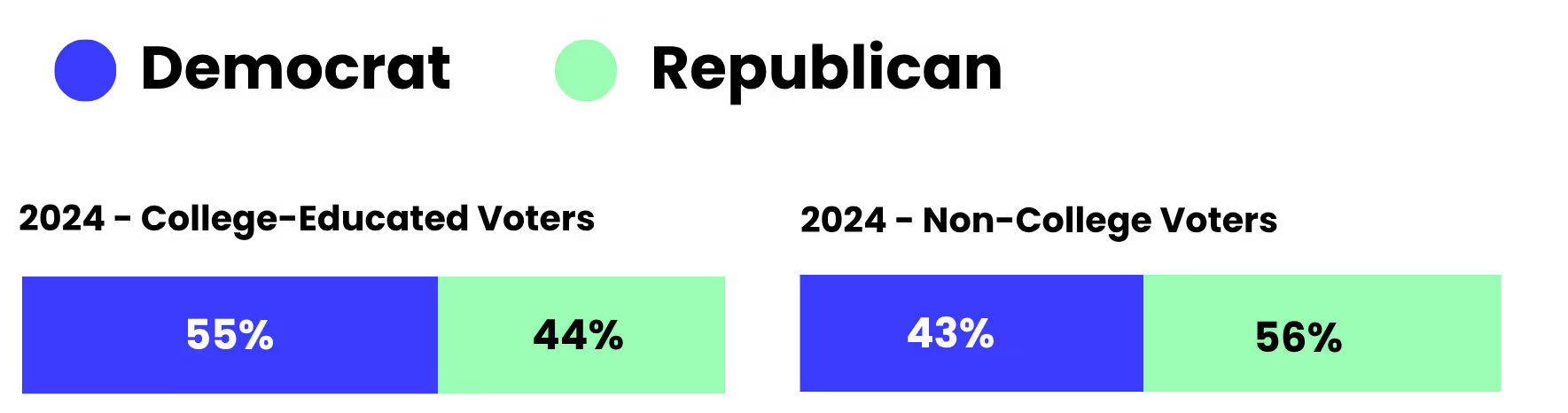
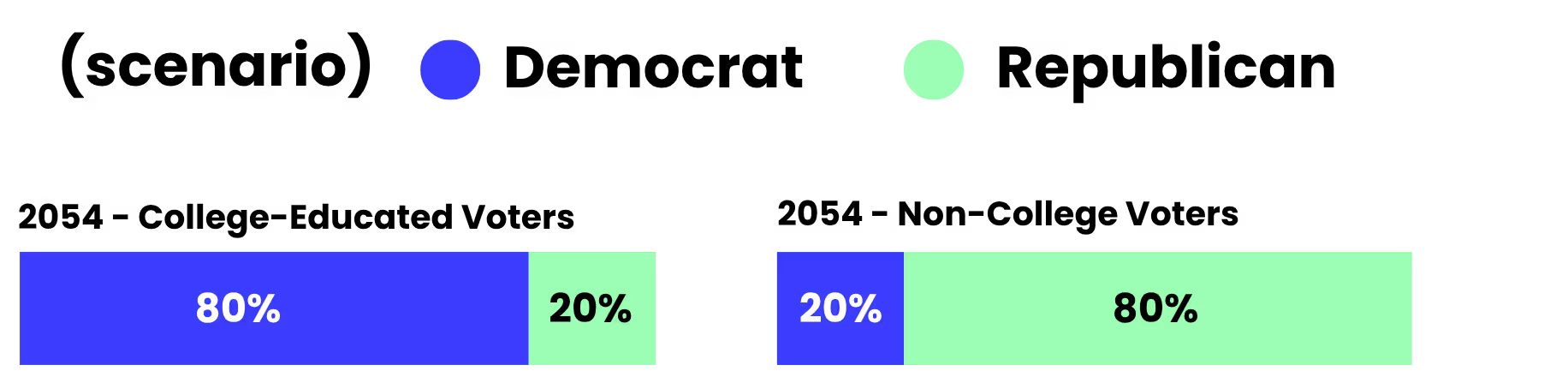
(2024 data sourced from CNN polling. Unless otherwise indicated, the 2024 data for all shifts in this document are referenced from the CNN Exit Poll Results 2024 and depict the National, US House General Results. 2054 data is a projected hypothetical extrapolating on existing data patterns within this predicted scenario.)
Possible wedge issues
- Cultural and identity politics
- Freedom of speech and expression (permitted speech vs democratic expression)
- Authority from religion or religious experts versus technocratic legitimacy
- Narrative control through technology governance
Implications & Recommendations
This scenario envisions a future where exhaustion and fear drive both major parties toward control and conformity under competing banners of order and revival. It highlights how democratic participation may persist even as democracy erodes. The following implications outline what pro-democracy actors can do now to safeguard open discourse, resist authoritarian drift on all sides, and preserve the cultural and institutional conditions that make democracy resilient. To prevent a decline into a scenario where both parties are authoritarian, we would recommend the following for various stakeholders:
- Pro-democracy organizations: Train staff to spot authoritarian tactics across the spectrum, not just on the right. It may be useful to train on what Left-leaning authoritarianism has looked like globally to spot it when it appears in the US.
- Faith leaders and universities: Build pluralistic forums that model disagreement without shutting down dialogue. Consider drawing from organizations like Search for Common Ground, One America Movement, Resetting the Table, or The Pluralism Project, which offer practical frameworks and resources to facilitate values-based, cross-perspective conversations within religiously and ideologically diverse communities.
- Civil liberties groups: Publish annual speech integrity audits that apply across government, social media platforms, and equity offices. These audits should not only track protections and violations but also how “free speech” narratives are being leveraged— sometimes selectively—to suppress dissent or entrench authoritarian control. The Foundation for Individual Rights in Education, for example, publishes an annual report on College Free Speech Rankings, as well as a National Free Speech Index. Further adoption of this work could bring increased awareness and accountability.
Both major parties drift toward authoritarian-adjacent governance under the banner of revival and order.
Scenario 2 Signposts
The signposts presented here reflect our best judgment about observable developments that may indicate movement toward this scenario. In many cases, the line between “observable” and “not yet observable” is fluid, as trends fluctuate or appear unevenly across the country. We offer these signposts not as predictions, but as potential markers to monitor over time.
1. Redirecting blame and rising economic nationalism amidst workforce automation
As automation displaced the traditional workforce, the resulting economic precarity might not be directly attributed to automation. Instead, public and political narratives might shift blame towards immigrants, international trade agreements, offshoring, or religions or cultural minorities, deepening social polarization.
Observable
Mainstream adoption of narratives blaming specific groups for economic decline
Religious and political leaders increasingly use sermons to shape views on immigration and non-Christian groups. This rhetoric frequently centers on claims that these groups are responsible for job loss, especially in industries that are vulnerable to automation. This could escalate if scapegoating leads to the rise of parallel policing institutions organized by religious or ethnic groups for self-protection, which would demonstrate a deterioration of pluralistic trust and shared public spaces.
Not Yet Observable
Loyalty-based policies such as patriotic employment mandates and citizen-linked job guarantees
The government implements job guarantees tied to citizenship. There is a rise in “patriotic employment” mandates, which are monitored through legislative tracking databases and executive orders that monitor corporate compliance and public sector hiring.
Economic Sovereignty Through Protectionist Legislation and Corporate Loyalty Scoring
Legislative restrictions against foreign trade and investment based on protectionism or national security concerns, and enforced by public loyalty scoring systems for corporations rating hiring practices, origin of capital, or perceived national allegiance. This limits cross-border economic activity.
Redirecting blame and rising economic nationalism amidst workforce automation

2. High connectivity with the illusion of free speech
High connectivity is assumed in the initial stages of this scenario for both the Left and Right to exert influence. If online engagement significantly declines and people instead prioritize offline communities and personal relationships, the scenario is less likely to materialize.
Observable
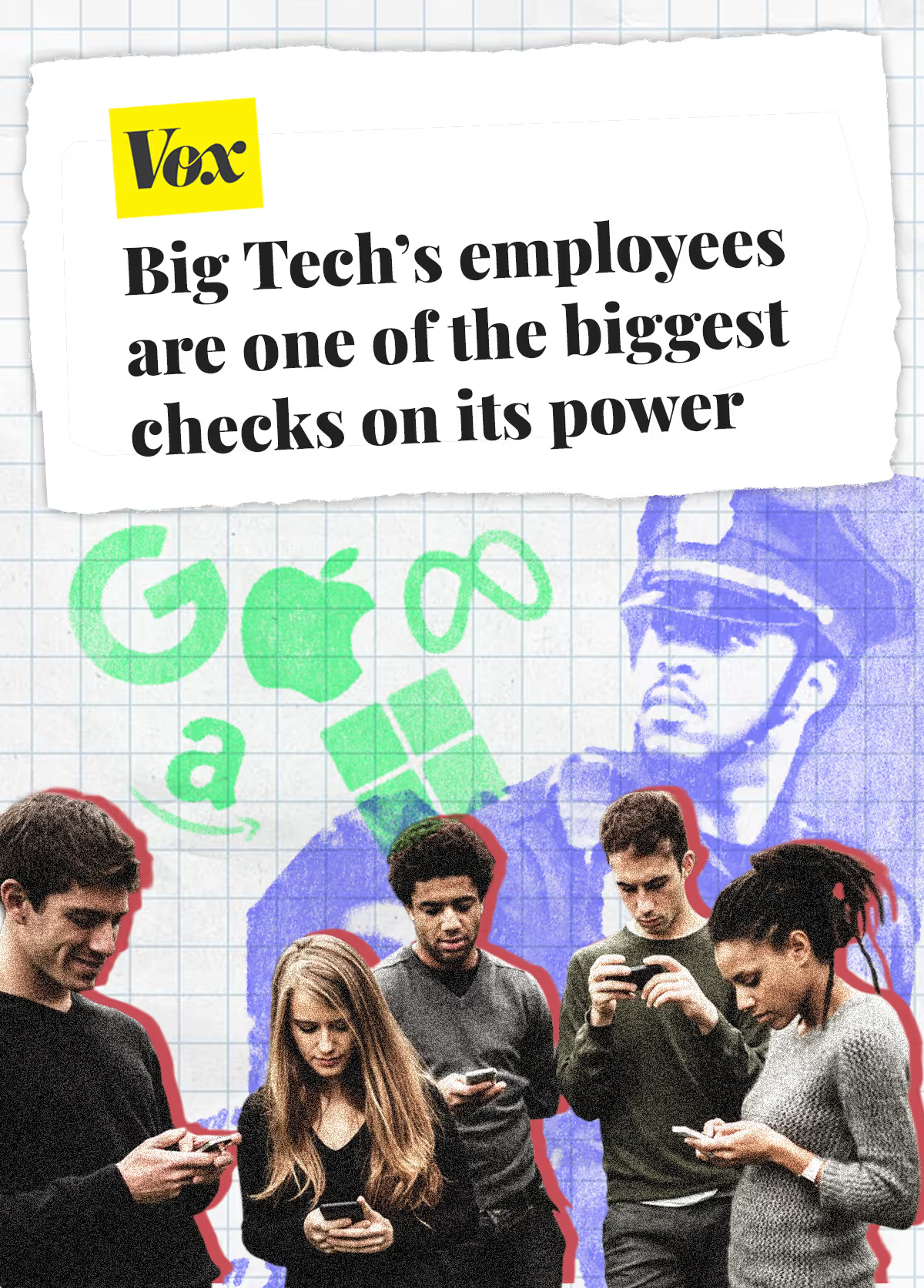
Exodus of technology workers seeking to avoid authoritarian regimes
Rising employee resignations, accounts of public whistleblowing, organized labor actions against major firms, and emigration as tech workers seek to avoid participating in or enabling authoritarian surveillance. This could escalate if governments respond to worker dissent with retaliation—through blacklisting, license denial, or national security investigations—pushing dissident tech workers to organize, resulting in the ideological fracturing of the global tech industry.
Not Yet Observable
Structural erosion of free speech protections despite rhetorical commitment to freedom
There is a discrepancy between popular opinion that freedom of speech is upheld and regulatory changes indicating the contrary, for instance, formal regulatory changes that include the redefinition of key terms such as "harm" and “civic safety," and the embedding of content moderation into federal law.
Rise in misleading Left-wing narratives driven by social media influencers
The Left starts spreading misinformation, specifically by leveraging social media and influencers to advance specific political agendas by manipulating narratives and reframing the truth in an attempt to control the narrative.
High connectivity with the illusion of free speech
3. The collapse of shared gender, cultural and civic norms exacerbated by algorithmic echo chambers
Emerging dichotomy between Left and Right in views on family structures and gender roles. The Left increasingly contests family values and gender norms, with greater questioning of traditional roles, while the right reinforces traditional gender roles. This is particularly evident in the workforce and economic structures, especially in the gendered division of labor.
Observable
Pro-nationalist policies and economic incentives
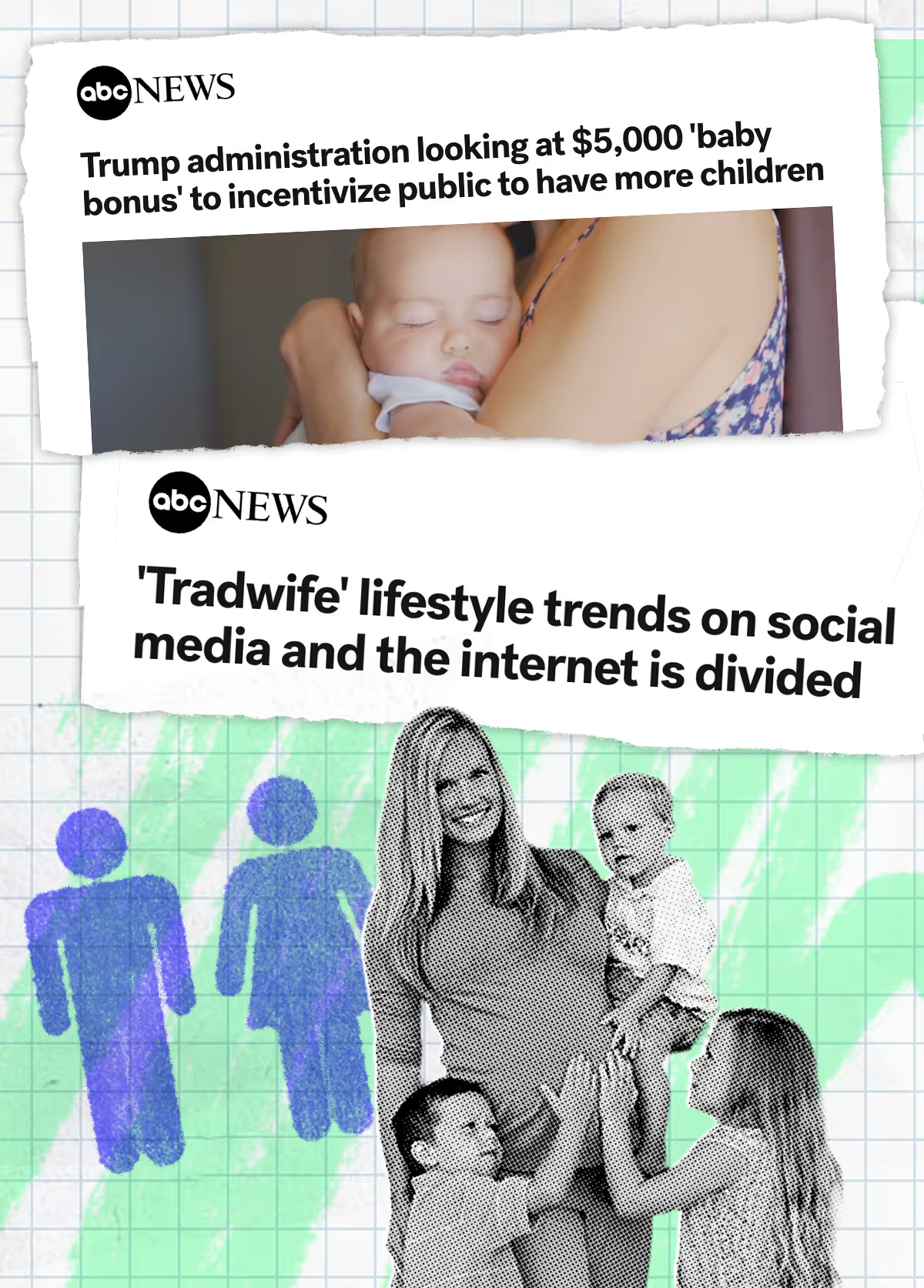
Child Tax credit expansion gains traction, proposing up to $4000 per child, as family policy is increasingly framed in nationalistic terms. This could escalate if federal or state governments formally link procreation incentives to civic rewards—such as tax exemptions, student loan forgiveness, or housing preferences, if national campaigns begin explicitly targeting declining birth rates as a threat to American sovereignty or cultural identity, or if procreation is recast as patriotic duty with motherhood equated to national service and childbearing incentives are embedded in national campaigns.
Online ecosystems align more strongly with traditional gender roles
Algorithm bias ensures careful content curation reinforces conservative narratives, while a growing number of influencers align with conservative values, such as Tradwives and the popularising of stay-at-home moms and traditional female roles. This trend could escalate if schools, education, and community programs start to reference or link to “patriotic motherhood” content creators, blurring the boundaries between digital culture and official policies and school district policies.
Rising restrictions on reproductive autonomy
Across multiple states, legislation has curtailed access to abortion, often in ways that explicitly favor procreation. These restrictions are disproportionately affecting low-income women, and are beginning to correlate with declines in legal protections and rising maternal health risks—especially in contexts of economic precarity. This could escalate if multiple states limit contraceptive care, or if reproductive restrictions are embedded into broader pro-natalist or moral governance frameworks—such as government-funded fertility incentives that exclude contraception access, surveillance of pregnancy outcomes.
Not Yet Observable
State-endorsed promotion of women’s caregiving roles
Mothers who opt out of the workforce receive direct caregiver stipends or lifetime tax credits. Existing public funding for childcare is replaced by vouchers for stay-at-home parenting, further disincentivizing women’s labor force participation.
Reproductive policy as a loyalty and control mechanism
Reproductive rights legislation is directly tied to national identity and demographic goals, and the limitation of reproductive rights forms part of a set of patriotic population policies.
Rising accounts of violence against women
A documented national increase in domestic violence or femicide rates. Local law enforcement and health systems report surges in intimate partner violence while federal and state tracking mechanisms struggle to keep pace with data collection.
The collapse of shared gender, cultural and civic norms exacerbated by algorithmic echo chambers
4. Citizen acceptance of coercion as a necessity for protection
Fear is a prerequisite for justifying coercion measures, leading to a rise in fear-based narratives, shifting focus to clearly defined threats such as foreign powers, internal dissenters, or cultural outsiders, creating conditions for public acceptance of restrictive policies.
Observable
Public rhetoric shifts from competition-oriented to fear-driven narratives
A notable shift in political and media narratives among the Left, from themes of competition (e.g., trade, technological rivalry) to fear-based messaging that frames specific groups, countries, or ideologies as existential threats—similar to Cold-War era portrayals of enemies (e.g., all billionaires as corrupt or all Trump supporters as threats to democracy). This could escalate if rhetoric starts to justify surveillance, blacklist policies, or retaliatory investigations against perceived internal threats—blurring the line between political dissent and national security risks.
Not Yet Observable
Normalization of coercive governance tools
The expansion of coercive measures is framed as safeguarding cultural or social stability, and public polls show growing acceptance of this across party lines.
Citizen acceptance of coercion as a necessity for protection
Scenario 3: Democracy Under Siege (2054)
The right-leaning party is marked by its authoritarian populism and is challenged by a pro-democracy coalition active at the local and regional levels.
Scenario Description
By 2054, the United States remains formally united under a single Constitution, but governance is increasingly fragmented, with federal power transformed into an authoritarian apparatus controlled by a single dominant party, while democratic life endures at local and regional levels. Federal institutions still exist, elections are still held, and the Constitution remains the supreme law of the land. However, the experience of governance diverges dramatically across regions, within states, and by class and community.
This divergence accelerated after the compounding crises of the 2030s—climate disasters, supply chain collapses, and technological unemployment—that disproportionately affected rural and post-industrial regions. The economic security gap widened dramatically as AI-augmented knowledge workers in high-growth hubs thrived while traditional and creative jobs disappeared. This economic bifurcation created a geographic sorting more powerful than historic red-blue divides, as climate migration concentrated wealth and opportunity in resilient pockets.
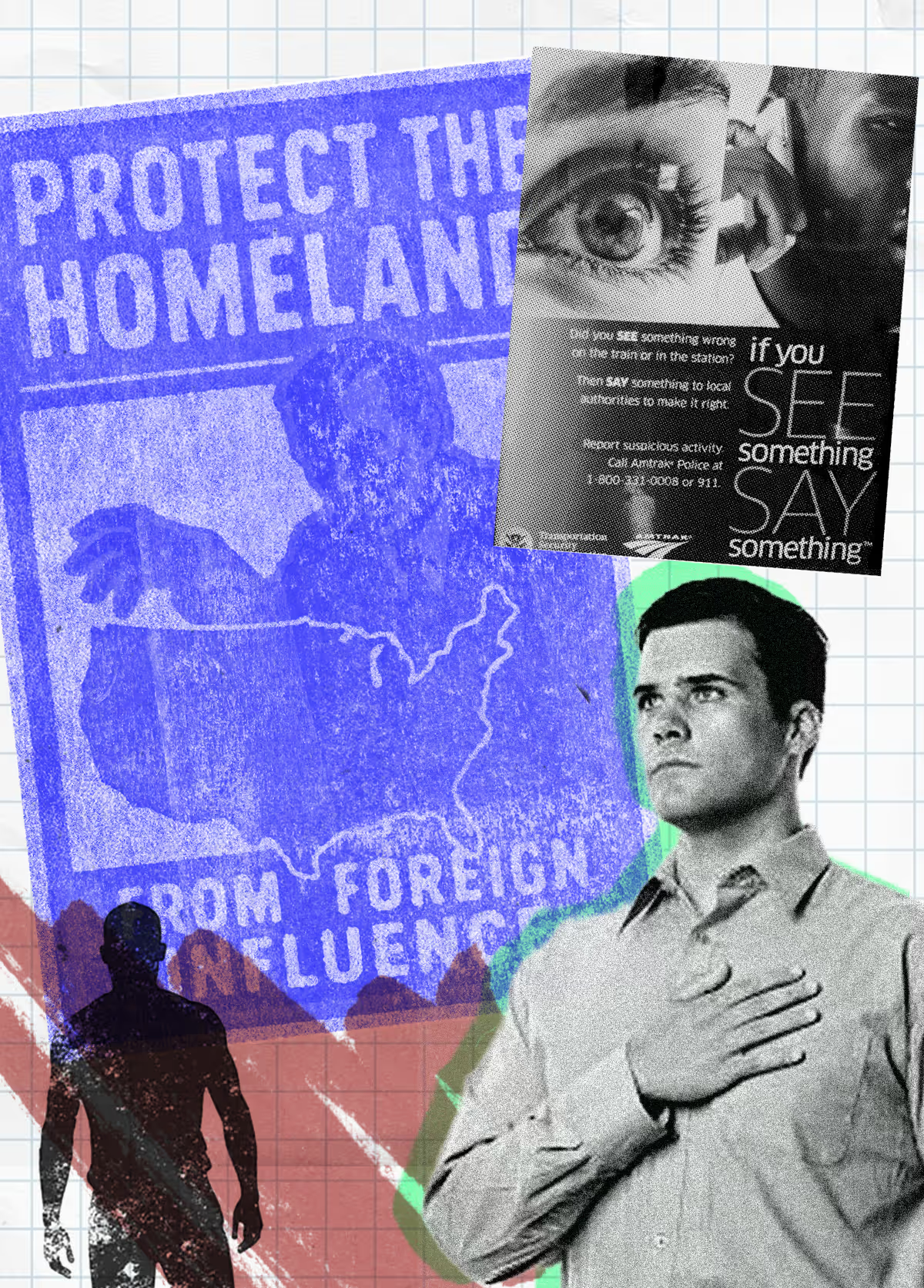
One dominant party has captured the machinery of the federal government through what began as Project 2025 and evolved into the Schedule F Restoration Act of 2038. The hallmarks of this takeover—loyalty tests for civil servants, the dismantling of independent agencies, the politicization of regulatory and oversight bodies, and the consolidation of executive power—have transformed the government into a sophisticated system of authoritarian control. Federal departments operate under "Efficiency Commissions" staffed entirely by political appointees. Ideological compliance is enforced through sophisticated AI-enabled surveillance, and the judiciary has been compromised by algorithms that ensure politically sensitive cases are assigned to sympathetic judges. Freedom of speech, assembly, and the press still formally exist in the Constitution, but the expanded Seditious Content Prevention Act empowers authorities to criminalize dissent as "threats to national cohesion." Federal oversight mechanisms that once served as guardrails are now instruments of partisan enforcement. This creates the illusion of democracy through a tacit arrangement of control and compliance.
In response, a decentralized pro-democracy coalition has emerged at local and regional levels, quietly constructing parallel civic infrastructures without formally seceding or breaking the law. Rather than directly confronting federal authority—which remains too powerful and dangerous to dislodge—the coalition is focused on building resilient non-governmental civic structures: worker cooperatives, mutual aid networks, citizen assemblies, municipal broadband, and alternative education systems. Digital commons initiatives provide technological infrastructure outside corporate control, with city-run broadband networks, community-owned data trusts, and platform cooperatives creating alternative spaces for democratic engagement. They also use AI to identify jurisdictions that are statistically more likely to uphold civil liberties in politically sensitive cases.
The transparency of these systems prevents obvious federal interference. People feel a strong sense of legitimacy and engagement, directly connected to local decision-making. While these initiatives remain fragmented and contained within state boundaries, they are also tolerated and not seen to be a threat to the system.
Climate adaptation has become a primary arena for innovation. As federal responses to climate disasters consistently failed vulnerable communities, local civic systems evolved to fill the gap. Community-managed microgrids, watershed councils, and food security networks operate through participatory governance models, with some regions developing sophisticated climate migration pacts to manage population shifts humanely.
Two Americas silently coexist under one Constitution. At the federal level, life is marked by surveillance, ideological conformity, and centralized authoritarian enforcement. At the local level, democracy endures—not everywhere, but in scattered pockets where constant vigilance, innovation, and solidarity sustain community life despite the national order.
Seismic shifts
Vertical alignment and governance layer replace left-right geographies
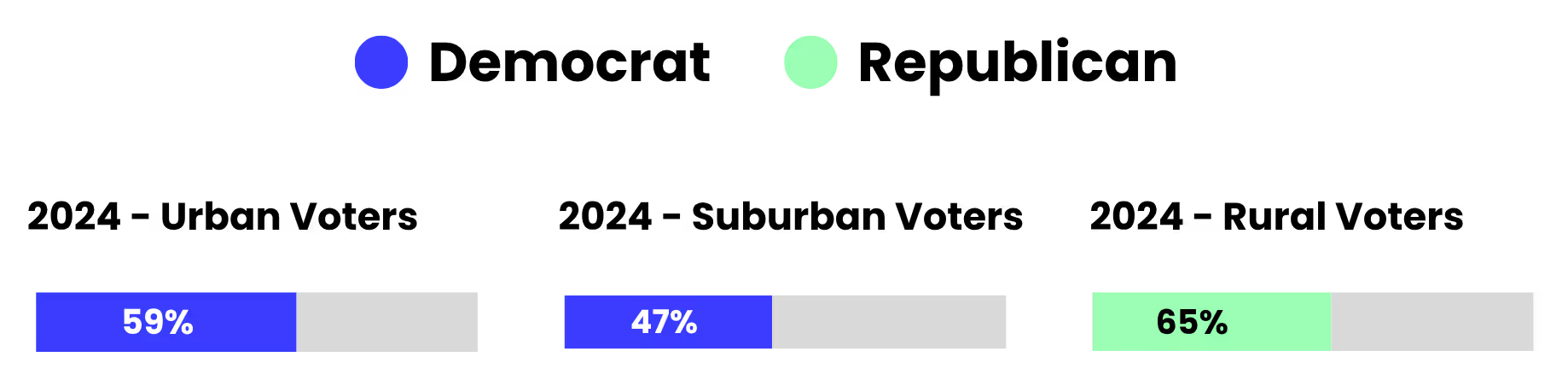
In 2024, identities and geographies were useful predictors of voting patterns: Democrats won 59% of urban and 47% of suburban votes, while Republicans won 65% of rural votes. In 2054, the decisive split occurred in governance layers, where the Republican party holds around 60% of the national vote and dominates all federal institutions, while democratic pockets exist in cities and small towns alike, representing about 20-25% of the population.
Party labels and geographical location matter far less than which layer people trust and engage with.
Other notable demographic shifts
From urban-rural split to pockets of democracy everywhere
In 2024, alignment is situated around geographies: rural voters favored Republicans by 65% to 33%, while urban voters favored Democrats by 59% to 39%. In 2054, all metro corridors and rural regions contain pockets of local democratic infrastructure, often tied to climate adaptation or digital commons capacity.
Possible wedge issues
- Government as a federal or local authority
- Technology governance and AI surveillance technology versus civic technology
- Freedom of speech and dissent
- Control of dissent and parallel civic spaces
- Top-down or local climate adaptation and response to climate migration
Implications & Recommendations
This scenario imagines a future where federal institutions retain their form but lose their democratic function, consolidating power under a single dominant party. Local and regional actors become a last line of defense, sustaining democracy through grassroots civic innovation and mutual aid. The following implications outline how democracy practitioners can act now to prevent democratic backsliding at the national level and strengthen the local infrastructures that could one day carry democracy through a crisis. To prevent a future where democracy survives only at the local level, we would recommend the following for various stakeholders:
- Local governments: Build parallel civic capacity, such as mutual aid programs that are legal and resilient to federal retaliation. Additionally, local governments could consider co-governance models that make democracy feel hyper visible and of high value, which may, in turn, reduce the appeal of authoritarian alternatives.
- Legal advocacy organizations: Establish rapid-response defenses for local democracy, like pre-drafting ordinances to protect governance from preemption overreach, or co-filing amicus briefs with local government attorneys.
- Civic technologists: Develop privacy-preserving tools owned by communities; this could look like participatory mapping or other local data collection that is managed at a community level by residents. These tools could focus on minimizing surveillance risk and encourage community decision-making. Communities could treat data governance as a democratic core function for building responsible and responsive oversight.
- National and federally focused advocacy organizations: Push for statutory safeguards that respond to the erosion of democratic norms and executive accountability already witnessed in recent years. This includes advancing legislative reforms that are already happening, like the Protecting Our Democracy Act (PODA), which was led by Protect Democracy and Issue One’s Check the Executive campaign, which strengthens congressional oversight, limits executive overreach, and preserves the rule of law. These actions may help prevent authoritarian consolidation.
- Democracy funders: Invest in local journalism organizations that focus on government transparency. There is a gap in independent coverage in this area, with a net loss of 3300 local newspapers between 2005 - 2024, which is a high-value touchpoint, as 60% of Americans trust local news to keep them informed on what is happening in their communities, and this gap may be contributing to a lack of public faith in the effectiveness of checks and balances. In Democracy 2076’s June 2025 Convening Report, we provide a Media Landscape analysis that lifts up the opportunity for high school newspapers to also resource the local news gap. Additionally, investing in robust investigative accountability may make covert actions of authoritarianism more visible and therefore less attractive to pursue.
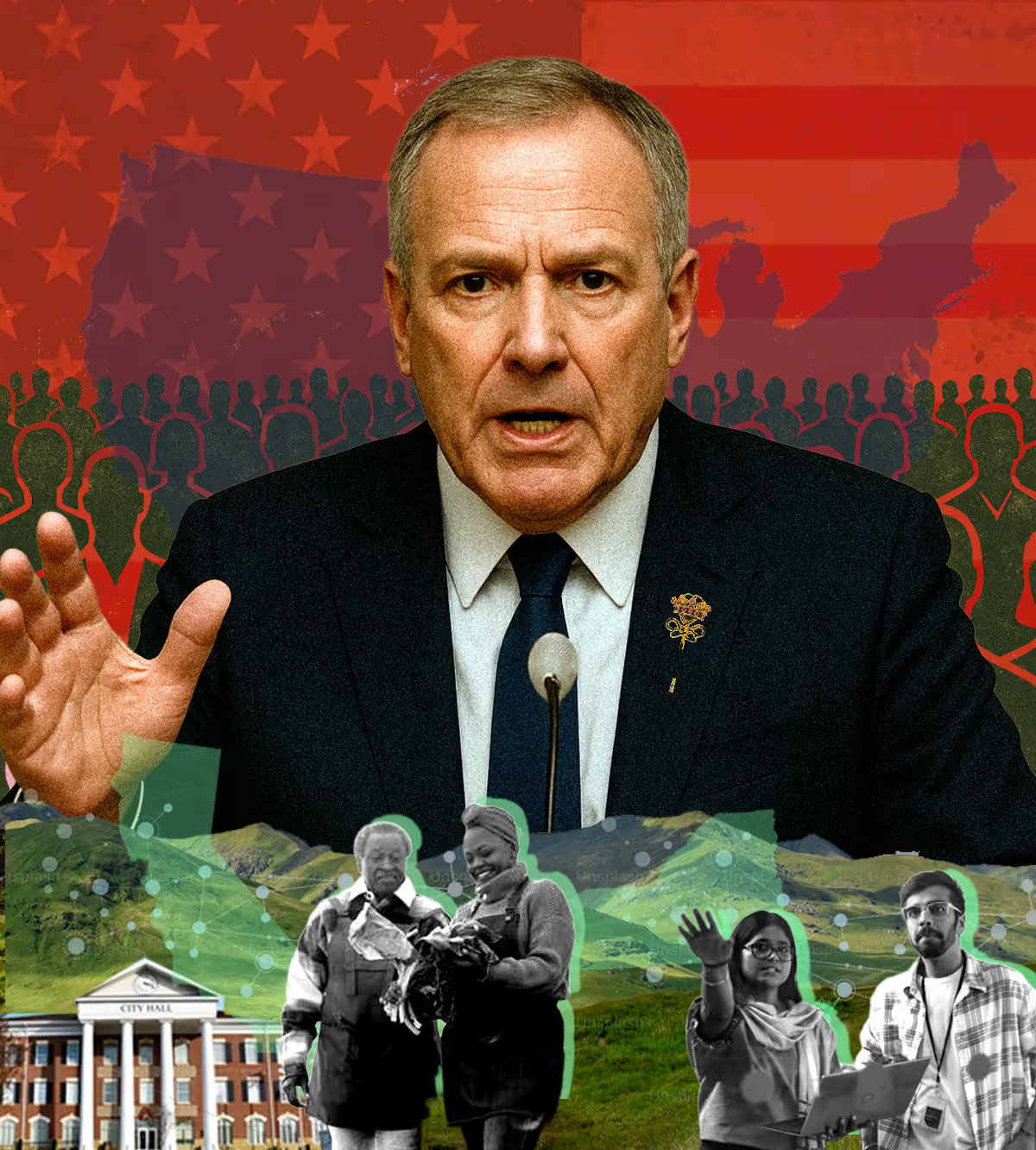
The right leaning party is marked by authoritarian populism and is challenged by a thriving pro-democracy coalition active at the local and regional levels.
Scenario 3 Signposts
The signposts presented here reflect our best judgment about observable developments that may indicate movement toward this scenario. In many cases, the line between “observable” and “not yet observable” is fluid, as trends fluctuate or appear unevenly across the country. We offer these signposts not as predictions, but as potential markers to monitor over time.
1. Federal consolidation of authoritarian control and the rise of self-governing communities
Faced with confusing information and forceful intimidation by the federal government, people recoil from engaging with national politics. In response, they set up small, insular communities grounded in shared worldviews to pursue a simpler lifestyle.
Observable
Deployment of the National Guard
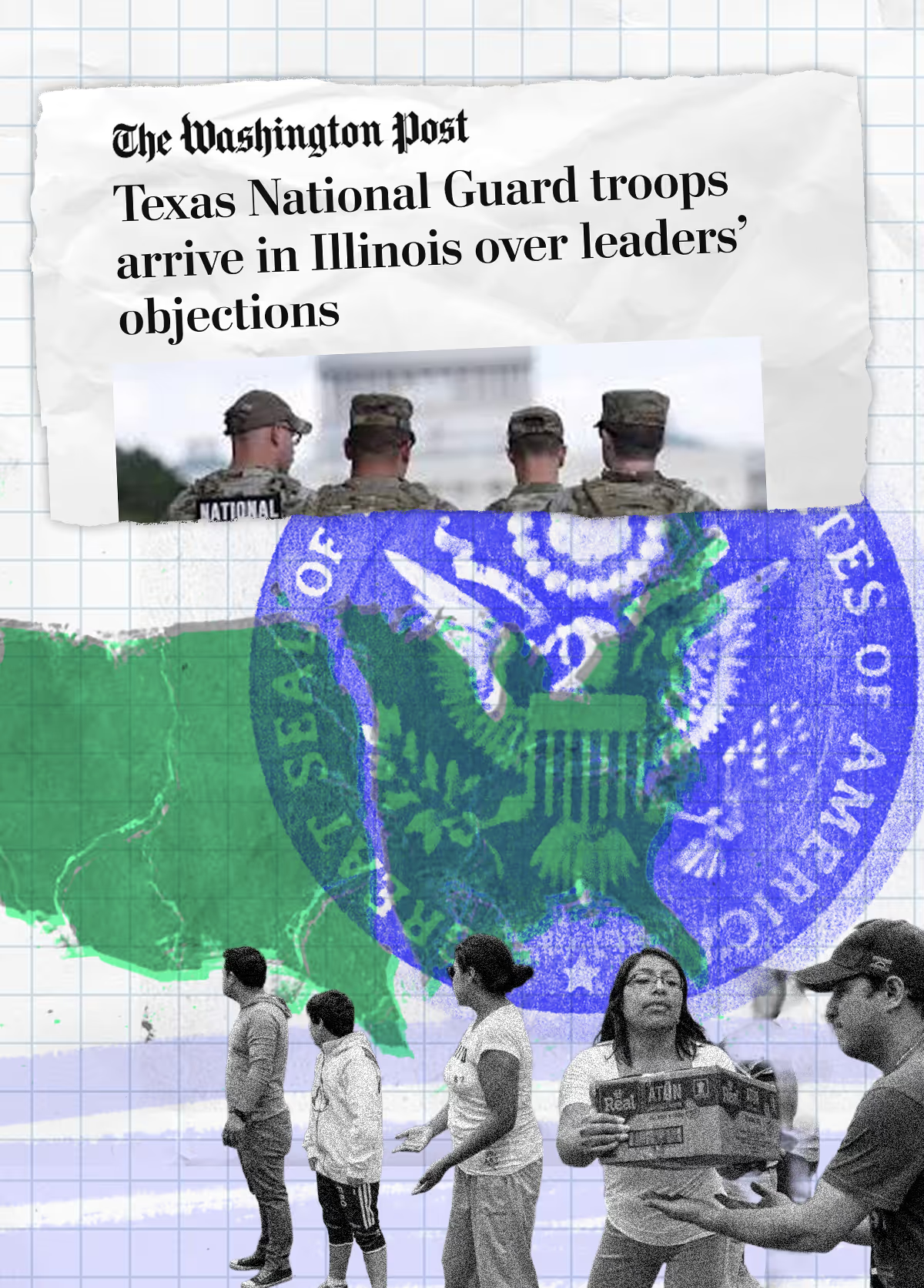
Federal leaders have begun deploying the Guard under the guise of public safety and unrest—risking a normalization of militarized domestic response as a tool of civic management rather than emergency intervention. This could escalate if the National Guard and federal security forces become a standard feature in response to civil unrest, documented through Department of Defense reports and State of Emergency declarations.
Not Yet Observable
Measurable decline in mass demonstrations
Demonstrations advocating civil liberties dwindle measurably across the country, tracked by protest monitoring databases, crowd-sourcing platforms, and the media.
Rise of self-governing, intentional or ideological micro-communities
Land purchases, zoning petitions, and cooperative tax structures indicate the rise of ideological communes, including secessionist spiritualist collectives, decentralized anarchist enclaves, or those recognizing AI as sentient with legal rights. These are part of a broader increase of federally disaffected or post-political enclaves that reject national governance, including “data havens” for nomads or off-grid townships with their own internal currencies and local charters. While ahead of the curve, it was reported that in 2010, Burlington, Vermont’s Champlain Housing Trust had 7.6% of the total housing units in the city; seeing 10% Community Land Trust ownership in metro areas across the nation may be a strong indicator of this signpost shifting to observable.
Sharp drop in national-level voter turnout
The Federal Election Commission and national polling institutions mark a voter decline with historic lows among under-40s, particularly in federal elections.
Federal consolidation of authoritarian control and the rise of self-governing communities
2. Dual systems of governance - the rise of decentralised democratic alternatives
As a technocratic and extractive federal government becomes increasingly detached from everyday concerns, communities turn inward. Democracy thrives locally with regional, purpose-built partnerships necessary to preserve a sense of safety, self-determination, and connection to nature.
Observable
Civil society organizations take on core public functions
Local public-private governance models and shifts in NGO funding indicate that traditional regional government roles such as local service delivery, aid distribution, and local democratic oversight are being taken over by civil society. At the local level, NGOs coordinate with local governments on public health surveillance. This could escalate if political dysfunction further erodes public capacity, prompting civil society actors to assume formal authority over key public functions—potentially reshaping the role of the state at the local level and blurring lines of democratic accountability.
Education policy devolves to the state level
Educational curricula diverge across states as education becomes a frontline for identity. Contesting historical narratives are taught as is evident in the difference in curriculum and approved texts used for education from state to state, and there is a rise in legal battles over curriculum standards. This could escalate if more states assert incompatible civic narratives, region-specific histories, or even educational migration by families seeking aligned values, or if a clear distinction begins to surface between “liberty-based,” “patriotic,” or “decolonial” curricula.
Not Yet Observable
Expansion of open-source digital infrastructure and localized tech platforms
Centralized tools and corporate Internet Service Providers are replaced by more open digital infrastructure, as evidenced by the adoption of municipal broadband, public-interest platforms, and decentralized networks that enable citizens to opt out of federal digital infrastructure entirely.
Opposing federal and grassroots AI regulation
The federal government enforces a centralized AI framework allowing extensive surveillance and automated decision-making, while grassroots-led states and municipalities attempt to pass stricter safeguards such as facial recognition bans, algorithmic transparency mandates, and community consent requirements.
Dual systems of governance - the rise of decentralised democratic alternatives
Scenario 4: Left Behind (2054)
The Democratic Party is marked by authoritarian populism and is challenged by liberal-proceduralist conservatism from the Republican Party.
Scenario Description
By 2054, the United States remains legally one nation, governed under the existing Constitution. However, in practical terms, governance structures, civic culture, and lived experience have diverged dramatically across regions. Americans in different states experience radically different interpretations of rights, freedoms, and government responsibilities, even without formal constitutional amendments.
This divergence was accelerated by the third wave of automation in the 2030s, which eliminated vast categories of knowledge work that had previously seemed immune to technological displacement. The resulting economic upheaval created unprecedented levels of status anxiety across socioeconomic classes. Traditional education no longer guaranteed economic security, with even advanced degrees proving insufficient for stable employment. This economic precarity coincided with a demographic shift, as America's aging population required expensive care systems that strained already weakened safety nets.
A fractured Democratic Party was overtaken in the 2040s by a new authoritarian populist faction, catalyzed by generational disillusionment, a surplus of elites with too few avenues for status or influence, labor instability, and cultural backlash. After years of perceived inaction by liberal elites, many younger voters abandoned traditional liberalism in favor of strongman promises of national solidarity, material security, and enforced cultural stability. Those younger voters who were not drawn by ideological conviction sought safety instead, becoming less inclined to resist or engage in activism—making the transition all the easier.
This new Democratic Party fuses disaffected Gen Z voters, Latino and Black working-class men, radical labor activists, climate nationalists, and authoritarian Leftists into an unstable governing coalition. Its platform emphasizes universal employment guarantees, centralized education reforms, strict digital ecosystem control, and nationalistic cultural revival—blending old New Deal ideals with twenty-first-century techno-authoritarianism.
Meanwhile, the Republican Party, having shed its MAGA wing after a set of electoral collapses, a general failure to solve the economic precarity, and leadership controversies has rebranded itself around liberal-proceduralist conservatism—an ideology that combines conservative values with protection of individual rights and civil liberties: emphasizing democratic process over ideology, market-oriented adaptation, religious and expressive pluralism, and constitutional restraint. Its new base includes upper-middle-class immigrants, religious minorities, suburban women, and classical liberals increasingly concerned about individual autonomy in a system that demands ideological conformity for security.
Formal elections continue, but democratic erosion accelerates at the local and federal levels. Digital surveillance and ideological conformity are normalized under the guise of "civic health." Dissent becomes dangerous, particularly against the dominant Democratic regime in blue-governed regions.
Democracy survives on paper, but in daily life, it fractures along class, geographic, and ideological lines.
Seismic shifts
Overall party role reversal
In 2054, Democrats are more religious, with 60-65% attending church regularly. They are also less college-educated, and the primary working-class authoritarian party, while Republicans emerge as the more educated, with over 70% holding a college degree, as well as being religiously diverse, and a rights-protecting party. This marks a radical inversion of the 2024 political landscape, where Democrats make up 55% of college graduates and Republicans 40% of weekly churchgoers.
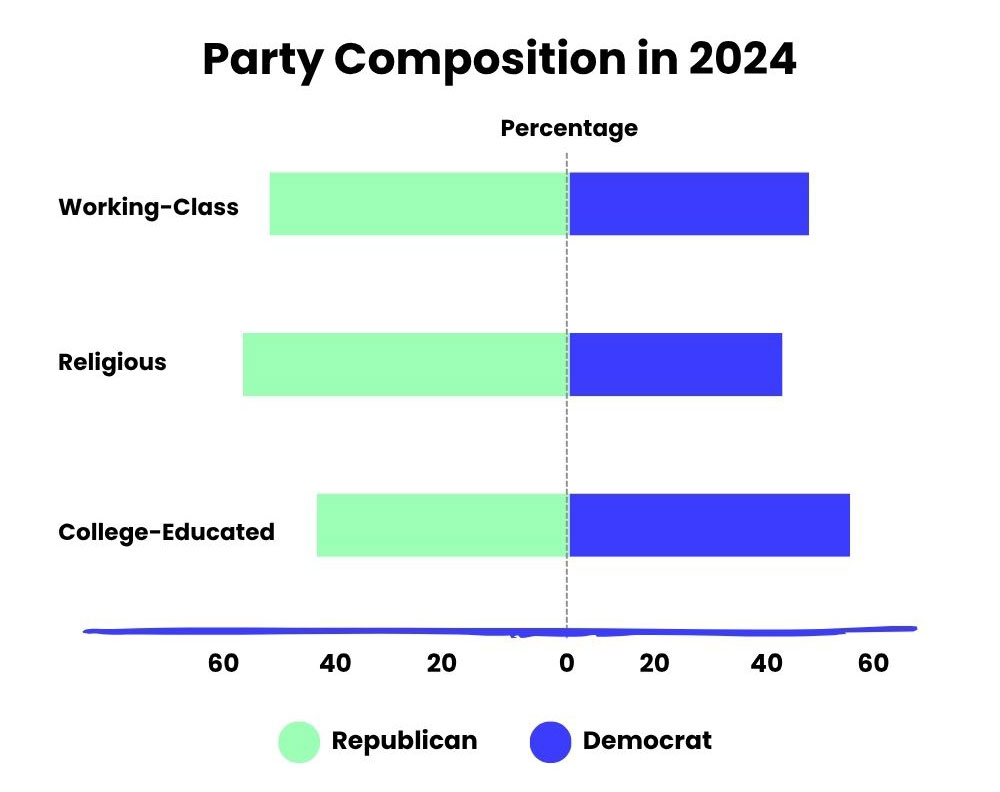
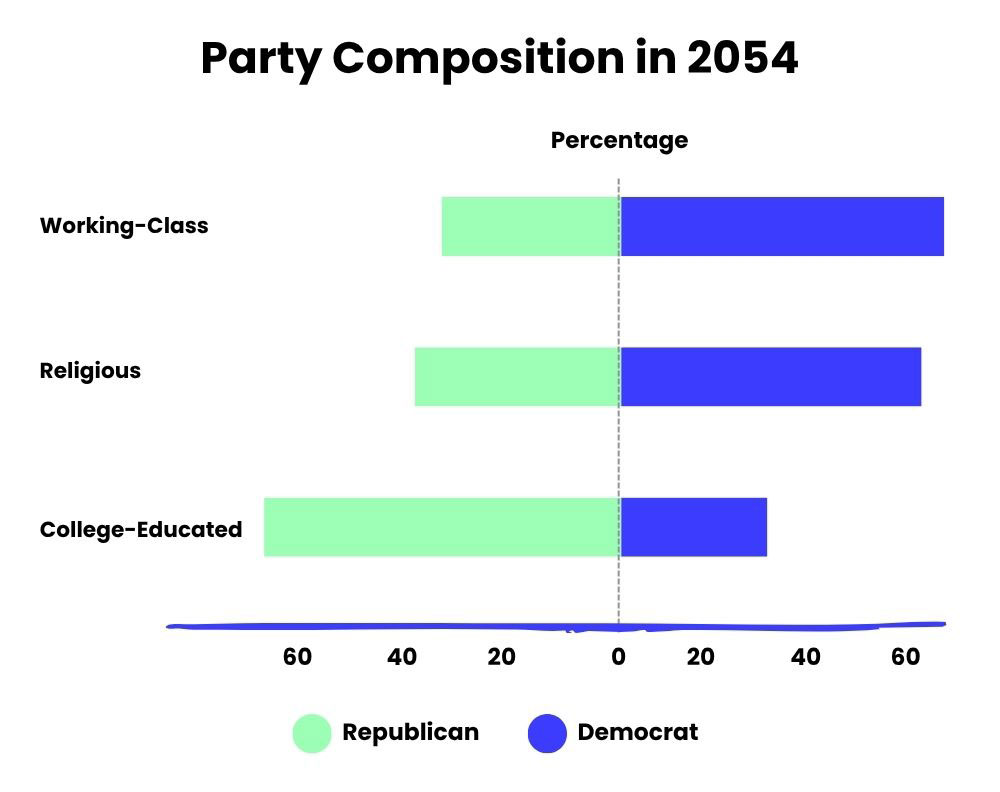
(2024 data sourced from CNN polling. Unless otherwise indicated, the 2024 data for all shifts in this document are referenced from the CNN Exit Poll Results 2024 and depict the National, US House General Results. 2054 data is a projected hypothetical extrapolating on existing data patterns within this predicted scenario.)
Other notable demographic shifts
From ideological activism to material and personal safety
In 2024, about 53% of adults reported being civically engaged through activities like volunteering, petitioning, or attending community events. In 2054, this falls to 15-20% nationwide, as many voters withdraw from activism, maintaining a public posture of compliance in exchange for material stability and personal safety.
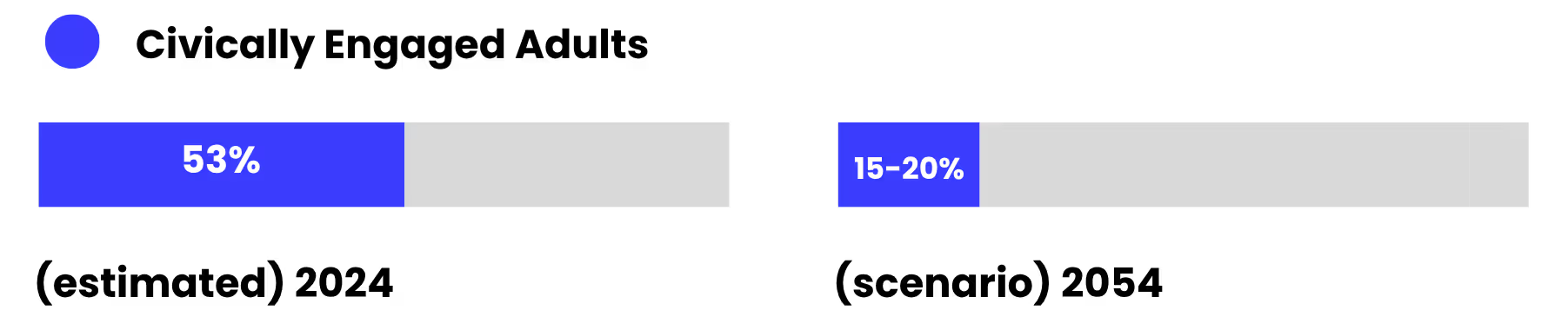
2024 data sourced from AAMC Center for Health Justice. 2054 data is a projected hypothetical extrapolating on existing data patterns within this predicted scenario.
From digital freedom to navigating strict online controls
As of 2025, approximately 73% of Americans use social media, reflecting “vibrant, diverse, and free” access to the internet. In 2054, 95% of online activity occurs within tightly controlled, state-regulated platforms, where participation requires visible compliance and public conformity, irrespective of identity.
Possible wedge issues
- The centralization of technology versus pluralist technology governance
- Market-based adaptation versus universal labor and economic guarantees
- Enforced cultural uniformity or expressive pluralism
- Trust in government or individual civic responsibility
Implications & Recommendations
This scenario envisions a future where an authoritarian populist movement arises from the Left, fueled by disillusionment, fear, and a demand for control disguised as solidarity. While its rhetoric centers justice and security, its tactics erode pluralism and due process. The following implications outline how actors across the democracy field can strengthen internal safeguards, resist coercive conformity, and preserve democratic practice within movements that claim progressive values. To prevent authoritarian populism from the Left and keep due process at the center, we would recommend the following for various stakeholders:
- Democracy educators & trainers: Develop curricula that examine the historical and contemporary dynamics of Left-wing authoritarianism with a goal of helping entities like unions, progressive institutions, and university campuses recognize and resist these tactics in their own ranks. This could include comparative studies from 20th-century revolutionary regimes or the suppression of dissent in an international context. These learnings could help these groups better understand and thus serve as a bulwark of accountability and institutional transparency against authoritarian impulses within their spheres of influence.
- Organizers: Maintain safe-to-disagree spaces inside movements; the priority here can be uplifting debate as a value add as opposed to a demonstration of disloyalty. This will require deliberate investments in cultivating viewpoint diversity, consensus-building methods, conflict resolution tools, and clear communication with members on expectations for participation and accountability.
- Digital rights groups: Prototype pluralist civic platforms as alternatives to state-regulated, compliance-only ecosystems. For example, New Public is prototyping digital communication spaces through their Public Spaces Incubator.
- Civil libertarians & conservatives: Form cross-ideological coalitions around due process, pluralism, and limits on state digital control. For example, Mormon Women for Ethical Government’s Advocacy page shares calls to action encouraging cross-ideological coalitions to stand together in support of safeguarding institutional structures and democratic norms; fair, nonpartisan redistricting; and ethics and accountability in government, including campaign finance and the rule of law.
- Political party power-brokers: Identify, fund, platform, and campaign for candidates who support government programs and policies that ensure the provision of economic and social assistance to the public, like universal healthcare, job guarantees, and elder care. These priorities meet people’s basic needs while preserving democratic norms, and the failure of the system to provide this in Scenario 4 ultimately is what allows authoritarianism to gain traction. To counter this, party actors backing candidates who deliver reliable basic needs can stabilize democracy by ensuring dignity and fairness while maintaining civil liberties.
The Democratic Party is marked by authoritarian populism and is challenged by liberal-proceduralist conservatism from the Republican party.
Scenario 4 Signposts
The signposts presented here reflect our best judgment about observable developments that may indicate movement toward this scenario. In many cases, the line between “observable” and “not yet observable” is fluid, as trends fluctuate or appear unevenly across the country. We offer these signposts not as predictions, but as potential markers to monitor over time.
1. The authoritarian capture of the Democratic Party
This could emerge through a gradual consolidation of power within the party, with decision-making concentrated around a narrow group of leaders displaying increased intolerance for internal dissent and alternative views. Over time, democratic norms are sidelined in favor of ideological control.
Observable
Policy paralysis fuels demand for strongman leadership
Polling data reveals increased frustration with internal Democratic divisions, boosting strongman-style leadership and authoritarian appeal amidst perpetual legislative gridlock. This could escalate if multiple major party figures on both sides continue to gain notoriety by openly criticizing procedural norms, calling for executive expansion, or promising to support bypassing Congress in the name of “getting things done.”
Anti-elite rhetoric surges within Left-aligned media ecosystems
Negative sentiment towards traditional party leadership, think tanks, and academic institutions is already present as some Left-aligned influencers, podcast hosts, and content creators increasingly portray party leaders, universities, and legacy media as being out of touch, corporate-aligned, or merely performative, fuelling a more forceful “burn it down from the Left” rhetoric. This might escalate should a Democratic presidential candidate experience a polling boost after suggesting vetting the media along ideological lines or to centralize speech oversight in the name of social justice.
Not Yet Observable
Favourable referencing of authoritarian regimes and figures in Leftist discourse
Party-affiliated publications, activist events, and academic panels in Left-wing circles idealize authoritarian regimes and ideologies such as Castro’s Cuba, Tunisia, or Jordan—as models for state-led economic planning, social cohesion, or resistance to Western imperialism.
Escalating attacks on core democratic institutions
Speeches, proposed legislation, and social media campaigns increasingly accuse universities, the media, and courts of corruption, irrelevance, or ideological betrayal.
Extra-judiciary or unconstitutional measures taken by the Left
The Left advances its political objectives through bypassing established legal processes, including executive actions to override undesired court rulings or directing agencies to act beyond legal authority.
The authoritarian capture of the Democratic Party
2. Collapse of institutions destabilizes democracy
Extreme funding cuts to government and elite institutions reduce their capacity to function effectively, eroding public trust and legitimacy. This breakdown would drive voter mistrust and set off a downward spiral towards the eventual collapse of these institutions, replaced by private or ad-hoc alternatives.
Observable
Public trust in key government institutions and agencies continues to fall to historic lows
Pew, Gallup, and Edelman tracking show a sustained decline in trust in Congress, the Supreme Court, the CDC, and public health agencies. Survey crosstabs show especially low trust among younger generations and political independents. This could escalate if younger generations fully disengage from government institutions and begin building alternative civic structures, further driving isolation between legacy institutions and the public.
Significant, sustained reduction in federal funding for core functions
Agency downsizing and service delivery gaps indicate a severe lack of funding for
governance institutions and government agencies, specifically in public health infrastructure such as the CDC, NIH, regulatory oversight bodies such as the EPA, OSHA, and other civic institutions such as the Corporation for Public Broadcasting or archives. This could escalate if sustained downsizing and funding reductions lead to full privatization or state-level takeover of formerly federal functions, leaving key public responses to be dictated by local capacity or private sector interest.
Not Yet Observable
National voter turnout falls below 20% in federal elections
The Federal Election Commission and state election boards raise alarm about low voter turnout.
Widespread adoption of direct-to-citizen paid alternatives for essential services
There is a rise in subscription-based emergency (fire and ambulance) and security services, reflecting private sector growth as public services disappear.
Aggressive partisan gerrymandering
Redistricting maps in Democratic-controlled areas are redrawn with extreme partisan advantage, and any legal challenges are dismissed or bypassed through state court restructuring or statutory changes to redistricting rules. An example of this is the recently passed Proposition 50 on the California November 2025 ballot, which is intended to counter partisan redistricting efforts in states like Texas. Seeing action like this take place in multiple states before the next Census would be an indication that this is an observable signpost.
Collapse of institutions destabilizes democracy
3. The gradual ideological reversal of the political spectrum
This shift represents a slow but steady reversal of current political polarization. Its continuation depends on the Republican Party distancing itself from its MAGA-affiliated faction. A key enabler is the restoration of trust in the media and more accurate reporting, preventing disillusioned voters from defaulting to MAGA-aligned narratives.
Observable
Public renunciations of MAGA ideology
A growing number of former MAGA influencers, podcast hosts, social media statements, including traditional press op-eds and interviews, indicate people are breaking with the movement. The "Leaving MAGA" discourse may mirror earlier deconversion trends where far-right influencers disavowed QAnon or distanced themselves from Trump post-Epstein or post-2024, but with more everyday citizens sharing their stories. This could escalate if major political, religious, or media figures publicly break with the movement, triggering a cascade of defections, grassroots fragmentation, or intra-party realignment. MAGA ideology could lose cultural dominance—especially in the 2028 presidential election—if no major figurehead emerges to unify the conservative voter bloc.
Strategic alliances normalized between liberals and moderate Republicans
An increase in campaign endorsements, joint press appearances, and cross-party cooperation was seen in 2024. This could escalate if we begin to see cross-party fundraising platforms, widespread joint candidate slates in almost every state, or even the emergence of a centrist third party or governing bloc, leading to a demand for open primaries.
Not Yet Observable
Cross-party coalitions emerge at the state or federal levels
Coalitions form in government across party lines, building on models already seen in states like Alaska, and supported by procedural reforms such as open primaries, ranked-choice voting, or shared committee leadership. These shifts can be tracked through legislative voting records, bipartisan bills, and co-governance announcements.
The gradual ideological reversal of the political spectrum
Scenario 5: Fractured Democracy—a Three-Bloc Patchwork (2054)
Rather than a clean red-blue divide, the US resembles a mosaic of clashing jurisdictions, a “fractured democracy” shaped by regional power, ideological silos, and contested truths.
Scenario Description
By 2054, the United States operates as a three-party system, shaped by electoral reforms in the 2030s that enabled the rise of a Democratic Left, Populist Right, and the Severance Movement as distinct political forces with regional strongholds and competing visions of governance. The financial collapse of 2033, triggered by unsustainable debt and accelerated by climate disasters, fundamentally undermined federal capacity and credibility. As Washington faltered, regional governance structures emerged out of necessity, often through formal interstate compacts approved by Congress. While the Constitution remains, changes to voting rules in the 2030s, including ranked choice voting, open primaries, and fusion voting, created a more level playing field, enabling the emergence of a third party.
Large-scale climate migration, economic dislocation, and political disillusionment have redrawn the nation's civic landscape. This physical and demographic reshuffling was accompanied by deep shifts in information culture. The rapid rise of algorithmic content filters and AI-mediated reality in the 2040s created radically divergent worldviews among citizens. People inhabited different cognitive worlds, with shared facts becoming increasingly rare. The nation witnessed the fragmentation of online spaces into ideologically siloed ecosystems, with distinct information environments evolving around regional identities and value structures.
Today, the federal government remains intact but weak, reliant on regional governance pacts and city-state alliances to maintain critical infrastructure, manage climate refugees, and uphold basic services. The "Digital Commons Initiative" of 2045 briefly attempted to create a shared information infrastructure but ultimately fragmented along ideological lines, with each bloc developing its own verification systems and knowledge frameworks.
The rise of three major political blocs marks a rare shift in American politics, as voters, disillusioned with the uniquely American two-party system and empowered through voting innovations such as ranked-choice voting, began casting ballots for alternatives. While each bloc holds sway in distinct geographic, cultural, and ideological territories, the country still largely functions as a two-party landscape—but which two parties or dominant factions are present at a given time varies by region.
The Socialist Left is ideologically purist, championing participatory democracy, racial and gender equity, environmental adaptation, and decentralized governance. This bloc has built peer-to-peer economic systems in the regions it controls, with community-owned platforms and cooperative enterprises managing everything from energy to healthcare. Augmentation-focused AI policies prioritize human-AI collaboration over full automation, emphasizing algorithmic justice and collective decision-making.
The Populist Right defends cultural traditionalism, local sovereignty, restrictive immigration, and Christian-influenced values. While rhetorically committed to free markets, this bloc has implemented significant protections for traditional industries and resource extraction. Their base includes white nationalists, Christian dominionists, and ultra-traditionalists united around a shared ambition to dismantle liberal democracy. Where their support is strongest, religious authority and tightly knit community networks exert their local power. Information systems emphasize moral verification through trusted community networks, with AI systems designed to preserve human decision primacy.
The Severance Movement emerged in the 2040s, a third major force, deeply sceptical of technocratic liberalism. Though grounded in far-Left values like equity and direct democracy, they reject Leftist institutions as stagnant and performative and feel a growing sense of spiritual emptiness and a deep search for meaning among their ranks. They are pragmatists, not idealists, driven by urgency around affordability, economic precarity, and systemic exhaustion. Their appeal spreads to those on the right who value autonomy and capitalism more than religious authority. Their base spans working-class urban zones, disenfranchised youth, precarious gig workers, non-Christian religions. and spiritual countercultures. Organized like a fandom—tightly knit, moralistic—they enforce alignment through informal, localized structures. Prioritizing communities and issues over parties, they gain traction at regional levels through ranked-choice voting, digital cooperatives, and a minimalist approach to AI.
National elections still occur, but power-sharing coalitions at every level are fragile. Cities, states, and regions experiment with different models of governance, often ignoring federal mandates. Regional migration pacts, cutting across ideological lines, have emerged to manage climate displacement humanely while protecting regional interests. These unexpected coalitions—focusing on water rights, infrastructure resilience, and food security—create surprising bridges between otherwise opposed blocs. Yet, migration patterns remain politically exclusive, as citizens relocate to regions aligned with their values.
Rather than a clean red-blue division, the country resembles a patchwork quilt of aligned and conflicting jurisdictions—not simply regional blocs, but with internal contrasts even within states—a "fractured democracy" struggling to cohere, shaped as much by faith and worldview as by policy preference.
Seismic shifts
Generational rejection of the two-party system
In 2024, 56% of voters aged 18–29 backed Democrats and 42% backed Republicans. By 2054, the Severance Movement—a major new national party—is supported by over 70% of voters under 40, signalling a generational break from the historic two-party spectrum.
Generational Shift in Part Support: 2024 vs 2054
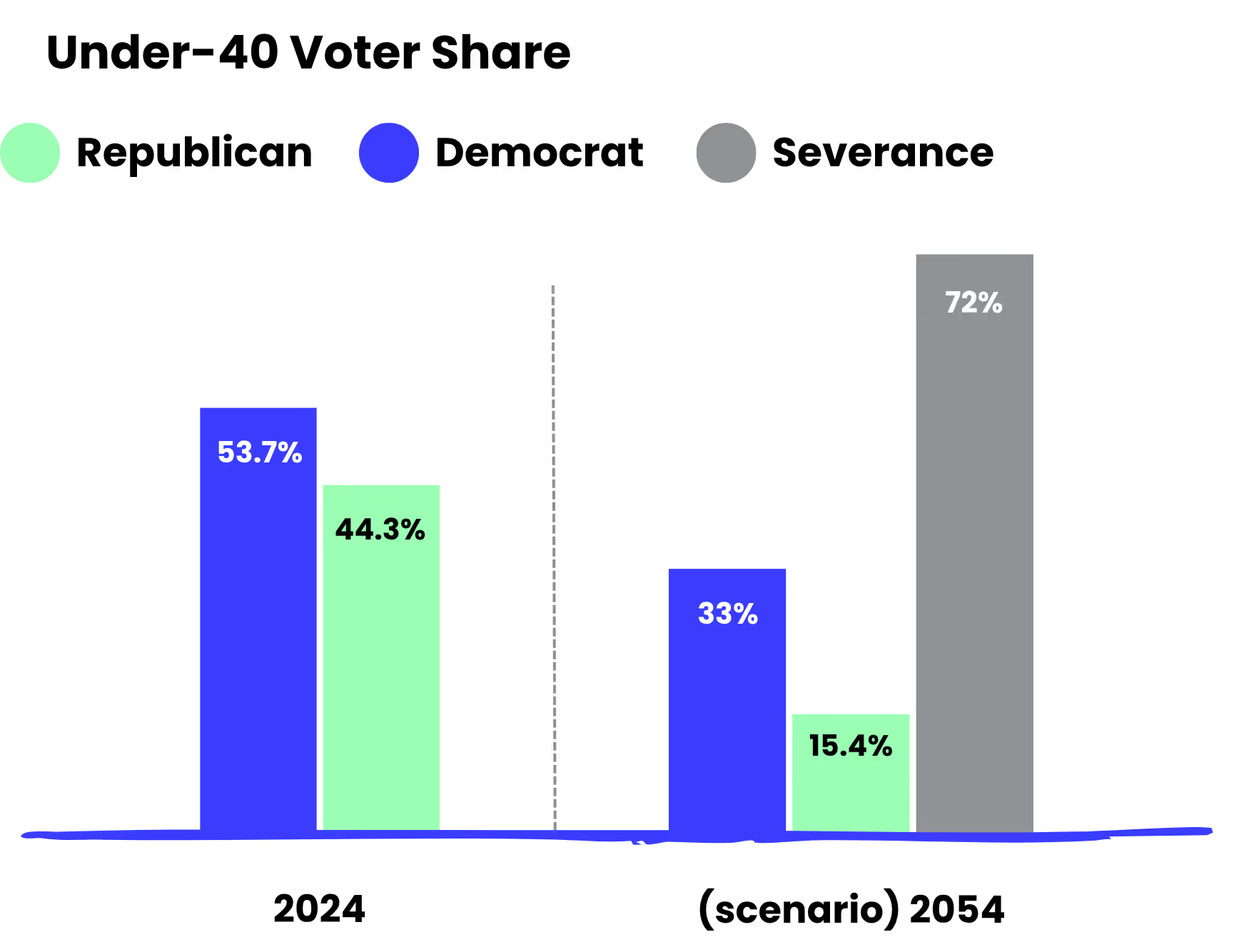
Other notable demographic shifts
From MAGA dominance to the collapse of the far-right base
In 2024, about 35-40% of Republican voters identified as MAGA supporters. In 2054, this fragmented bloc represents less than 5% of voters, having slowly unravelled as a cohesive political force.
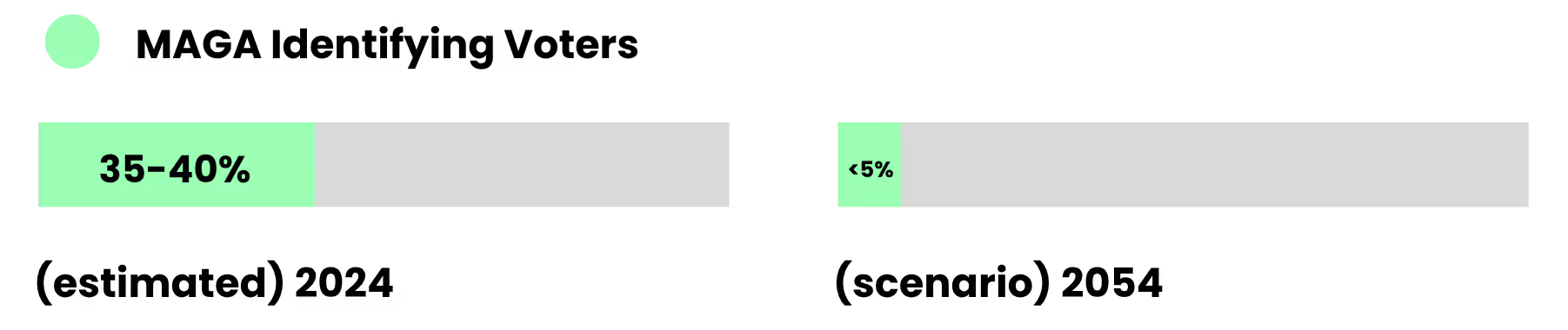
(2024 data sourced from YouGov. 2054 data is a projected hypothetical extrapolating on existing data patterns within this predicted scenario.)
From Christian-majority politics to a forceful spiritual counterculture
In 2024, both party bases were rooted in predominantly Christian traditions, comprising 62% of voters, with Democrats skewing slightly toward non-Christian and unaffiliated voters. In 2054, the Severance Movement attracts a religiously diverse coalition with a significant spiritual counterculture segment not captured in earlier polls: 40% of its base adhere to non-Christian religious traditions, 35% are unaffiliated or part of a spiritual counterculture, and only 25% are progressive Christians.
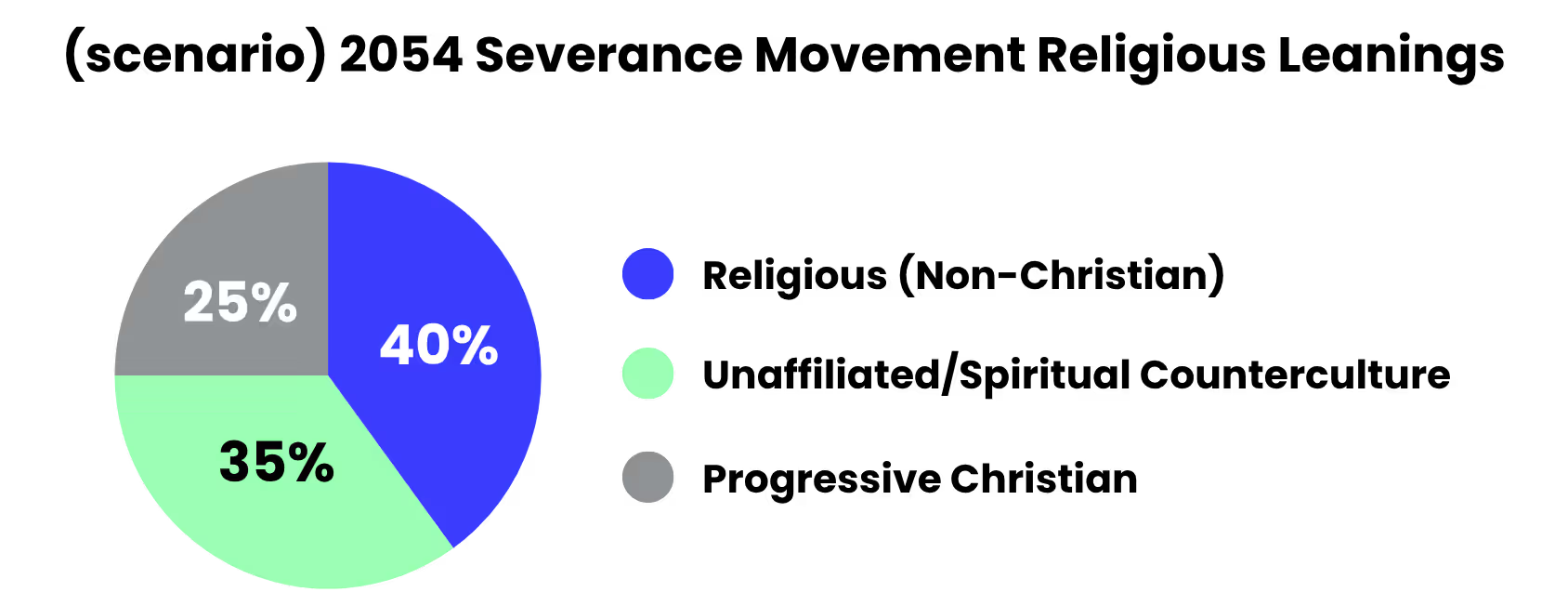
Possible wedge issues
- Fragmented reality and competing systems of truth
- Climate adaptation and regional migration
- Religious and spiritual ideologies, Spiritual pluralism, and religious nationalism
- Economic participation and systemic exhaustion
- Civic rights, identity, and regional belonging
Implications & Recommendations
In this scenario, the US political system evolves into a patchwork of competing regional democracies—some vibrant and participatory, others exclusionary and brittle. To prevent this outcome from hardening into permanent fragmentation, democracy actors must focus now on building connective tissue between regional blocs, investing in pluralist governance systems, and maintaining shared standards for truth, belonging, and representation. To operate effectively in a multi-bloc, regionally variegated system, we would recommend the following for various stakeholders:
- Coalition-builders: Cross-issue strategists, civic intermediaries, and institutional conveners should design modular alliances that reflect the political fluidity of a post-two-party America. In a fractured democracy, it is likely that governance will happen more frequently through regional or issue-based coalitions, which require flexible alliances that are issue-specific, with clear durations, goals, and processes that are resilient to disagreements, since allies will vary issue by issue.
- Narrative strategists and researchers: Tailor messaging and proof points to multiple informational worlds; don’t assume a shared baseline even within the parties. Democracy 2076 and Harmony Labs released a report in January 2025 that highlights the impact of values-based segmentation for effective storytelling around issues of democracy and governance.
- Youth engagement groups: Invest in non-political party forms of belonging (civic guilds, service corps, fandom-style communities) to capture under-40 disillusionment. For example, the Harry Potter Alliance had built a successful fan-based coalition to advocate for issues with broad support for literacy, equality, and human rights over the 19 years of their organization’s history.
- Migration and planning networks: Regional planning agencies, municipal governments and other planning entities should negotiate regional migration compacts and shared-benefit agreements that treat mobility as a realignment challenge as opposed to a logistics challenge. Compacts could outline shared infrastructure responsibilities or environmental resource allocation and access, thus shifting the focus of a regional identity from being determined by borders to one of mobility and co-governance.
- Election reformers: Defend and expand ranked-choice voting, fusion voting, and proportional pilots to sustain pluralist governance. At the moment, several of these innovations are only happening in municipal governments. Scaling these tactics at the state level through campaigns to build public understanding of alternative voter systems could help create the structural conditions for flexible coalition building and voter choice in a democratic system that is not focused on binary opposition.
Rather than a clean red-blue divide, the US resembles a mosaic of clashing jurisdictions, a “fractured democracy” shaped by regional power, ideological silos, and contested truths.
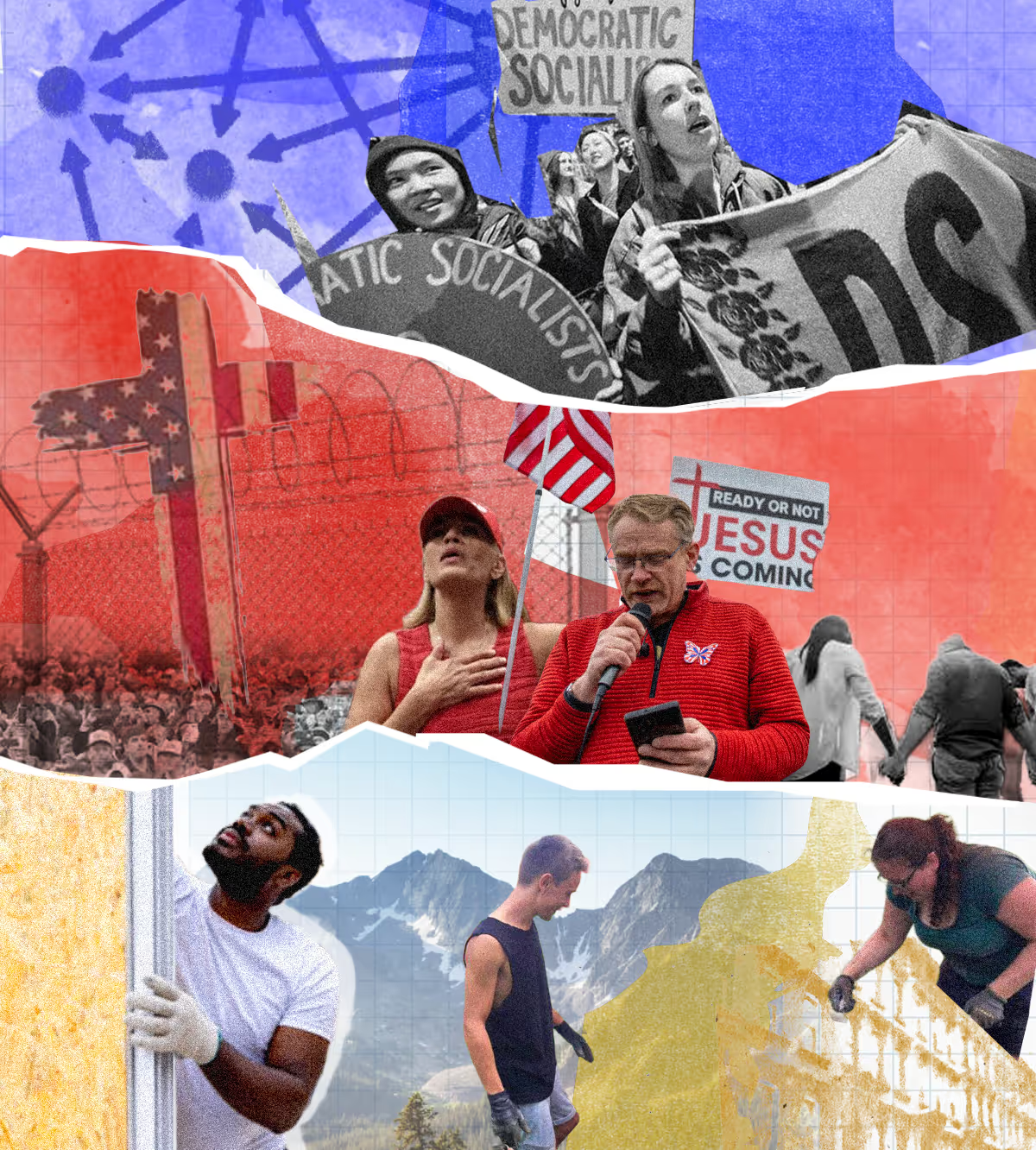
Scenario 5 Signposts
The signposts presented here reflect our best judgment about observable developments that may indicate movement toward this scenario. In many cases, the line between “observable” and “not yet observable” is fluid, as trends fluctuate or appear unevenly across the country. We offer these signposts not as predictions, but as potential markers to monitor over time.
1. The emergence of a three-bloc political system
The conventional left–right political dichotomy is breaking down, and disillusionment with the federal voting system is deepening. Traditionally, the Left was aligned with workers' rights and social equality, while the right championed big business and traditional Christian values. In this scenario, growing numbers of people are weary of these entrenched divides, and any meaningful sense of “centrism” has faded. Feeling politically homeless, they are increasingly open to new alternatives—options that are now more viable through reforms like ranked choice voting and other structural innovations.
Observable
Civic engagement with traditional parties declines
Voter decline seems evident in primary turnout data, and growing numbers of voters identify as independents or unaffiliated—especially younger voters. Indications from Pew, Gallup, and state-level election boards' data seemingly indicate that younger urban voters, the disenfranchised working class, and experimental Gen Z voters are moving beyond the historic two-party system. This could escalate if major demographic blocs—particularly Gen Z and disillusioned working-class voters—begin to advocate for and participate in new forms of political engagement such as third-party experiments or issue-based coalitions that operate outside legacy party structures.
Sharp rise in public discourse rejecting the binary political framework
Social media trends, candidate messaging, and civic surveys show a decline in ideological self-identification as left or right. This could escalate if this post-partisan sentiment gives rise to new political identities, cross-cutting coalitions, or media platforms that explicitly reject the two-axis framework. For example, if the 17 spectra contained in this report begin to replace traditional partisan labels in civic discourse, voter education, or media analysis, it could signal a foundational shift in how political identity is understood and mobilized.
Not Yet Observable
Ranked choice voting, fusion voting, and open primaries adopted in more states and municipalities
While there is growing awareness, ranked-choice voting, fusion voting, and open primaries remain adopted in only a handful of municipalities. There have been high-profile implementations like New York City’s 2021 RCV elections, but no statewide new passages have followed. Seeing at least 5 states move to implement ranked-choice voting, or open primaries, would serve as a strong indication that this signpost is observable.
Third parties or movements gain significant support and electoral wins
Registration numbers, fundraising data, and polling indicate rising popularity in parties and movements explicitly rejecting left–right categorization. This is reflected in the frequent inclusion of third parties in nationally televised debates for presidential elections, further legitimizing them as viable national contenders.
Independent movements formalizing into parties
Successful efforts by independents and movements to transition into formalized parties, as reflected in state party registration filings and ballot access petitions.
The emergence of a three-bloc political system
2. The evolution of grassroots governance models
The federal government’s effectiveness declines, and grassroots democratic governance models emerge through regional pacts. Third parties step into the vacuum to address local needs. Community-defined notions of safety are likely to play an important role in shaping these models, reflecting local values and priorities.
Observable
Delegation of federal governance functions to state, regional, or local entities
Emergency response, infrastructure, or environmental regulation previously held by federal governance structures are delegated downward, trackable by FEMA gaps and rising state-level regulation in the environmental and economic domains. This could escalate if regional compacts and local coalitions become the primary architects of policy implementation—leading to the emergence of semi-autonomous governance ecosystems shaped more by regional capacity than national standards.
Civic engagement with traditional parties declines
Voter decline is evident in primary turnout data, decreasing party membership, and growing numbers of independents or unaffiliated voters. This could escalate if the major parties fail to adapt to generational demands for transparency, flexibility, or participatory structures—this could erode the dominance of the two-party system and shift political energy toward issue-based coalitions or decentralized civic movements.
Not Yet Observable
Community safety reframed through grassroots models
Public messaging and resource allocation indicate community safety as a core purpose, including formal neighborhood militias with legal recognition, municipal policies funding unarmed patrols over police, or entire districts declaring “community protection zones” with alternative justice systems.
The evolution of grassroots governance models
3. Change in flow of financial support
The flow of money is restructured, and major funders withdraw support to the Left as it more openly adopts socialist positions. Financial backing shifts towards either the populist right, still favoring big business, or emerging blocs like the Severance Movement, which advocates equity without directly opposing wealth. Funding decisions become increasingly shaped by the regional dominance of specific parties across different contexts.
Not Yet Observable
Sharp decline in financial contributions to Left-aligned parties
Funding is redirected to either the populist right or economically moderate alternatives such as the Severance Movement.
Strategic realignment of political finance ecosystems
New regional funding coalitions bypass national parties and dominate with names like “Mountain West Funders Bloc” or “Midwest Innovation PAC”. There is also stronger rising activity among digital cooperatives and a reliance on crypto systems or DAO-governed PACs. Traditional party fundraising models start to collapse.
Change in flow of financial support
4. The fragmentation of shared reality
As AI is increasingly viewed as the source of truth, its authority is both contested and politicized. Debates intensify over the quality of AI-generated information and its ability to marginalize individuals and perspectives. This tension deepens divisions across party lines and communities and erodes institutional trust.
Observable
Rapid increase in algorithmic content and AI-mediated realities
Public information systems are shaped by AI as seen in news production, education, and social media feeds. This trend could escalate if AI-generated content replaces legacy institutions—like newspapers, universities, or public media—as the primary source of information for a majority of Americans, diminishing trust in expert-led knowledge and weakening civic literacy.
Growing divergence in trusted information sources across all spheres of society
Shifting beyond the echo chambers between political blocs, there emerges a wholesale fragmentation of societal information itself—from scientific research and education materials to civic knowledge and historical narratives. Competing realities now define what counts as truth, legitimacy, and expertise across the ideological spectrum. Gradually, these divergent views of reality become institutionalised through bloc-aligned bodies such as education boards, research panels, and science authorities. This could escalate if national institutions (e.g., scientific agencies, election boards, accreditation bodies) fracture into partisan or regional versions, eliminating neutral intermediaries and creating incompatible standards for public knowledge.
Not Yet Observable
Expanding regional and demographic digital divides
Marked differences between regional identities and across demographics due to different levels of technology literacy, values, and digital infrastructure access—measured by broadband coverage per region, connectivity costs, digital skills by age, gender and education level, and polls on public trust and confidence in technology.
The fragmentation of shared reality
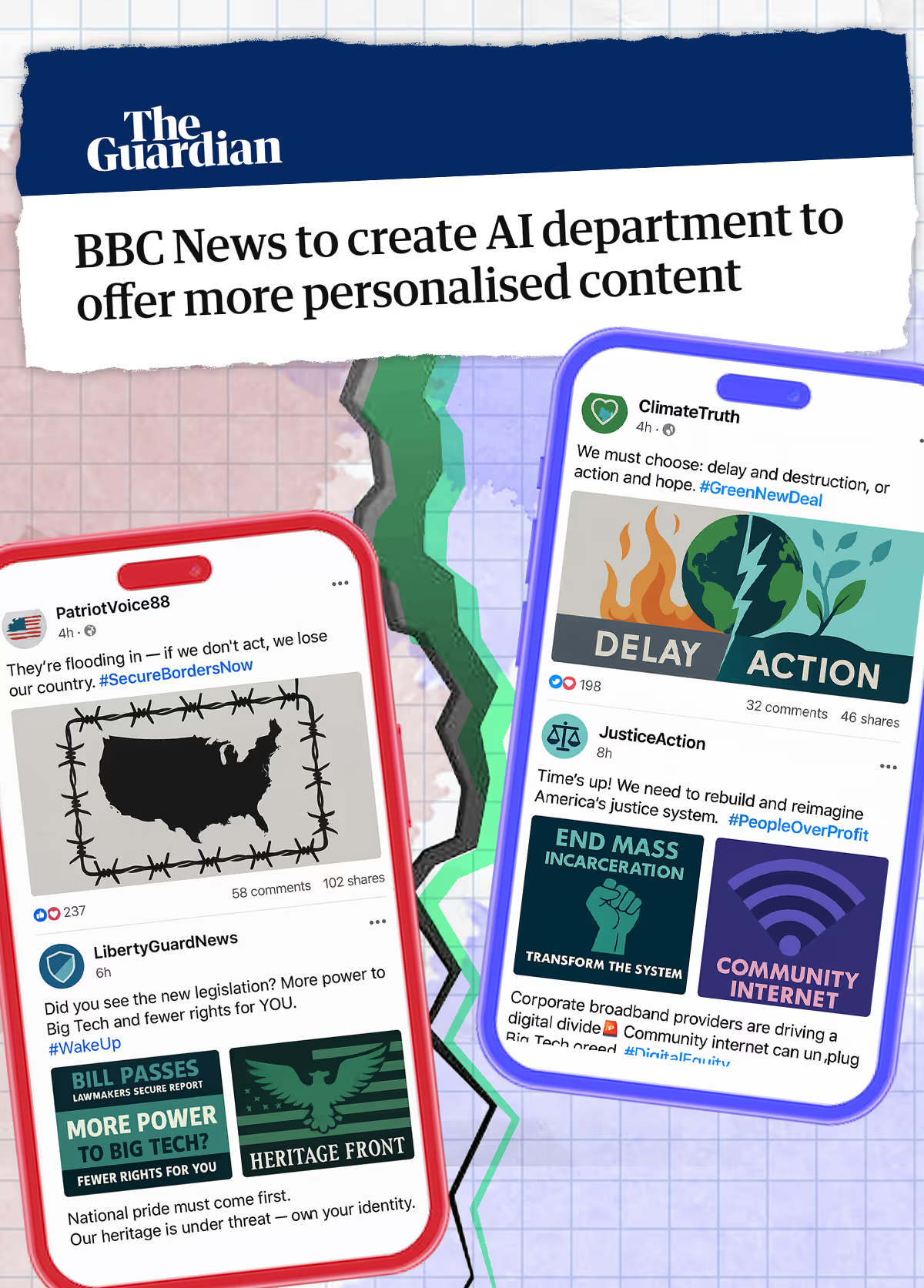
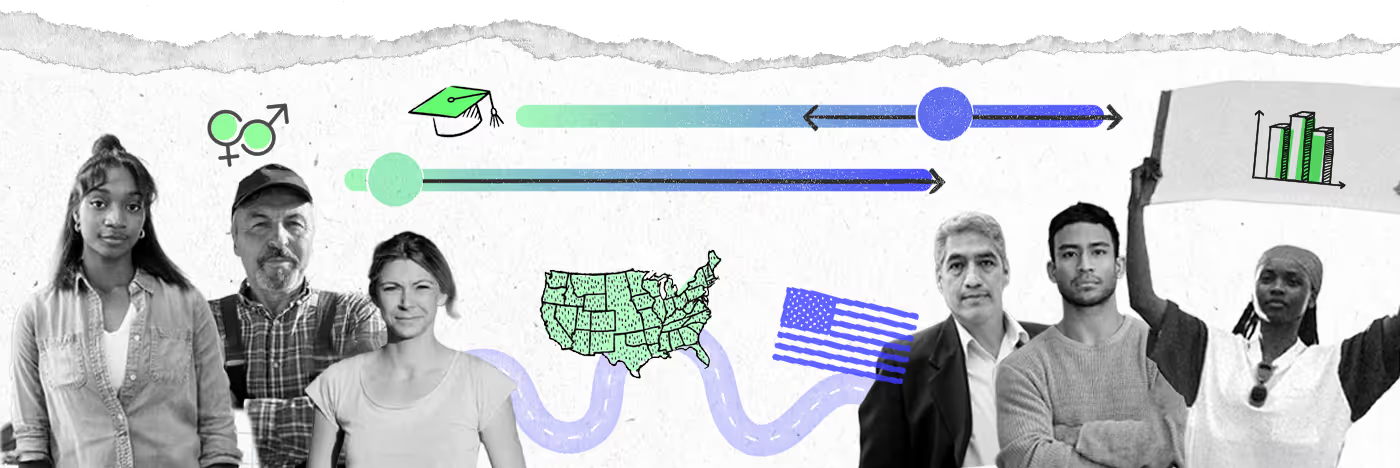
Spectra Analysis
A core goal of Political Coalitions for 2076 is to shape the current political realignment to move us towards a more pro-democracy future. To achieve this mission, we need to understand what political divides may emerge, drive new political alignments, and influence political polarization.
Analysts, commentators, and the general public often only identify new spectra of political divides after they have taken hold. Through a comprehensive synthesis of over 100 research pieces, expert interviews, and surveys across the political spectrum, Democracy 2076 and our partners identified 17 new axes of political polarization that transcend the traditional left-right divide and provide a preview of the divides that could define the American experience in the coming decades.
Our qualitative methodology prioritized diverse knowledge sources—from grassroots perspectives to academic analysis. By drawing on the expertise of our participants, we were able to capture insights from within a variety of communities before those insights could be gleaned in polling or election returns. As a result, we were able to define and refine the spectra based on a range of types of evidence.
These spectra were instrumental in the creation of our five scenarios, and monitoring their progression could provide us with the valuable opportunity to employ interventions to move the national discourse away from authoritarian tendencies and toward a more democratic future.
The 17 spectra serve as a comprehensive framework for understanding the many dimensions of political realignment. These descriptions are intended to be high-level summaries and generalizations of broader, evidence-based trends. While most individuals or organizations tend to focus on a few familiar axes of change, this synthesis offers a fuller map of the field—illuminating where work is already happening and, just as crucially, where it is not. The 17 spectra outlined in this project serve as a comprehensive framework for understanding the many dimensions of political realignment. While most individuals or organizations tend to focus on a few familiar axes of change, this synthesis offers a fuller map of the field—illuminating where work is already happening and, just as crucially, where it is not.
Practitioners, researchers, and organizers can use the spectra to:
- identify blind spots in their own approaches;
- better coordinate with other actors and stakeholders across areas of overlap;
- strategically engage emerging or neglected fronts—whether that’s public health, authoritarian drift on the Left, or the democracy implications of climate inaction;
- inform or serve as foundations for landscape analysis, helping to surface actors who could be brought into the fold or catalyzed into action; or
- establishing a shared set of reference points for a growing community of practice.
Spectra Overview & Organization
The spectra are grouped into six clusters representing key arenas where realignment is occurring:
Demographics & Generations
Political Structures & International Dynamics
In the following sections, each spectrum is presented with:
- Core Dynamic: The underlying shift driving change
- Spectrum: The poles and continuum framing the divide
- Evidence Examples: Data, quotes, and insights from the surveys, interviews, and research
17 emerging spectra of political ideology
Thank you for taking the time to complete our survey. The spectra in this tool reflect political divides that are emerging in American society today. They are not meant to represent fixed ideologies, ideal solutions, or historical truths; rather the emerging divisions we have identified that are shaping how people engage with politics in this moment.
We’ve intentionally presented simplified contrasts to reflect the binary nature of our current two-party system—not because we believe there are only two sides, but to highlight how emerging divides are being framed in public discourse. You may not feel strongly about every issue, or identify fully with either side—and that’s okay. Please select the spectra where you do feel aligned, and feel free to skip those you don't.
When you submit, our tool will send you an email with information about where you align and diverge with others who share your demographics. The AI model used to generate your response will not receive your name or email. We ask for that information solely so you can receive information on how your answers compare with others who filled out the survey. Democracy 2076 will not share this data with anyone.
Identity
Educational Stratification and the Diploma Divide
Core Dynamic
Education level is increasingly replacing income and occupation as the primary predictor of political affiliation, creating new political coalitions organized around educational attainment and associated cultural values. Rather than college experience itself transforming people’s worldviews, evidence suggests that individuals already predisposed toward embracing diversity, openness to new experiences, and questioning established norms are more likely to seek higher education in the first place. Those with more traditional or stability-oriented worldviews might be less inclined toward academic environments. As a result, educational attainment is less of a liberalizing influence and more of a sorting mechanism and a moral and political identity marker.

Beliefs about the systemic role of education in society.

Education as Social Equalizer
This side of the spectrum believes that education helps reduce societal divisions because education gives people the chance to move between social and economic classes. People who hold this view think that strong school systems, easy access, high-quality teaching, and good outcomes can open up opportunities. They also believe that they can lower class barriers instead of upholding them.
Education as Status Reinforcer
This side of the spectrum believes that the education system mostly works to protect and strengthen the social order that already exists. They see things like degrees and diplomas as symbols of status and privilege, not as tools for real upward mobility. The people on this side of the spectrum often believe that the way schools are set up—and the results they produce—end up repeating class and cultural divides. They think this keeps power in the hands of those who already have it.

Identity
Evolving Identity Politics and Coalition Fluidity
Core Dynamic
Traditional racial and identity-based political coalitions are becoming more fluid, with cross-cutting factors creating more complex political alignments. The factors contributing to the erosion of longstanding identity blocs include generational change and social mobility. Policy priorities around economic security and climate change are introducing new bases for alliances, weakening identity-centered politics. Consequently, existing coalitions are becoming more fragmented and reconfigured through shifting combinations of values and emerging concerns.
Belief in the relative importance of identity in political organization.
Identity-Centered Politics
This side of the spectrum believes identity—like race, gender, or background—should be at the center of how people organize politically. They believe that who you are plays a pivotal role in shaping your political views. People who believe this usually put group unity first, even more than specific policies. This can make it hard for different identities to unite.
Issue-Centered Politics
This side of the spectrum believes that political coalitions should be built around policy ideas and real-life needs, not just identity. People on this side believe that groups of voters—no matter their background—should have more political diversity within them. They believe people should come together around shared priorities and everyday concerns.

Identity
Gender Role Evolution
Core Dynamic
Rapid changes in gender norms and roles create new tensions and opportunities. Emerging cultural expectations around gender and growing acceptance of more fluid gender constructs are destabilizing established norms. This widens the gap between progressive and traditional perspectives. New opportunities for inclusion also generate resistance, leading to heightened tension over values. The conflict is driving debates in policy, cultural practices, and institutional approaches to gender.
Beliefs about gender.
Gender Role Traditionalism
People on this side of the spectrum uphold traditional gender roles and celebrate them as core social organizing principles.
Gender Role Fluidity
People on this side of the spectrum understand gender as a flexible social construct with minimal importance to social organization.

Geography & Economics
Geographic Sorting and Place-Based Politics
Core Dynamic
Geographic sorting generates distinct regional political cultures, bypassing traditional partisan alignments.
Geographic sorting is increasingly reshaping regional political cultures, concentrating identity and worldview clusters, and creating distinct regional cultures that may crosscut national divides. Economic mobility, housing affordability, and climate migration may further intensify through local policy choices, especially sharpening differences between urban, suburban, and rural geographies. However, homogeneity is partly countered by remote work and the presence of major employers and educational institutions, preserving geographical areas where diverse perspectives continue to exist. The result is a patchwork of distinct regional political cultures, each developing unique dynamics around polarization or pluralism.
Beliefs about the role of geography in shaping political identity.
Geographic Determinism
This side of the spectrum believes that a person’s political views are most likely to be shaped by where they live. They see communities become politically similar as people move into areas with like-minded people. People on this side expect growing divides between urban, suburban, and rural places. They believe this leaves little room for common ground.
Geographic Pluralism
This side of the spectrum believes that where people live doesn’t fully decide their politics. They believe economic factors, like remote work and climate-related moves, are the reasons why political views stay mixed in many places. They also believe that those factors sustain political diversity within the same communities. People on this side see space for diversity, cooperation, and possibilities for new or third-party alignments.
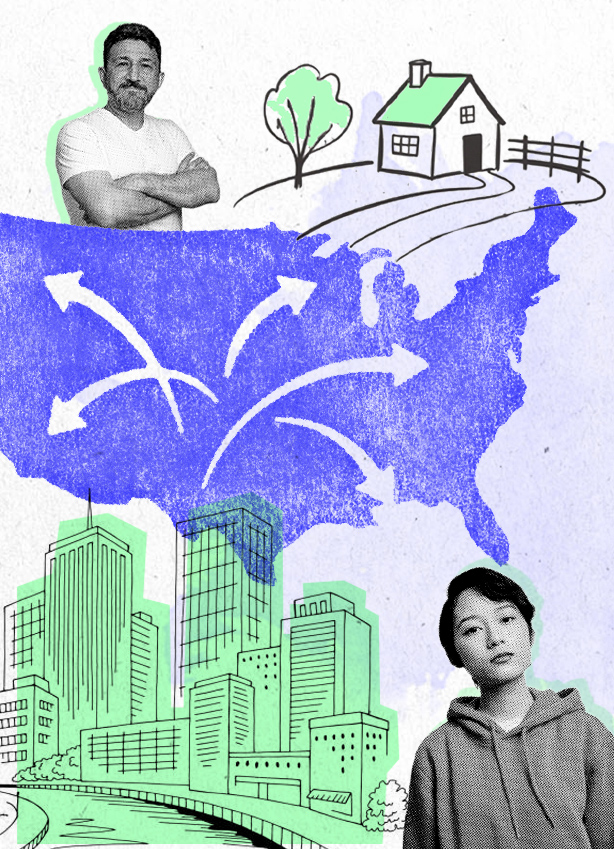
Geography & Economics
Economic Precarity and Material Security
Core Dynamic
Deepening economic insecurity and the visible detachment of political and economic elites from everyday realities are driving political behavior that often does not align with traditional ideological positions. The simultaneous rise of the influence of the billionaire class and widespread financial vulnerability creates complex political responses across social classes, as voters question whether current systems and policies can still deliver fairness and material security.
Beliefs about distribution of economic responsibility.
Individual Responsibility for Economic Security
This side of the spectrum believes that people’s financial success comes from the choices they make and the value they bring to the economy. They believe economic security comes from hard work, independence, and local community support. Additionally, they believe building wealth shows effort and talent. They believe billionaires earned their success by creating new ideas and investing in ways that help society.
Collective Provision of Economic Security
This side of the spectrum thinks unfair systems and limits on opportunity shape people’s financial success. They believe true security comes from strong public systems that meet everyone’s basic needs. People on this side of the spectrum also believe that too much wealth and power in the hands of a few companies can weaken democracy. They think shaping markets early on or changing the sharing of resources after the fact would fix this.

Geography & Economics
Climate Politics and Environmental Realignment
Core Dynamic
Climate change and environmental concerns are creating new political divisions and unexpected alliances that transcend traditional partisan boundaries. As environmental impacts intensify, responses to climate disruption increasingly reveal competing social logics where some prioritize protection, stability, and innovation within existing systems, and others demand structural transformation. As action becomes increasingly necessary, climate politics could increasingly reorganize around competing visions for how society should respond, rather than debates about whether action is necessary.
Beliefs about the correct approaches to climate response.
Adaptation-Focused Climate Politics
This side of the spectrum focuses on how to handle the unavoidable effects of climate change. They support efforts to help communities survive the climate crisis. These may include stronger infrastructure, new technology, and local systems. People with this view want climate policies that safeguard our homes, neighborhoods, and economy from environmental threats.
Transformation-Focused Climate Politics
This side of the spectrum believes we need big changes to fix the root causes of environmental harm. These changes might include changes in how our economy and society work. This side of the spectrum supports climate policy that rethinks how we use energy, grow food, travel, and consume goods. People with this perspective aim for long-term change and cultural shifts. They are willing to face short-term disruptions to reach their goals.
Governance & Authority
Authority Crisis and Democratic Legitimacy
Core Dynamic
Erosion of trust in democracy leads to new forms of legitimacy based on end-goals and effectiveness. As confidence in institutions and formal governance systems declines, citizens increasingly redefine legitimacy around tangible performance when judging authority. The perceived ability to solve problems gains greater weight as a marker for legitimacy, even if results are achieved through unconventional means. The consequence is that standards of legitimacy differ between those who value rules and institutional authority and those who prioritize outcomes above all else.
Beliefs about the sources of political legitimacy.
Process-based Legitimacy
This side of the spectrum believes that political power comes from following trusted rules and systems that have been in place over time. People with this view accept government decisions because they believe in the process—like elections, laws, and democratic norms—even if the outcomes aren’t perfect or take more time. They see rules and institutions as what make a government legitimate.
Results-based Legitimacy
This side of the spectrum believes political power comes from getting real results and solving problems. People on this side think that a government earns trust by improving people’s lives, even if it doesn’t always follow traditional rules. They believe strong performance makes a government legitimate. This is true even if the methods are fast-tracked, unusual, or authoritarian.
Governance & Authority
Technological Governance and Digital Rights
Core Dynamic
Creation of new political divisions around governing technology and protecting digital rights that don't map onto traditional left-right spectra. The perceived benefits of technology for the greater good attract both progressive advocates of innovation and pro-business conservatives. At the same time, the desire for privacy, the risk of powerful actors empowered by technology, and the erosion of individual agency resonate with civil libertarians on the right and equity-focused activists on the Left alike. These cross-cutting dynamics blur the lines, making technology governance a defining arena of emerging political alignments.
Beliefs about digital society governance models.
Tech Optimism
This side of the spectrum believes in using new technology to improve society. They support partnerships between government and business, fewer rules that slow things down, and the use of digital tools in many parts of life. People with this view prioritize innovation and speed. They aim to solve social problems with technology. They also work to stay ahead in global competition.
Tech Sovereignty
This side of the spectrum believes people and communities should have more control over digital technology. They support local ownership, community decision-making, and breaking up big tech companies. People with this view think tech monopolies hurt democracy. So, they push for stronger data privacy, real consent, and the ability for individuals and communities to decide how technology affects their lives.

Governance & Authority
Health, Wellness, and Bodily Autonomy
Core Dynamic
Creation of new political divisions around health, wellness, and bodily autonomy is producing unexpected political coalitions that blur traditional partisan divides. Expanding emphasis on bodily autonomy and personal choice increasingly clashes with collective health imperatives. The tension is heightened during moments of crisis and by rising mistrust of scientific expertise, where demands for personal freedom come up against scientific evidence or public protection. The result is a reshaping of debates over health and health governance that cuts across left-right boundaries.
Beliefs about governance of personal health.
Individual Health Sovereignty
This side of the spectrum believes that each person should make health choices with little outside control or rules from others. People with this view think personal freedom and control over their own bodies matter more than public health goals. They might not trust the medical system. They could follow alternative or natural approaches to health. They believe communities should have limited power to enforce health rules for others.
Collective Health Governance
This side of the spectrum believes that health choices should balance personal choice with the good of the community and input from science. People with this view think it's okay for public health to limit personal choices when those choices affect others. They think families, communities, and public institutions should play a stronger role because health choices can impact more than just one person.

Values
Hierarchical vs. Egalitarian Worldviews
Core Dynamic
A fundamental divide is emerging between those who prioritize ascribed status––based on who you are––and those who emphasize achieved status derived from merit of performance ––based on what you have done. As historical identities and collective group claims regain prominence, they increasingly collide with individualist visions of merit and accomplishment. This tension polarizes politics around whether laws and institutions should preserve social position and group standing, or instead reward personal effort and demonstrated capability.
Beliefs about social hierarchy.
Ascribed status
This side of the spectrum believes that social rank should be based on group identity and historical advantages. People with this view think that roles and opportunities should reflect a person’s background and the status of their group, with a focus on keeping the existing social order in place.
Achieved status
This side of the spectrum believes that social rank should be based on a person’s hard work, skills, and achievements. People with this view think that roles and opportunities should be earned through effort and ability, and that success should be recognized no matter someone’s background.

Values
Moral Intuitions and Moral Reasoning
Core Dynamic
Competing moral logics shape how people engage with public life. While some believe morality is grounded in universal truths—often informed by religious tradition, cultural heritage, or philosophical principles—others see morality as contingent, evolving, and rooted in lived experience. As institutional religion loses cultural dominance and moral authority decentralizes, Americans increasingly draw on personal, cultural, or spiritual sources to interpret right and wrong. This tension plays out in policy debates, political realignments, and the fragility of moral consensus in pluralist governance.
Beliefs about the source and structure of moral authority
Fixed Moral Frameworks
This side of the spectrum believes that we should build society on lasting moral truths. These truths are often shaped by religion, philosophy, or natural law. People with this view see politics as a way to protect clear moral values. They believe that institutions should support a shared ethical code that helps guide public life.
Contextual Moral Reasoning
This side of the spectrum believes people’s sense of right and wrong is shaped by their experiences, identities, and social surroundings. People with this view think there are many valid moral systems, shaped by things like community needs, spiritual beliefs, or practical ethics. They believe political institutions should make space for different values by using flexible rules and respecting personal judgment.

Values
Expressions of Freedom
Core Dynamic
How freedom is understood, exercised, constrained, or instrumentalized creates different types of political alignments. A fundamental divide is emerging between those who view freedom as requiring certain conditions or responsibilities versus those who see liberty as an inherent and basic human right that should face minimal constraints. This tension is amplified by flashpoints such as restrictions during pandemics, speech controversies, and cultural battles, as each side interprets events through its own conception of liberty. The result is growing political divergence over how governments should balance freedom with responsibility,
Beliefs about conceptions of freedom and liberty.
Conditional liberty
This side of the spectrum believes that freedom must be earned by meeting social responsibilities. People with this view think that liberty should work within rules and systems that protect the well-being of the whole community and keep society stable.
Unconditional liberty
This side of the spectrum believes that freedom is a basic right that should always be protected, no matter the situation. People with this view think there should be very few limits on personal choice or on how someone expresses themselves. They place a high value on independence and individual voice.
Demographics & Generations
Generational Value Shifts and Political Consciousness
Core Dynamic
Younger generations show voting patterns and priorities that differ from historical norms, raising questions about deep value shifts and new forms of political consciousness. Facing a set of emerging, interconnected, and systemic crises, ranging from social fragmentation to technological disruption to ecological instability, they are developing new frameworks for understanding the human experience and explaining the world around them. These frameworks are shaped by trauma, mental health awareness, neurodiversity, experiences of identity, and interdependence. Together, these frameworks expand what counts as political consciousness and moral responsibility. The result is a generational divide in priorities and a broader transformation of the worldviews that inform what society prioritizes, and how it views progress, fairness, and well-being.
Beliefs about institutional continuity vs. systemic transformation.
Established worldviews
This side of the spectrum believes that society should be guided by cultural stories, traditions, and identity groups that have been around for a long time.. People with this view think meaning and order come from keeping things steady. They believe we should build on values that have been passed down from earlier generations.
Emergent worldviews
This side of the spectrum thinks younger generations are finding new ways to understand themselves and the world around them. These views are shaped by growing awareness of mental health, different ways of thinking, trauma, and how people are connected across the globe. People with this view support ideas that are more open and flexible. They also question older ideas about how society should stay the same and who gets to be in charge.

Demographics & Generations
Shifting Foundations of Information, Truth, and Meaning
Core Dynamic
Diverging responses to how facts are defined, verified, and either accepted or rejected, and how this helps shape people’s social and political and generational realities. The tension is evident in the emergence of new, parallel systems of truth, enabled by digital media, the commercial algorithms of social networks, and anchored in alternative forms of authority, ranging from tightly knit online communities to influential public figures. The result is a gradual displacement of traditional institutions of verification, producing a rift between those seeking common standards of evidence and those embracing plural or fragmented understandings of truth. This dynamic is now reorganizing identities and political alignments around competing truths.
Beliefs about the nature of truth.
Shared truth
This side of the spectrum believes that facts should be based on clear rules for evidence and proof. People with this view think trusted institutions, science, and careful methods are needed to decide what counts as reliable knowledge and what’s real.
Fragmented truths
This side of the spectrum believes that different groups and viewpoints can have their own valid ways of understanding the world. People with this view think that how we see truth depends on context, and that it’s okay—sometimes even better—if there isn’t just one shared version of reality.

Political Structures & International Dynamics
Political Restructuring and Two-Party System Evolution
Core Dynamic
The two-party system itself is under strain, generating potential for structural changes to how political competition is organized. Tension arises as a diverse electorate—with varied identities, values, and worldviews, and, in particular, younger generations—feels poorly represented by existing parties. Declining trust in institutions, widespread dissatisfaction with a binary choice, increased emotional distance between citizens and parties, and broader cultural fragmentation place additional strain on the two-party system. The result is growing demand for more diverse political competition that may align around emerging issues or interests.
Beliefs about political structuring
Two-party system
People on this side of the spectrum believe politics should be organized around two main parties. People with this view think this system allows for big, flexible coalitions. They also think it helps keep things stable. They believe that elections function best when the winner takes all. They believe government, media, and funding should flow mainly through these well-known party structures.
Multi-party or coalitional party system
This side of the spectrum believes the political system should include more parties. These parties would reflect different beliefs, interests, or single issues. People with this view support changes like ranked-choice voting or proportional representation. They believe this would better match how voters are thinking and feeling today. They believe the government should work through flexible coalitions, and that people should be able to take part in politics both inside and outside of political parties.
Political Structures & International Dynamics
Institutional Legitimacy and Purpose
Core Dynamic
Institutions are reshaped, contested, or dismantled based on competing political visions of how power should be embodied, structured, and sustained. Repeated government failures, institutional inertia in the face of technological and social change, unmet expectations, and an overall decline in institutional trust have created a tension between those who seek to reform or reinvent institutions to better serve contemporary needs and those who see existing structures as irredeemably flawed, calling for outright dismantling. The result is increased uncertainty over the future of institutions, perceived legitimacy, civic relevance, and their purpose.
Beliefs about institutional structuring.
Institution reimagining
This side of the spectrum believes that our current institutions need major changes to meet today’s needs and values. People with this view think we can keep the basic structure of institutions, but change how they work, who holds power, and how decisions are made. They believe trust can be rebuilt by making institutions more flexible, responsive to technology, and focused on real results—not just sticking to old rules.
Institution dismantling
This side of the spectrum believes that today’s institutions are too broken or corrupt to fix and should be taken down or left to fall apart. People with this view think real legitimacy comes from starting fresh—either by creating new systems from the ground up or by reducing the role of institutions in society altogether.
Political Structures & International Dynamics
International Engagement and Foreign Policy Realignment
Core Dynamic
Traditional foreign policy coalitions are fracturing under domestic and emotional pressures, as attitudes toward international engagement, interventionism, and global affairs create new political alignments. The lived experiences of economic anxiety and rising inequality linked to globalization, cultural displacement, and perceived migration pressures have transitioned foreign policy from being anchored in bipartisan consensus to becoming more contested in domestic politics. The result is a rising tension between those who see interdependence and shared responsibility as essential for security and economic prosperity, and those who view international entanglements as weakening sovereignty and a distraction from urgent needs at home.
Beliefs about global engagement.
Globalist / Internationalist
This side of the spectrum believes that the US should lead by working with other countries and staying active in global partnerships. People with this view think open trade, strong alliances, and shared decision-making are key to solving big problems like climate change or conflict. They see the US as playing a leading role in keeping the world stable by supporting international cooperation.
Nationalist / Isolationist
This side of the spectrum believes that the US should be less involved in global affairs and focus more on issues at home. People with this view support pulling back from international commitments, building up self-reliance, and bringing jobs and resources back to the country. They think national security should focus on strong borders. They believe in limited involvement overseas. They believe domestic needs should take priority over global ones.
Conclusion
Learnings and Recommendations
The Implications of Issue Prominence
Throughout this process, we better understand the dynamic of an issue becoming prominent in a political system and then consequently becoming divisive. Take the issue of democracy, for example. What used to be considered a relatively nonpartisan, noncontroversial topic—support for strengthening and improving American democratic systems—has become significantly more polarized in the past decade. We hypothesize that, in some ways, it is because of the increasingly overt discussion and movements around this particular issue that contributed to its polarization. In various scenarios with which participants interacted, where both parties are pro-democracy, the continuation of democratic institutions is not a significant political issue. Similarly, in scenarios where both parties are multi-racial and not defined by race or racism, race is not a divisive political issue.
There is, of course, a double-edged sword to all of this. To effectively organize––gathering resources, raising consciousness, and generating impact––around political issues, those issues need to be discussed. This is not, therefore, a recommendation to organizers and activists to stop bringing attention to important and occasionally divisive political issues. Rather, it is an observation of a pattern that occurred throughout our research of how bringing attention to a particular issue will activate both potential allies and opponents.
Importance of Emphasizing Protopian Stories
At the end of the scenario-generating process, participants reflected that they wished we had more scenarios where both parties are pro-democracy. They were naming a hunger for more pathways to pro-democracy futures and the need to cultivate their imagination for those stories.
Participants recognized that the scenarios were developed based on the scans that our participants had given us. The process of co-creation meant that the scenarios were only going to be as protopian—a term for a society that makes incremental, ongoing progress and improvements, rather than aiming for a perfect, utopian state or falling into a dysfunctional, dystopian one—as the scans they submitted indicated. At the end of the process, participants reflected that they wished they had been more focused on surfacing the positive signs that they are seeing in the world.
This realization shows that even after designing a process that was neutral as to the types of scans about the future, participants were still constrained by their own negativity bias and needed more active guidance and support to pay attention to positive signals of change. Additionally, this challenge reveals just how strong the dystopian democracy narrative is in our culture. We have also seen this dynamic reflected in our research into media depictions of future democracies: only 8% of stories about democracy in film and TV are about the future, and only half depict healthy democracies. We’d encourage storytellers to consider how to tell more stories about the future with vastly different imaginations for how our politics could look. Additionally, in future iterations of this project, we want to more deliberately cultivate stories about preferred pro-democracy futures, potentially building out multiple scenarios with a variety of outcomes.
Developing Clarity on Left-Wing Authoritarianism
Current knowledge, advocacy, and resources within the democracy movement are focused primarily on countering authoritarianism from the political right—in response to the reality that current authoritarian behaviors and trends are concentrated on the political right. However, we know from historic trends that authoritarianism does not stay confined to one political party or side of the political spectrum when it takes hold within social, political, and cultural systems. Preparing to better mitigate the authoritarian trend in the long term will require understanding how democratic institutions can be undermined from multiple political directions.
The political Left must develop clear frameworks for distinguishing between policy preference disagreements and fundamental disagreements about democratic governance itself. This might include internal mechanisms to evaluate whether organizational tactics, public statements, and advocacy strategies advance democratic values or inadvertently adopt authoritarian approaches. Using hypothetical scenarios of Left-wing authoritarianism—like the ones laid out in this report—in pro-democracy education and strategic planning can demonstrate that defending democracy is genuinely nonpartisan by showing how any political preference can be implemented in ways that either strengthen or undermine democratic institutions.
The goal is not to create false equivalencies, but to ensure that defense of democracy remains principled and consistent regardless of from which political direction authoritarian threats emerge. This also means recognizing that defending democratic institutions may require working with those who hold different policy preferences but share a commitment to democratic governance.
Understanding Emerging Axes of Political Division and Alignment
This first phase of our project emphasizes the ways in which current political alignments and divisions are proving insufficient for understanding those we are seeing today and predicting the ones to come. Organizations and leaders across sectors should recognize that attitudes on one issue no longer reliably predict positions on another, creating both challenges and opportunities for strategic engagement.
For Researchers and Polling Organizations: Consider incorporating the 17 emerging axes of political division into polling methodologies and weighting systems. Just as researchers and pollsters began weighting for education to improve polling accuracy after the 2016 election, these new dimensions may be crucial for representative sampling and predictive modeling.
For Issue-Based Organizations: Interrogate assumptions about political alignment based on traditional party affiliation. Someone's position on one issue cannot reliably predict their stance on others. This will likely require more nuanced coalition-building strategies and careful attention to mission focus. These new alignments highlight emerging potential allies who agree on your core issue but diverge on others, and engaging them will require care and clarity.
For Bridge-Building and Peace-Building Efforts: Leverage these new political spectra to create unexpected coalitions. For example, facilitating dialogue between public health advocates or between individual health sovereignty supporters may reveal shared values and common ground that transcends traditional left-right divisions and allow for a focus on common ground before discussing areas of disagreement. Focusing on emerging wedge issues where people have less entrenched identity attachments may create space for more productive conversation.
Impact on Participants
The strategic foresight process also catalyzed a significant shift in how participants approached long-term pro-democracy work. Despite many participants reporting aspirations to think in generational terms, many acknowledged struggling to practice this amidst the realities of election-cycle pressures and the constant reactive mode of the larger sector. This was reflected in participants’ scoring an average of 2.15 out of 4 in response to the question, “What is your confidence in pro-democracy actors to respond to economic, political, environmental, cultural, and technological change over the next 30-50 years?” By the process's conclusion, these figures reversed dramatically: participants reported a 30% increase in their confidence that pro-democracy actors will respond to economic, political, environmental, cultural, and technological change over the next 30-50 years while demonstrating expanded capacity for scenario thinking, gaining practical tools for navigating uncertainty and planning iteratively rather than reactively. They described gaining practical tools for navigating uncertainty, scanning for emerging signals, and planning iteratively rather than reactively.
Beyond individual mindset shifts, participants reframed their understanding of coalition work itself—moving from crisis-driven responses to proactive, visionary strategies that bridge ideological divides and center intergenerational responsibilities. Many emphasized newfound agency in shaping possible futures rather than passively awaiting outcomes. The process equipped them not just to acknowledge foresight's importance but to actively practice it, encouraging them to integrate scenario planning into their organizational strategies. Participants described becoming more intentional about bringing a plurality of perspectives into their strategies, both to surface opportunities for impact earlier and to identify potential blind spots. This mindset shift extended to their understanding of pro-democracy coalitions themselves. Many framed their evolution throughout our time together as moving from reactive to proactive, no longer waiting for crises to dictate priorities. They described how this type of planning and thinking opened up space for imagining what coalition work could look like. When asked how this process changed their views about pro-democracy political coalitions in the future, one participant said, “Democracy is a human enterprise. I am more interested in working with individuals who value human beings and will seek ways for them to flourish—regardless of ideology and identity politics.”
These outcomes suggest that the strategic foresight process itself—not merely the spectra, scenarios, and signposts it produced—served as a powerful catalyst for building the adaptive capacity essential to imagine, test, and co-create more democratic futures.
What's Next
As Democracy 2076 turns to the next phase of our work, we will build on this report in the following ways:
1. Map networks and ecosystems
We will identify the networks, influencers, and online ecosystems shaping discourse along each spectrum. By understanding where cross-pollination and overlap occur, we can better anticipate where interventions will have the most leverage and design targeted approaches to shift narratives.
2. Catalyze interventions where they are not happening
Using our network mapping, we will map and bridge intervention gaps across the field. Through the landscaping of organizations, interventions, and online ecosystems, we will identify where resources or expertise are missing and connect communities to intervention innovators with proven models. This work will support the development of a community of practice, enabling more actors to collaborate across issues and geographies. Over time, these ongoing assessments will allow us to provide expert-driven recommendations tailored to specific actors in the pro-democracy ecosystem, ensuring that opportunities are seized and risks are mitigated in real time.
3. Track shifts in signposts and revise scenarios
To ensure continued relevance in a rapidly evolving political environment, we will track shifts in our signposts and update our scenarios regularly. This will enable timely responses to emerging risks and opportunities and help inform partners when rapid coordination or new interventions are needed.
4. Validate the 17 spectra with quantitative research
Using survey data and other quantitative tools, we plan to test our 17 spectra to determine where existing population demographics fall along these new ideological lines. This work will test, validate, and strengthen the framework so it remains a relevant and reliable tool for political analysis. By embedding the spectra into survey design, mapping exercises, and coalition strategy, we aim to equip researchers, journalists, organizers, and policymakers with sharper tools for understanding and shaping realignment dynamics.
5. Create more preferred future scenarios
In response to feedback from participants, we will be working to co-create a set of pro-democracy preferred future scenarios. Our current scenario work has been useful in helping participants clearly identify what desirable outcomes are. We will build a cohort to collaborate on these preferred future scenarios that will encourage the development of strategic planning, interventions, and coalition building focused on ensuring the prevalence of one of these preferred futures, to anchor collaborators in pathways that are both aspirational and actionable. These efforts will be intentionally oriented toward identifying preferred futures to strive for, while also monitoring early signs of dystopian drift that require urgent intervention. The identification of preferred futures as a next step is a step towards building durable change. We believe that working towards a preferred future as opposed to working to prevent a possible, less desired one will lend itself to the mission of forming trans-partisan, pro-democracy coalitions.
Methodology
Introduction
The foresight methods used in this project were selected to explore the future of political realignment in the United States and identify possible pathways toward a future where all US parties are pro-democracy.
Beyond the typical benefits of strategic foresight, the project’s most innovative contribution was its recognition that the expertise of communities identifying early signals of change through conversations should be valued just as highly as written and academic analysis of political shifts. The equal weighting of lived experience and formal research is what makes this project innovative within our sector.
The project followed a classic foresight arc: moving from the probable future to possible futures, with the ultimate intention that future users of the scenarios will use them to explore a preferred future. It began by assessing the current context and its underlying systems, then examined key shifts and emerging changes to explore alternative futures. Finally, it considered what these futures imply for the present—and how we might better prepare for or shape the future.
Horizon 2045 were the foresight experts who supported phase 1 and most of phase 2. The School of International Futures (SOIF) provided foresight expertise for phase 2, starting with the third sensemaking session, phase 3, and phase 4.
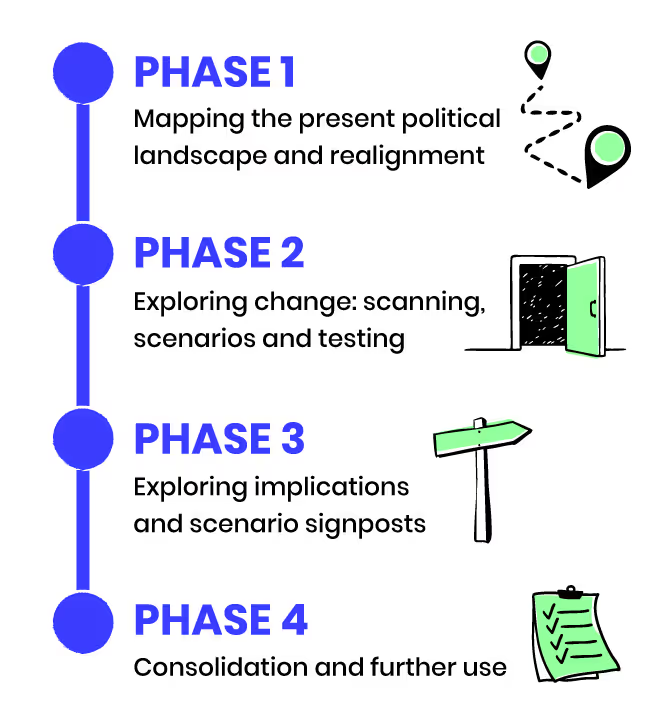
Phase 1 - Mapping the present political landscape and realignment
Research Summary and Key Insights
An additional research summary, drawing on published literature including ten books and over 100 articles, described current political alignments, prominent ideological frameworks, and key wedge issues.
Emerging Axes of Political Division: A Framework for Spectra
The final product of this phase was the Emerging Axes of Political Division, which identified six key clusters where US society may align or fracture: Identity, Geography and Economics, Governance and Authority, Values, Demographics and Generations, and Political Structures and International Dynamics.
Each of these axes contains underlying polarity elements, understood as spectra or continua: for example, the spectrum between global/internationalist and nationalist/isolationist within the Political Structures and International Dynamics cluster. The result is 17 spectra along which political alignment may occur, not just at the poles but across the full range. These spectra form a framework to better understand current and future patterns of political alignment in US politics. Notably, they often do not map onto the current left-right axis—individuals and groups from both sides of the political continuum may be found at either end of a given spectrum.
Additional feedback was gathered from peacebuilders who work in the US and abroad and researchers, including people who lead advocacy centers and think tanks on both sides of the left-right divide. This input was collected through a small group gathering at a conference and via email.

Phase 2 - Exploring change: scanning, scenarios, and testing
Horizon Scanning and Workshop 1
Horizon scanning examines current and future changes in the external environment, including those not yet widely visible. It surfaces weak signals (early signs of emerging change that may indicate future disruption), challenges assumptions, and builds shared understanding of possible future change across diverse perspectives.
A group of 13 community leaders—12 of whom also submitted Delphi surveys—and foresight experts contributed to a collaborative scanning process that supplemented existing research. Scans explored potential drivers of political realignment, including demographic shifts, economic transformation, technological disruption, and cultural evolution. Participants submitted 120 scans, linking them to the spectra to test and refine the framework. This phase concluded with Sensemaking Workshop 1, where outputs were reviewed and clarified.
The Scenario Development
This group then pivoted to an intentional, collaborative effort to develop and refine five scenarios of the future. The output from the previous research informed the scenario-building process.
Two sets of scenarios were initially developed using different foresight approaches. As highlighted in the literature, different methods produce different types of futures, and combining them significantly enriches the quality and depth of foresight work. Drawing on the Spectrum of Scenario Methods, both approaches were intuitive in nature, but one was more values-based and inductive, while the other was more structured and deductive. These sets were later integrated into a single, cohesive set of five scenarios. This integration of deductive and inductive approaches allowed for a richer and more balanced scenario set, anchoring creativity in logic and structure.
Developing values-based, inductive scenarios
One set was built using the 17 spectra from the research, with each scenario written in three paragraphs to reflect future value shifts as indicated by the spectra, mapping the overall context very broadly.
A review ensured the scenarios also accounted for variations in democratic support and key wedge issues.
Developing structured, deductive scenarios
Another set of scenarios was developed using a structured approach based on different combinations of party “archetypes,” for instance, where both parties were pro-democracy, both authoritarian, or other variations. These scenarios included key wedge issues, underlying ideologies, support for democracy, and the demographics likely to form coalitions.
Two additional constraints were introduced: first, the US must remain a single federal country, meaning all regional governance would occur within that constraint; second, no Constitutional amendments should be necessary for any scenario to remain plausible.
The resulting high-level outlines were further refined using ChatGPT. A first iteration prompted the 17 spectra to clarify the scenarios. A second iteration made use of the Delphi results, interviews, scanning data, and Workshop 1 outputs to improve them further. ChatGPT was also prompted to provide evidence from the project data and flag any points lacking data support or contradicting evidence.
This process produced eight scenarios, which were refined into five distinct ones based on different democratic alignment between parties. Each was described in three to four paragraphs, addressing party ideologies, systemic changes, unexpected coalitions, wedge issues, spectra positions, demographics, and supporting or contradictory evidence.
All use of ChatGPT was carefully overseen to ensure accuracy, with the team verifying cited data and preventing fabrication.
Integrating the scenario sets and validation
Both scenario sets were reviewed in detail and incorporated any missing themes from the research. The two sets were then integrated into a final set of five scenarios, each about seven to eight paragraphs in length. This new set was reviewed again, refined for coherence, and improved where needed.
Scenario testing through expert and community reviews
After development, the scenarios were reviewed through several community and expert feedback loops:
Sensemaking Workshop 2: Scanning participants reviewed and suggested updates based on their initial scanning and conversations during the workshop
New Pluralists Community of Practice: Scenarios were tested for coherence with the political diversity working group.
Stakeholder briefing: External stakeholders recommended structural and language updates based on generally accepted scenario criteria: that they are future-oriented, credible, coherent as a set, yet distinctly different from one another.
Sensemaking Workshop 3: Additional underrepresented themes were identified, prompting focused scanning. Participants submitted scanning inputs beforehand, which were then discussed during the workshop, with attention to their implications for democracy.
The set of scenarios was updated, incorporating feedback from the above engagements.

Phase 3 - Exploring implications and scenario signposts
This phase identified the key implications of each scenario and mapped signposts—early indicators that a given scenario or some of its elements might be unfolding.
Sensemaking Workshop 4 and signposting
Participants identified the most critical shifts and enabling factors for each scenario, which were then translated into clear signposts and measurable variables to monitor over time.
Implications
Workshop participants briefly discussed the most significant implications for their communities and suggested a small list of possible responses. While not an immediate project focus, this set the stage for future action.
Scenario and spectra revisions and additions
Final scenario updates incorporated the signposts and implications from Workshop 4. The 17 spectra were also reviewed and revised where necessary, based on process outputs.

Phase 4 - Consolidation and further use
Translation into a report and other usable formats
The scenarios, spectra, signposts, and supporting data were translated into this report, designed to support workshops around scenario exploration, future planning, and decision making.
This resource is intended for leaders, bridge-building and pluralism-focused organizations, funders mapping the field, and secondary audiences.

Appendix
Full list of background sources
Books
Levitsky, S., & Ziblatt, D. (2019). How Democracies Die. Broadway Books, an imprint of Crown Publishing, a division of Penguin Random House.
Sides, J., Tesler, M., & Vavreck, L. (2019). Identity Crisis: The 2016 Presidential Campaign and the Battle for the Meaning of America. Princeton University Press.
Gest, Justin (2022). Majority Minority. Oxford University Press.
Kaplan, Seth D. (2023). Fragile Neighborhoods: Repairing American Society, One ZIP Code at a Time. Hachette Book Group.
Ruffini, Patrick (2023). Party of the People: Inside the Multiracial Populist Coalition Remaking the GOP. Simon & Schuster.
Grossmann, M., & Hopkins, D. A. (2024). Polarized By Degrees. Cambridge University Press.
Madrid, M., & Bretón, M. (2024). The Latino Century: How America’s Largest Minority is Transforming Democracy. Simon & Schuster.
O’Brian, Neil A. (2024). The Roots of Polarization: From the Racial Realignment to the Culture Wars. The University of Chicago Press.
Ramos, Paola (2024). Defectors: The Rise of the Latino Far Right and What it Means for America. Knopf Doubleday Publishing Group.
Traldi, Oliver (2024). Political Beliefs: A Philosophical Introduction. Taylor & Francis.
Podcasts
The Larger Us Podcast. Episode— Why Some People are Primed to be Authoritarians - with Karen Stenner.
https://podcasts.apple.com/us/podcast/why-some-people-are-primed-to-be-authoritarians-with/id1573552765?i=1000526591478
Next City. Episode— Repairing Democracy Beyond the Ballot Box.
https://nextcity.org/podcast/repairing-democracy-beyond-the-ballot-box
The Realignment.
https://podcasts.apple.com/us/podcast/the-realignment/id1474687988
Weblinks
American Enterprise Institute. Could It Be 2016 All Over Again?
https://www.aei.org/articles/could-it-be-2016-all-over-again/
American Enterprise Institute. Defund the Police Cost Democrats Hispanic and Black Votes.
https://www.aei.org/op-eds/defund-the-police-cost-democrats-hispanic-and-black-votes/
The American Prospect. “Did We Just See Electoral Realignment?” November 7, 2024.
https://prospect.org/blogs-and-newsletters/tap/2024-11-07-did-we-just-see-electoral-realignment/
APA PsycNet. Left-Wing Authoritarianism Is Not a Myth.
https://psycnet.apa.org/record/2022-09577-002
The Association for Manufacturing Technology. The World Shifts to a New Economic Paradigm: Productivism.
https://www.amtonline.org/article/the-world-shifts-to-a-new-economic-paradigm-productivism
The Atlantic. American Loneliness and Personality Politics. February 2025.
https://www.theatlantic.com/magazine/archive/2025/02/american-loneliness-personality-politics/681091/
The Atlantic. The Anti-Social Century.
https://www.theatlantic.com/magazine/archive/2025/02/american-loneliness-personality-politics/681091/?gift=krNuYGPGH5LuhGSoB0bEhpPrv4tcllEGKLmgMMnZOR8&utm_source=copy-link&utm_medium=social&utm_campaign=share
The Atlantic. Throw More Parties: Rebuilding Connection in a Lonely Nation. January 2025.
https://www.theatlantic.com/family/archive/2025/01/throw-more-parties-loneliness/681203/
The Atlantic. “Why Are Americans So Geographically Polarized?” November 2018.
https://www.theatlantic.com/ideas/archive/2018/11/why-are-americans-so-geographically-polarized/575881/
Axios. Younger voters declare independence.
https://www.axios.com/2023/01/15/voters-declare-independence-political-parties
Beyond Conflict. America’s Divided Mind.
https://beyondconflictint.org/americas-divided-mind/
Bipartisan Policy Center. Exploring the Affordable Housing Shortage and Its Impact on American Workers. March 2024.
https://bipartisanpolicy.org/download/?file=%2Fwp-content%2Fuploads%2F2024%2F03%2FExploring-the-Aff-Housing-Shortage-Impact-on-American-Workers-Jobs-and-the-Economy_BPC-3.2024.pdf
Bureau of Labor Statistics. 61.4% of Recent High School Graduates Enrolled in College in October 2023.
https://www.bls.gov/opub/ted/2024/61-4-percent-of-recent-high-school-graduates-enrolled-in-college-in-october-2023.htm
Business Insider. How to Get a Job Without a College Degree at Big Companies Like Amazon, Intel & IBM.
https://www.businessinsider.com/how-to-get-job-without-college-degree-amazon-intel-ibm-2024-3#:~:text=Eight%20major%20companies%20talked%20to,you%20didn't%20graduate%20college
Business Insider. Rent in Sun Belt Cities is Falling After Building Lots of Housing.
https://www.businessinsider.com/rents-falling-southern-sunbelt-cities-building-apartments-housing-2024-12
Carnegie Endowment for International Peace. Polarization, Democracy, and Political Violence in the United States. September 2023.
https://carnegieendowment.org/research/2023/09/polarization-democracy-and-political-violence-in-the-united-states-what-the-research-says
Carnegie Endowment for International Peace. Understanding and Responding to Global Democratic Backsliding.
https://carnegieendowment.org/research/2022/10/understanding-and-responding-to-global-democratic-backsliding?lang=en
CAWP (Rutgers University). Gender Differences in the 2024 Presidential Vote.
https://cawp.rutgers.edu/blog/gender-differences-2024-presidential-vote
CCN. Big Tech Market Dominance Reached 25% in 2024.
https://www.ccn.com/news/big-tech-market-dominance-reached-25-in-2024/
The Center for Politics. The “Big Sort” Continues, with Trump as a Driving Force.
https://centerforpolitics.org/crystalball/the-big-sort-continues-with-trump-as-a-driving-force/
Cipher News. At two years, GOP states benefit the most from climate law.
https://www.ciphernews.com/articles/at-two-years-gop-states-benefit-the-most-from-climate-law/
Cisneros Center (George Washington University). Spanish-Speaking Latinos Are More Prone to Misinformation Exposure.
https://cisneros.columbian.gwu.edu/spanish-speaking-latinos-are-more-prone-misinformation-exposure
Clean Technica. Two Years In, The IRA Has Benefitted GOP Districts & Red States The Most.
https://cleantechnica.com/2024/08/14/two-years-in-the-ira-has-benefitted-gop-districts-red-states-the-most/
The Conversation. In 2024, independent voters grew their share of the vote, split their tickets and expanded their influence.
https://theconversation.com/in-2024-independent-voters-grew-their-share-of-the-vote-split-their-tickets-and-expanded-their-influence-245125
The Conversation. Populism can degrade democracy but is on the rise − here’s what causes this political movement and how it can be weakened.
https://theconversation.com/populism-can-degrade-democracy-but-is-on-the-rise-heres-what-causes-this-political-movement-and-how-it-can-be-weakened-222323
Deloitte. United States Economic Forecast.
https://www.deloitte.com/us/en/insights/topics/economy/us-economic-forecast/united-states-outlook-analysis.html?id=us:2el:3dp:wsjspon:awa:WSJCMO:2024:WSJFY24
The Copper Courier. ‘MAHA’: What to know about the ‘movement’ gaslighting health and wellness followers in the US.
https://coppercourier.com/2024/10/31/maha-trump-rfk/
The Economist. “How Gaga Is MAHA.” November 20, 2024.
https://www.economist.com/united-states/2024/11/20/how-gaga-is-maha
Emerson College Polling. December 2024 National Poll: Young Voters Diverge from Majority on Crypto, TikTok, and CEO Assassination.
https://emersoncollegepolling.com/december-2024-national-poll-young-voters-diverge-from-majority-on-crypto-tiktok-and-ceo-assassination/
Emory University News Center. Left-wing authoritarians share key psychological traits with far right, Emory study finds.
https://news.emory.edu/stories/2021/09/esc_left_wing_authoritarians_psychology/campus.html
Equis Research. A Preliminary Look at the 2024 Latino Vote.
https://www.weareequis.us/research/prelimlatinovote2024
Frameworks Institute. The State of American Culture 2023–2024.
https://www.frameworksinstitute.org/resources/the-state-of-american-culture-2023-2024
Freedom House. Freedom on the Net 2024.
https://freedomhouse.org/country/united-states/freedom-net/2024
Gallup. Democrats’ Identification as Liberal Hits New High.
https://news.gallup.com/poll/467888/democrats-identification-liberal-new-high.aspx
Gallup. Gallup Trends Watch 2025.
https://news.gallup.com/opinion/gallup/654479/gallup-trends-watch-2025.aspx
Gallup. GOP Holds Edge in Party Affiliation for Third Straight Year.
https://news.gallup.com/poll/655157/gop-holds-edge-party-affiliation-third-straight-year.aspx
Gallup. Independent Party Identification Tied for High; Democratic at New Low.
https://news.gallup.com/poll/548459/independent-party-tied-high-democratic-new-low.aspx
Gallup. LGBTQ+ Identification in U.S. Now at 7.6%.
https://news.gallup.com/poll/611864/lgbtq-identification.aspx
Gallup. Mixed Views Among Americans on Transgender Issues.
https://news.gallup.com/poll/350174/mixed-views-among-americans-transgender-issues.aspx
Gallup. More Say Birth Gender Should Dictate Sports Participation.
https://news.gallup.com/poll/507023/say-birth-gender-dictate-sports-participation.aspx
Gallup. In U.S., 71% Support Transgender People Serving in Military.
https://news.gallup.com/poll/258521/support-transgender-people-serving-military.aspx
Gallup. Understanding Shifts in Democratic Party Ideology. https://news.gallup.com/poll/246806/understanding-shifts-democratic-party-ideology.aspx
Gallup. U.S. Economic Confidence Ticks Down as Partisans' Views Shift.
https://news.gallup.com/poll/655859/economic-confidence-ticks-down-partisans-views-shift.aspx
GLAAD. GLAAD 2020 Post-Election Poll: 81% of LGBTQ Voters Voted for President-Elect Biden; 93% of Registered LGBTQ Voters Turned Out to Vote and 25% Were First-Time Voters.
https://glaad.org/releases/glaad-2020-post-election-poll-81-lgbtq-voters-voted-president-elect-biden-93-registered/
The Hill. Approval of labor unions nears record high: Gallup.
https://thehill.com/business/4869155-poll-approval-labor-unions/
Human Rights Campaign. On National Voter Registration Day, Human Rights Campaign Foundation Report Finds More Than 95% of LGBTQ+ Adults are Registered to Vote, Nearly 75% are “Very” Motivated to Vote in 2024 Elections.
https://www.hrc.org/press-releases/national-voter-registration-day-human-rights-campaign-foundation-report-finds-more-than-95-of-lgbtq-adults-are-registered-to-vote-nearly-75-are-very-motivated-to-vote-in-2024-elections
Institute for Citizens & Scholars. The Civic Outlook of Young Adults in America.
https://citizensandscholars.org/research/civic-outlook-of-young-adults/
Institute for Citizens & Scholars. The Civic Outlook of Young Adults in America: Gen Z Compared to National Baseline.
https://citizensandscholars.org/research/civic-outlook-of-young-adults/gen-z-compared-to-national-baseline/
Interfaith America. Covering Religion and the 2024 Elections.
https://www.interfaithamerica.org/article/covering-religion-and-2024-elections/
ISD Global. How Women Seeking Information About Health and Wellness Are Recommended Sites That Promote Election Denialism.
https://www.isdglobal.org/digital_dispatches/how-women-seeking-information-about-health-and-wellness-are-recommended-sites-that-promote-election-denialism/
Latana. Democracy Perception Index 2023.
https://6389062.fs1.hubspotusercontent-na1.net/hubfs/6389062/Canva%20images/Democracy%20Perception%20Index%202023.pdf
Latitude Media. It’s conservative states that benefit most from the IRA.
https://www.latitudemedia.com/news/its-conservative-states-that-benefit-most-from-the-ira/
The Liberal Patriot. “Monk Mode” Is Destroying Young Men.
https://www.liberalpatriot.com/p/monk-mode-is-destroying-young-men?utm=
The Liberal Patriot. “The Shattering of the Democratic Coalition.”
https://www.liberalpatriot.com/p/the-shattering-of-the-democratic
McKinsey Global Institute. A new future of work: The race to deploy AI and raise skills in Europe and beyond.
https://www.mckinsey.com/mgi/our-research/a-new-future-of-work-the-race-to-deploy-ai-and-raise-skills-in-europe-and-beyond
Michigan Journal of Economics. Navigating Political Barriers and Economic Opportunities in America’s Green Transition.
https://sites.lsa.umich.edu/mje/2025/01/06/navigating-political-barriers-and-economic-opportunities-in-americas-green-transition/
MIT Sloan. Who, What, and Where: AI Adoption in America.
https://mitsloan.mit.edu/ideas-made-to-matter/who-what-and-where-ai-adoption-america
More in Common. How Americans Misunderstand Political Opponents’ 2024 Voting Decisions.
https://drive.google.com/file/d/1U_nrCPT62CL3ZsslBTkl_nwBWHb7q54A/view
Morningstar. Why We Expect the Job Market’s Slowdown to Renew in 2024.
https://www.morningstar.com/markets/why-we-expect-job-market-slow-2024
Mother Jones. “Musk, Trump, Men, and the 2024 Election Results.” November 2024.
https://www.motherjones.com/politics/2024/11/musk-trump-men-election-results-misogyny-sexism/
NBC Los Angeles. Nearly 30% of Gen Z adults identify as LGBTQ, national survey finds.
https://www.nbclosangeles.com/news/national-international/nearly-30-of-gen-z-adults-identify-as-lgbtq-national-survey-finds/3321492/
NBC News. “LGBTQ Voters Move Away from Trump in 2024 Election.” 2024.
https://www.nbcnews.com/nbc-out/out-politics-and-policy/lgbt-voters-away-from-trump-2024-election-record-change-rcna178939
NBC News. West Virginia: How the Bluest State Became the Reddest.
https://www.nbcnews.com/meet-the-press/west-virginia-how-bluest-state-became-reddest-n697491
New York Times. “Crunchy Moms, MAHA, and the RFK Jr. Voter.” December 18, 2024.
https://www.nytimes.com/2024/12/18/well/crunchy-moms-maha-rfk-jr.html
Newsweek. Putin Fueling Independence Plans in California, Texas: Republican.
https://www.newsweek.com/putin-fueling-independence-california-texas-2021257?ref=america2.news
Niskanen Center. How Racial Realignment Ignited the Culture War.
https://www.niskanencenter.org/how-racial-realignment-ignited-the-culture-war/
NPR. “The Big Sort: Americans Move to Areas of Political Alignment.” February 18, 2022.
https://www.npr.org/2022/02/18/1081295373/the-big-sort-americans-move-to-areas-political-alignment
NPR. The number of U.S. adults who identify as LGBTQ+ doubled in 12 years, new poll shows.
https://www.npr.org/2024/03/13/1238262638/lgbtq-adults-us-gallup-poll-bisexual-transgender
NY Mag: Intelligencer. David Shor’s Postmortem of the 2020 Election.
https://nymag.com/intelligencer/2020/11/david-shor-analysis-2020-election-autopsy-democrats-polls.html
Pew Research Center. 72% of Americans say the U.S. used to be a good example of democracy, but isn’t anymore.
https://www.pewresearch.org/short-reads/2024/07/10/72-of-americans-say-the-us-used-to-be-a-good-example-of-democracy-but-isnt-anymore/
Pew Research Center. The Changing Demographic Composition of Voters and Party Coalitions. April 9, 2024.
https://www.pewresearch.org/politics/2024/04/09/the-changing-demographic-composition-of-voters-and-party-coalitions/
Pew Research Center. Changing Partisan Coalitions in a Politically Divided Nation.
https://www.pewresearch.org/wp-content/uploads/sites/20/2024/04/PP_2024.4.9_partisan-coalitions_REPORT.pdf
Pew Research Center. Confronting 2016 and 2020 Polling Limitations.
https://www.pewresearch.org/methods/2021/04/08/confronting-2016-and-2020-polling-limitations/
PMC (National Library of Medicine). Authoritarianism, religious fundamentalism, and the human prefrontal cortex,
https://pmc.ncbi.nlm.nih.gov/articles/PMC3389201/
PMC (National Library of Medicine). Generational Trends in Political Identity and Behavior.
https://pmc.ncbi.nlm.nih.gov/articles/PMC10763974/
PMC (National Library of Medicine). Public Support for Democracy in the United States Has Declined Generationally.
https://pmc.ncbi.nlm.nih.gov/articles/PMC10662659/
Project Over Zero. Decoding LGBTQ Scapegoating.
https://static1.squarespace.com/static/5f7f1da1ea15cd5bef32169f/t/667c295afa513e4c4ef0bacc/1719413082261/FINAL+Full+-+Decoding+LGBTQ+Scapegoating++%286%29.pdf
PRRI. Gen Z and the Future of American Democracy: Draft Report. January 2024.
https://www.prri.org/wp-content/uploads/2024/01/PRRI-Jan-2024-Gen-Z-Draft.pdf
ResearchGate. Public Support for Democracy in the United States Has Declined Generationally. 2023.
https://www.researchgate.net/publication/373991335_Public_Support_for_Democracy_in_the_United_States_Has_Declined_Generationally
Reshoring Initiative. Reshoring Initiative 2022 Data Report.
https://reshorenow.org/content/pdf/2022_Data_Report.pdf
Roosevelt Institute. Sea Change: A New Political-Economic Paradigm.
https://rooseveltinstitute.org/publications/sea-change/
San Antonio Current. To Texas With Love: What Russia’s support of TEXIT tells us about the frayed nature of U.S. politics.
https://www.sacurrent.com/news/to-texas-with-love-what-russias-support-of-texit-tells-us-about-the-frayed-nature-of-us-politics-33862864/?ref=america2.news
Semafor. “No Matter Who Wins, the Country Is Moving to the Right.” October 15, 2024.
https://www.semafor.com/article/10/15/2024/no-matter-who-wins-the-country-is-moving-to-the-right
SOAX. What percentage of Americans use social media?
https://soax.com/research/what-percentage-of-americans-use-social-media
S & P Global. Slow adoption, profitability path hamper private equity interest in EVs.
https://www.spglobal.com/market-intelligence/en/news-insights/articles/2024/11/slow-adoption-profitability-path-hamper-private-equity-interest-in-evs-86086681
Statista. Educational Attainment in the United States.
https://www.statista.com/statistics/184260/educational-attainment-in-the-us/
Success Knocks. AI’s Impact on the U.S. Economy: Trends for 2025 and Beyond.
https://successknocks.com/us-economy/
TIME. What Jimmy Carter Taught Us About Civic Populism.
https://time.com/7204540/what-jimmy-carter-taught-us-about-civic-populism/
Undark Magazine. “The MAHA Movement Gains Steam.” December 3, 2024.
https://undark.org/2024/12/03/trump-maha-movement-gains-steam/
Unidos US. Latino Voters and the 2020 Election: Part 1: Numbers, Trends, and Influence.
https://unidosus.org/wp-content/uploads/2021/07/unidosus_latinovoters2020election_072620.pdf
Unidos US. New, Younger Latino Voters are Driving Shifts in Latino Voter Sentiment.
https://unidosus.org/press-releases/new-younger-latino-voters-are-driving-shifts-in-latino-voter-sentiment/
United States Census Bureau. Demographic Turning Points for the United States: Population Projections for 2020 to 2060.
https://www.census.gov/content/dam/Census/library/publications/2020/demo/p25-1144.pdf
The University of Chicago Energy Policy Institute. 2024 Poll: Americans’ Views on Climate Change and Policy in 12 Charts.
https://epic.uchicago.edu/insights/2024-poll-americans-views-on-climate-change-and-policy-in-12-charts/
Urban Institute. The Number of Hispanic Households Will Skyrocket by 2040. How Can the Housing Industry Support Their Needs?
https://www.urban.org/urban-wire/number-hispanic-households-will-skyrocket-2040-how-can-housing-industry-support-their-needs
The Wall Street Journal. “GOP Cements Gains as the Working-Class Party Across Racial Lines.”
https://www.wsj.com/politics/elections/gop-cements-gains-as-the-working-class-party-across-racial-lines-cd7e3ba5
Yale Medicine. What Is MAHA? How Wellness Culture With Legitimate Concerns and Some Conspiratorial Beliefs Became a Movement Poised to Take Washington.
https://web.archive.org/web/20250130171521/https://medicine.yale.edu/news-article/what-is-mahahow-wellness-culture-with-legitimate-concerns-and-some-conspiratorial-beliefs-became-a-movement-poised-to-take-washington/ (Page removed; previously available at https://medicine.yale.edu/news-article/what-is-mahahow-wellness-culture-with-legitimate-concerns-and-some-conspiratorial-beliefs-became-a-movement-poised-to-take-washington/)